

This reading path walks through the science-first philosophy in accessible language. It begins with the split between the material world and our ideas about it, then moves through truth, belief, confidence, and historical narrative. Together, these pieces show how science-first philosophy grows from metaphysics into a full framework for better judgment without losing clarity or discipline.
Column Thread
Understanding Philosophy
EXPLORE: An introduction to science-first philosophy.
By Michael Alan Prestwood
Author and Natural Philosopher
Tue 12 May 2026
Published 8 months ago.
Updated 5 months ago.
Understanding Philosophy
By Michael Alan Prestwood
1 of 6
Science-First Philosophy
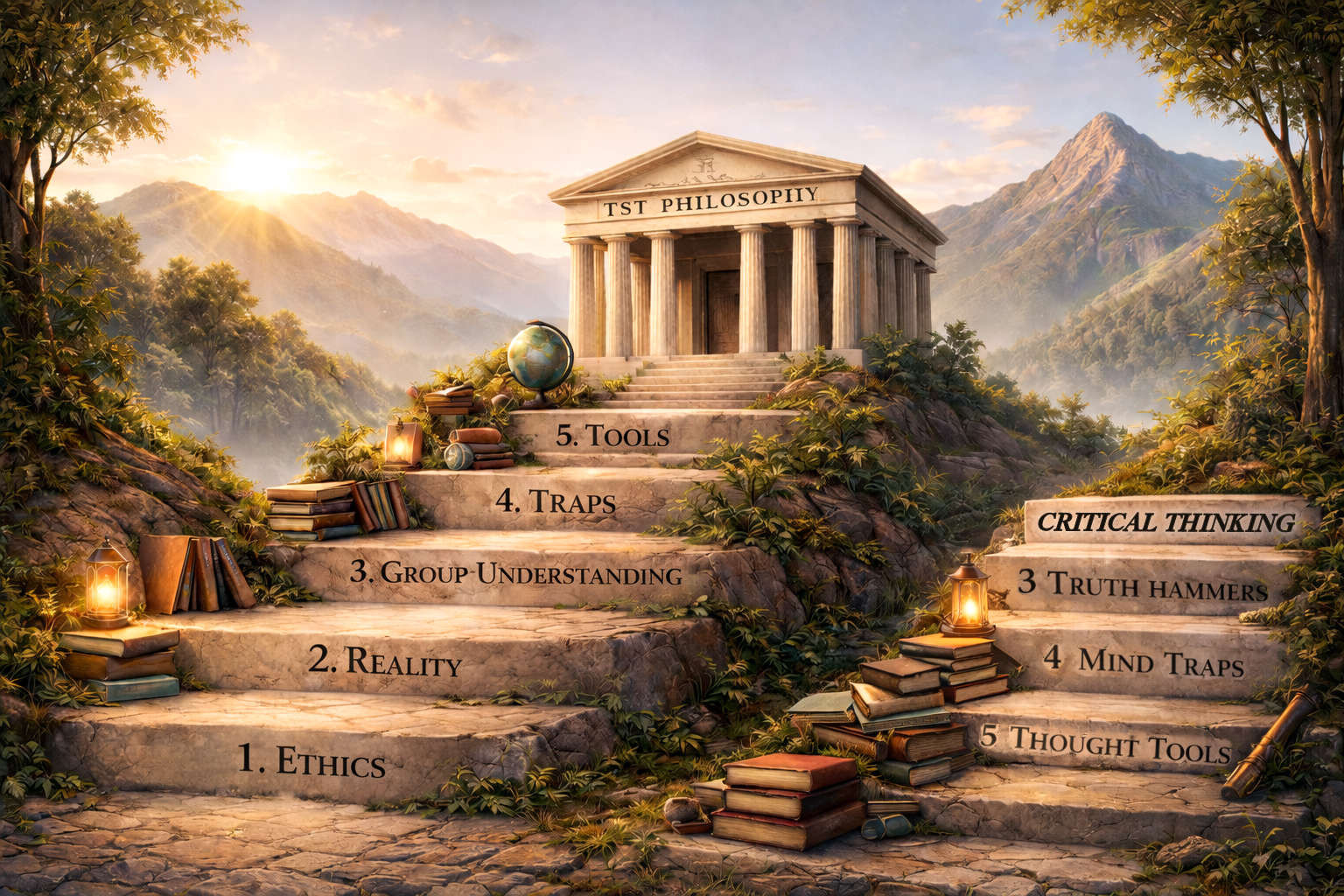
Science-first philosophy keeps your feet grounded in reality while you explore life’s big questions. The science-first philosophy here is called TST Philosophy. It offers two paths in. One begins with flourishing, supported by two layers of metaphysics. The other begins with applied epistemology, a critical thinking path built around a 5-4-3 structure: Five Thought Tools, Four Mind Traps, and Three Truth Hammers.
2 of 6
3 of 6
4 of 6
Belief
Public belief is different from group or personal belief. Public belief is not about identity or loyalty. It is a claim about reality that requires evidence, coherence, and disciplined reasoning. Justification determines how much confidence a public belief deserves. Without justification, public belief remains unsupported.
5 of 6
History and Fiction
Stories shape human understanding. Fiction explores meaning without claiming factual correspondence. History attempts to reconstruct real events using evidence. The distinction matters because only one carries empirical responsibility. Believability depends on justification, not emotional resonance.