

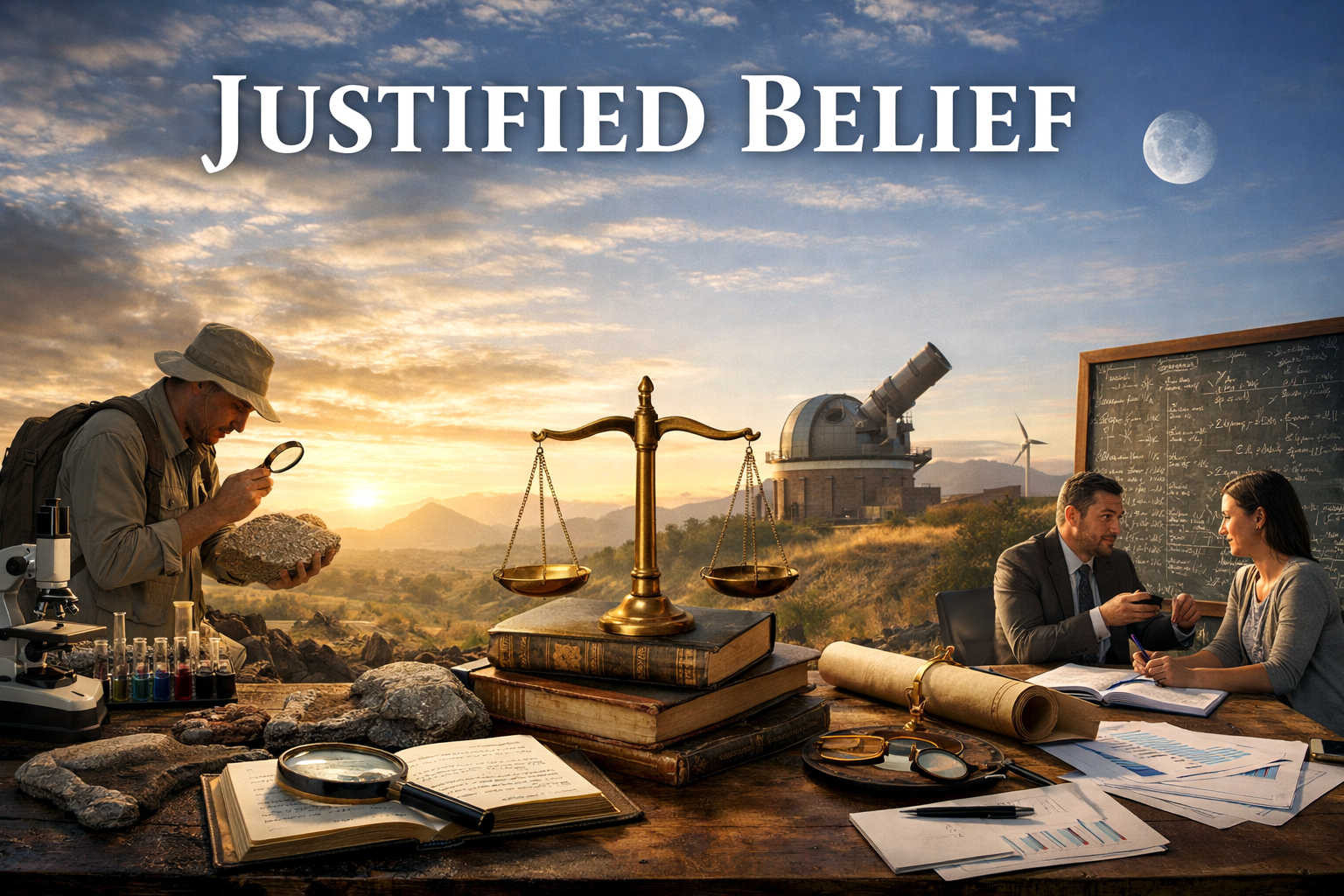
Introduction: Truth versus belief.
In philosophy, truth and belief are related, but they are not the same. Truth, as in a theory of truth, asks what is true and why. The Why Truth Requires Reality column explains that our ideas are true when they align with the material world, and that absolute truth belongs not to human thought, but to reality itself. It also explains that our ideas are either empirically true, rationally true, or false, depending on how they align with the material world. That is how truth is established.
Belief enters where confidence begins. That confidence must be justified, and it comes in degrees.
When are we warranted in believing something?
That is what a theory of justification defines. Justification concerns belief, as in how we justify what we believe. Truth belongs to reality, but justification belongs to us. It is about how we think, how we test, and how responsibly we hold what we believe to be true.
Belief also comes in three forms: personal, group, and public. In TST, the theory of justification focuses on public belief. Group belief and personal belief relate to it, but TST treats them separately, with respect and care. Next week, we’ll delve into personal and group belief and how they relate to public belief.
For now, let’s break down belief into three parts: framing, justifying, and ranking.
Let’s start with framing belief.
Belief Begins with a Frame.
Before we justify or rank a belief, we need to know what kind of belief it is. That sounds simple, but it is where a great deal of confusion begins.
Belief comes in three categories: empirical, rational, or irrational. Some beliefs are empirical. They describe the material world directly. They can be tested through observation, measurement, and evidence. These are the kinds of beliefs science handles best. Your belief in climate change, gravity, or germs draws on empirical belief.
Some beliefs are rational. They describe reality indirectly through logic, structure, and inference. These matter deeply too. They help organize what we know, connect ideas, and extend understanding beyond direct observation. Your belief in logic, mathematics, or the law of noncontradiction draws on rational belief. So too can your beliefs about love, beauty, and justice. These also describe the world indirectly, though in a less precise way. They help us interpret reality without necessarily imagining beyond it.
And some beliefs are speculative. In TST, these fall under the irrational category, not as an insult, but as a signal that they are not yet grounded in testable contact with reality. In TST, empirical, rational, and irrational are not insults or praise words. They are framing categories. Irrational things concern fiction, the currently unknown, or the unknowable. They often matter personally, emotionally, or culturally. But irrational belief should not be confused with well-supported direct and indirect descriptions of the material world. Your belief in an afterlife, astrology, or Santa Claus draws on irrational belief. Again, this is not negative. Just the shared category.
Framing matters because different kinds of beliefs require different handling. An empirical claim about water boiling at sea level is not the same kind of claim as a rational geometric proof. And neither is the same kind of claim as a spiritual story about ultimate purpose. If we throw all three into one basket and call them equally justified, we have already lost the thread.
This is one reason TST insists on the split between the material world and our ideas about it. The world is what it is. Our ideas are our attempts to describe it, interpret it, and imagine beyond it. Good thinking begins by knowing which of those you are doing.
So, the nature, or framing, of each belief is empirical, rational, or irrational. And a framed belief is not yet justified. It is not yet calibrated to a degree of confidence. But good framing is always the first step.
Public Belief Needs Common Ground
Once we know what kind of belief we are dealing with, the next question is whether it deserves our confidence at all.
William Kingdon Clifford once wrote,
“It is wrong always, everywhere, and for anyone, to believe anything upon insufficient evidence.”
TST is a little more flexible than that, even with public belief, but it agrees with the heart of his warning: belief should never be careless. Confidence should be ranked. Reason matters. And speculation should be labeled rather than ignored or confused with knowledge.
Public belief is justified when it is supported in the right way. In a science-first philosophy, that means grounding belief in reality, using reason carefully, and testing claims wherever testing is possible. TST does not reject logic, coherence, or elegant theory. It simply orders them under one rule:
Where empirical implications exist, they are decisive.
That means if a theory, model, or argument makes contact with the material world, the world gets the final say. Evidence wins over preference. Observation wins over ideology. Reality is the judge.
This does not make reason unimportant. Quite the opposite. Reason organizes belief. It keeps our thinking coherent. It helps us trace implications, compare explanations, and detect contradiction. But rational structure alone is not enough. An idea can be internally consistent and still fail in the presence of reality. A beautiful theory can still be wrong.
This is where discipline enters.
Justified public belief is not a feeling. It is not a tribe. It is not a slogan. It is a process. Beliefs must be exposed to pressure. They must survive questioning, criticism, and testing. If a claim cannot be questioned, it cannot be justified. If it cannot survive criticism, it should be revised. If it makes testable contact with the world and fails that test, then it does not deserve continued belief in its current form.
This is also where critical thinking matters. Thought tools like logic and careful review help us gather and process claims responsibly. Understanding our mind traps helps us avoid distortion, haste, and stereotypes. The truth hammers remind us that society built institutions such as science, law, and journalism because individual human beings are not enough on their own. We need systems of correction. We need public testing. We need pressure beyond personal and group belief.
So, what should we believe?
In TST, public belief is calibrated to the degree that each belief is grounded in the material world, held together by reason, and strengthened by disciplined testing. That is what makes public belief more than preference.
Confidence Must Be Earned
Even then, belief is not all-or-nothing. A look at confidence is our last stop.
One of the biggest mistakes people make is to treat belief like a switch. Either I believe it or I do not. Either it is settled or it is nonsense. Even belief in the most empirical things must remain open to revision. Once we close debate, we leave out other options. It is a mistake to think belief must be all or nothing. Life is more nuanced and messy than that. Real thinking is rarely all or nothing. Justification for belief comes in degrees. It builds as evidence accumulates. It grows as reasons strengthen and shrinks when reasons weaken. When predictions succeed, confidence rises. When predictions fail, confidence falls accordingly.
This is why ranking belief is essential. Some beliefs deserve strong confidence. Others deserve cautious confidence. Others should remain open questions, tentative models, or honest speculation. We do not need to pretend certainty where certainty does not exist.
That is not weakness. It is calibration. It is strength.
Absolute certainty belongs to nature, not to us. The material world contains absolute truths, but human beings hold only fallible approximations of them. Sometimes we get pretty close, but still, we are fallible. We reach toward reality with better and worse ideas, and we rank those ideas by how well they hold up.
This protects us from two common failures. The first is dogmatism: the illusion that because a belief feels settled to me, it is now beyond revision. The second is paralysis: the fear that because certainty is impossible, no belief deserves confidence at all.
Public belief must reject both. We do not need perfect certainty to act. We need disciplined, proportionate confidence. That is enough to live, decide, and move forward without pretending to know more than we do.
Ranking belief is where humility becomes practical. It is where good thinking becomes livable.
Conclusion: The common ground of belief.
Truth and justified belief are related, but they are not the same. Truth concerns reality. Justification concerns belief. And belief appears in three forms: public, group, and personal.
Belief also comes in three categories: empirical, rational, and irrational. Empirical beliefs describe the material world directly. Rational beliefs describe it indirectly. The rest are more speculative.
Justification concerns confidence. Our confidence in each belief is measured against reality, especially when dealing with public belief and shared common ground. Justification asks how firmly we should hold a belief, and how open we should remain to revision.
So, what should we believe?
The answer is clear for all belief, but especially for public belief. Frame each belief correctly. Justify it through evidence, reason, and disciplined testing. Then rank it by the strength of its alignment to reality.
Reality grounds public belief. Reason organizes it.
Discipline tests belief. Humility sustains it.

