
Phil • Cr. Think • Science • Hist • …
TST PRACTICE

By Philosopher Michael Alan Prestwood

FAQ

Did we evolve from single cells into plants and animals then chimps to human?

☐ Read
☑ Read
You’ve read this 0 times.
You’ve listened to this 0 times.
Fri 15 May 2026
Published 6 months ago.
Updated 6 months ago.
Related FAQs
Did red algae descend from green algae?
What ancient human species first realized it was going to die?
What is the IQ of a chimpanzee?
When did play evolve in mammals?
Did Charles Darwin’s uncle invent the steam engine?
How does the Idea of Ideas handle Dawkins memes?
Share :
Email
Print

Did we evolve from single cells into plants and animals then chimps to human?

All life on Earth is carbon-based. The chemistry of life is built around carbon’s flexible bonding power. But that simple fact can hide a more interesting story. Life did not begin as plants and animals. It began as single-celled organisms, and much of life stayed single-celled because the strategy works.

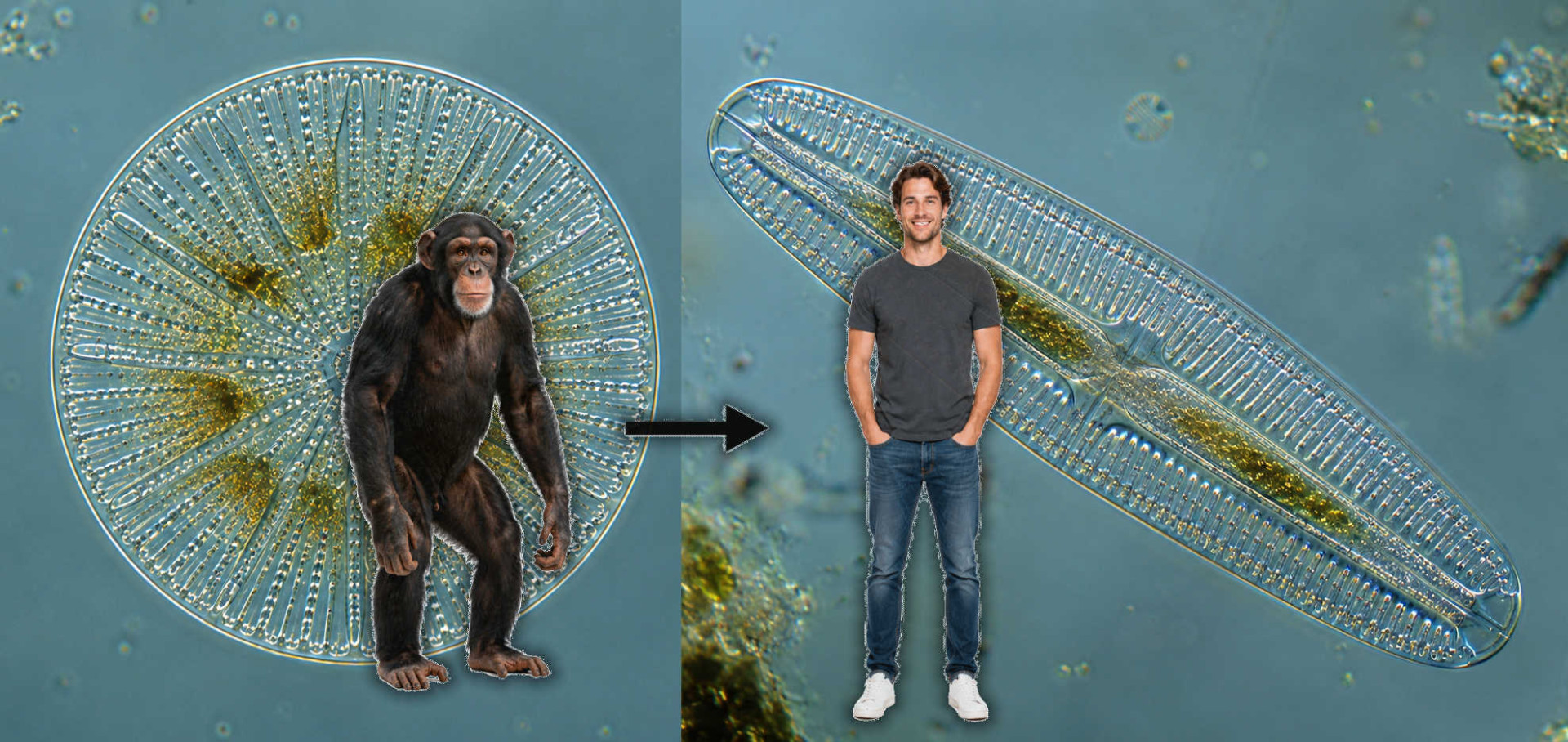
The mistake is thinking evolution is a ladder: single-celled life followed by multicellular life, then plants and animals. That is not how evolution works. Evolution is a branching tree. Some ancient single-celled lineages eventually led to multicellular plants, animals, and fungi. But many other branches remained single-celled, diversified, and are still evolving today. Bacteria, archaea, protists, algae, amoebas, yeasts, and diatoms are not evolutionary leftovers. They are successful living branches of single-celled life.

One of the great later turning points was multicellularity. Some cells began living together, communicating, specializing, and forming larger bodies. From there, animal evolution eventually developed bilateral bodies: left and right sides, direction, and agency. A creature with direction can begin moving through the world in a more organized way.

But single-celled life never stopped being powerful. Diatoms are a beautiful example. Each diatom is one cell, yet many form chains or colonies and help shape entire ecosystems. They are photosynthetic algae wrapped in glass-like silica shells called frustules. They are carbon-based life using silica as armor. In them, life flirts with a science-fiction idea: silica-based life.

All this helps clarify the idea of a last common ancestor, or LCA. When we say humans and chimpanzees share a last common ancestor, we do not mean one modern animal evolved directly from the other. We mean both lines branched from earlier populations. 
— map / TST —

TST Tracker
✓ Reading recorded.
Evolution is not a ladder from single cells to chimps to humans. It is a branching tree: single-celled life came first, some branches led to animals, chimps and humans share a later ancestor, and single-celled evolution continues today.
Michael Alan Prestwood
Natural Philosopher & Author
Prestwood explores science-first philosophy, with particular attention to the convergence of disciplines. Drawing on his TST Philosophy, his work emphasizes rational inquiry grounded in empirical observation while engaging questions at the edges of established knowledge. With TouchstoneTruth positioned as a living touchstone, this work aims to contribute reliable, evolving analysis in an emerging AI era where the credibility of information is increasingly contested.
The Prestwood Column
Menu
November 2026
Column Research….
1. Timeline Story
Fear-Based Ethics
2. Linked Quote
“A person is a person through other persons; you can’t be human in isolation; you are human only in relationships.”
3. Science FAQ »
Why do complex systems fail when proportionality is removed?
4. Philosophy FAQ »
How does TST Ethics handle the trolley problem?
5. Critical Thinking FAQ »
Why do people confuse rule-following with moral reasoning?
6. History FAQ!
How are original Daoism, Mohism, Confucianism, and Legalism related?
Bonus Deep-Dive Article
TST Moral Calibration: Legal, Moral, and Fair

Comments

Join the Conversation! Currently logged out.
NEW BOOK! NOW AVAILABLE!!

30 Philosophers: A New Look at Timeless Ideas

by Michael Alan Prestwood
The story of the history of our best ideas!
Scroll to Top