Explore Science-first Philosophy

FAQ

Did we evolve from single cells into plants and animals then chimps to human?

Fri 15 May 2026
Published 4 hours ago.
Updated 3 hours ago.
Related FAQs
How did writing first evolve?
Are dogs and wolves the same species?
Were neanderthals artistic?
What ancient human species first realized it was going to die?
When did blood evolve in life on Earth?
Do cats see humans as another cat?
Share :
Email
Print

Did we evolve from single cells into plants and animals then chimps to human?

All life on Earth is carbon-based. From bacteria to trees to whales to you, the chemistry of life is built around carbon’s flexible bonding power. But that simple fact can hide a more interesting story. Life did not begin as plants and animals. It began as single-celled organisms, and much of life stayed single-celled because the strategy works.

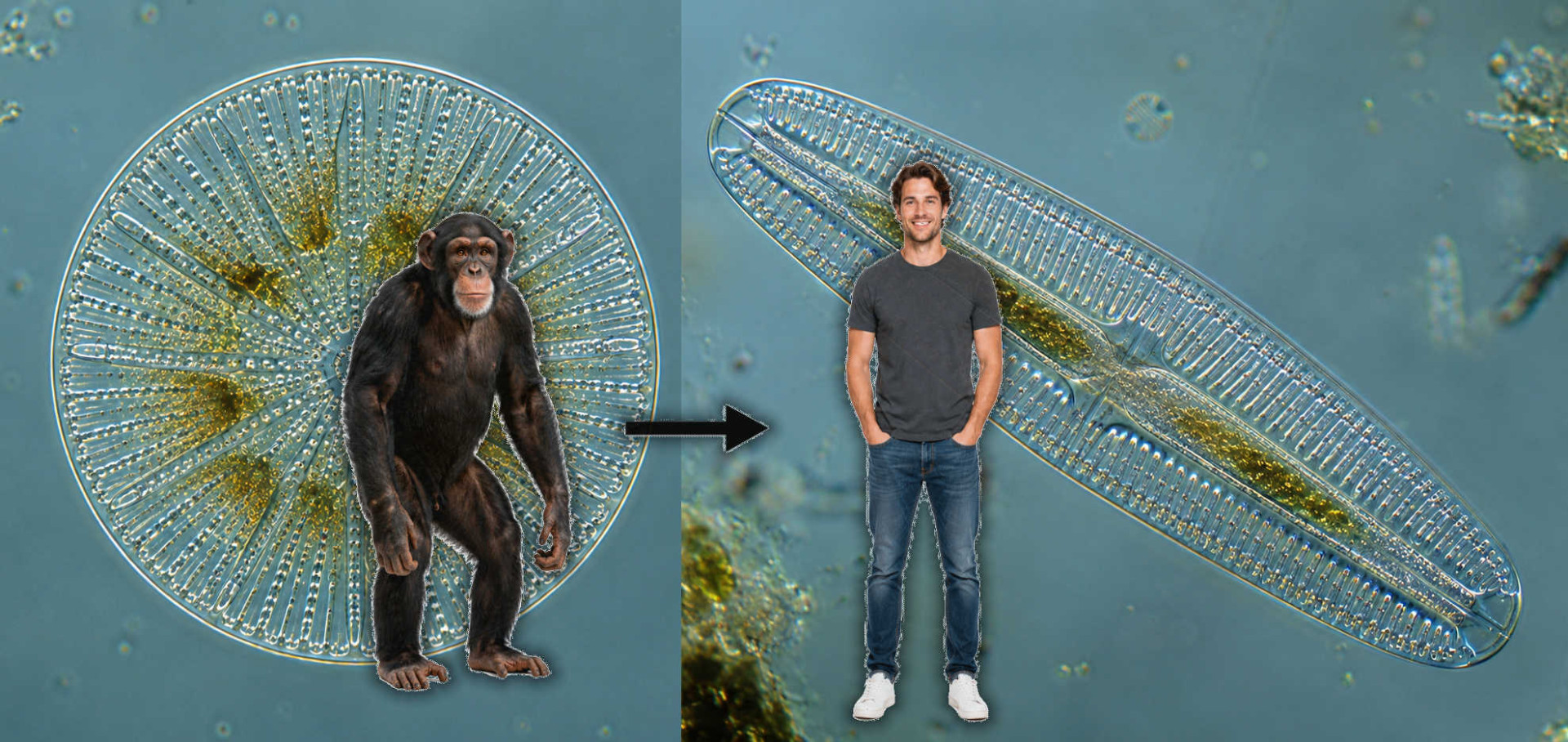
The mistake is thinking evolution is a ladder: first single-celled life, then multicellular life, then plants and animals, with each step replacing the last. That is not how evolution works. Evolution is a branching tree. Some ancient single-celled lineages eventually led to multicellular plants, animals, and fungi. But many other branches remained single-celled, diversified, and are still evolving today. Bacteria, archaea, protists, algae, amoebas, yeasts, and diatoms are not evolutionary leftovers. They are successful living branches.

This also helps clarify the idea of a last common ancestor, or LCA. When we say humans and chimpanzees share a last common ancestor, we do not mean one modern animal evolved directly from the other. We mean both lines branched from an earlier population. The same is true deeper in life’s story. Animals did not simply “replace” earlier life. They branched from older forms while many other branches kept going in their own direction.

One of the great later turning points was multicellularity. Some cells began living together, communicating, specializing, and forming larger bodies. From there, animal evolution eventually developed bilateral bodies: left and right sides, front and back, direction, motion, sensing, and eventually agency. Bilateral structure did not create agency by itself, but it gave life a geometry that agency could build on. A creature with direction can begin moving through the world in a more organized way.

But single-celled life never stopped being powerful. Diatoms are a beautiful example. Each diatom is one cell, yet many form chains or colonies and help shape entire ecosystems. They are photosynthetic algae wrapped in glass-like silica shells called frustules. They are carbon-based life using silica as armor and architecture. In them, life almost seems to flirt with a science-fiction idea: carbon writes the living chemistry, while silica helps build the house.

So no, life did not simply evolve from single cells into plants and animals as if the old world vanished. Life branched. Some branches became forests, fungi, insects, birds, and humans. Other branches remained microscopic and still run much of the planet. Diatoms bring the story full circle: single-celled carbon life wearing silica glass, sometimes organized with shape, direction, and movement. Not full agency, but perhaps a modest glimpse of proto-agency — life responding to the world through form.

— map / TST —

Evolution is not a ladder from single cells to chimps to humans. It is a branching tree: single-celled life came first, some branches led to animals, chimps and humans share a later ancestor, and single-celled evolution continues today.
Michael Alan Prestwood
Author & Natural Philosopher
Prestwood writes on science-first philosophy, with particular attention to the convergence of disciplines. Drawing on his TST Framework, his work emphasizes rational inquiry grounded in empirical observation while engaging questions at the edges of established knowledge. With TouchstoneTruth positioned as a living touchstone, this work aims to contribute reliable, evolving analysis in an emerging AI era where the credibility of information is increasingly contested.
This month @ TST
Column Menu
May 2026
»COLUMN ARCHIVE
--COLUMN--
Column Research….
1. Timeline Story
Book: The Idea of History
2. Linked Quote
“The historian without his facts is rootless…the facts without their historian are…meaningless.”
3. Science FAQ »
Is science tainted by bias?
4. Philosophy FAQ »
Debating History: Should We Say “Dark Ages” or “Middle Ages?”
5. Critical Thinking FAQ »
What is the preservation bias?
6. History FAQ!
Did Einstein’s driver really give one of his early talks?
Bonus Deep-Dive Article
TST Philosophy of History

Comments

Join the Conversation! Currently logged out.
NEW BOOK! NOW AVAILABLE!!

30 Philosophers: A New Look at Timeless Ideas

by Michael Alan Prestwood
The story of the history of our best ideas!
Scroll to Top