
Phil • Cr. Think • Science • Hist • …
TST PRACTICE

By Philosopher Michael Alan Prestwood

FAQ

Are Freud’s id, ego, and superego still relevant?

☐ Read
☑ Read
You’ve read this 0 times.
You’ve listened to this 0 times.
Fri 27 Nov 2026
Published 4 hours ago.
Updated 3 hours ago.
Related FAQs
Is 30 Philosophers a philosophical apologia?
What is cognitive dissonance?
What’s the difference between intentional change and wishful thinking?
How does consciousness differ from intelligence?
What is the difference between a heuristic and a cognitive bias?
Is the idea of ownership a real thing?
Share :
Email
Print

Are Freud’s id, ego, and superego still relevant?

First, ego and id go back to ancient Rome: Latin for “I” and “it.” Long before Freud, philosophers used ego to explore the concept of self. Freud gave them specific mental functions. Freud wrote in German, but we adopted the Latin versions to make them sound more academic — superego is a specifically Freudian term.

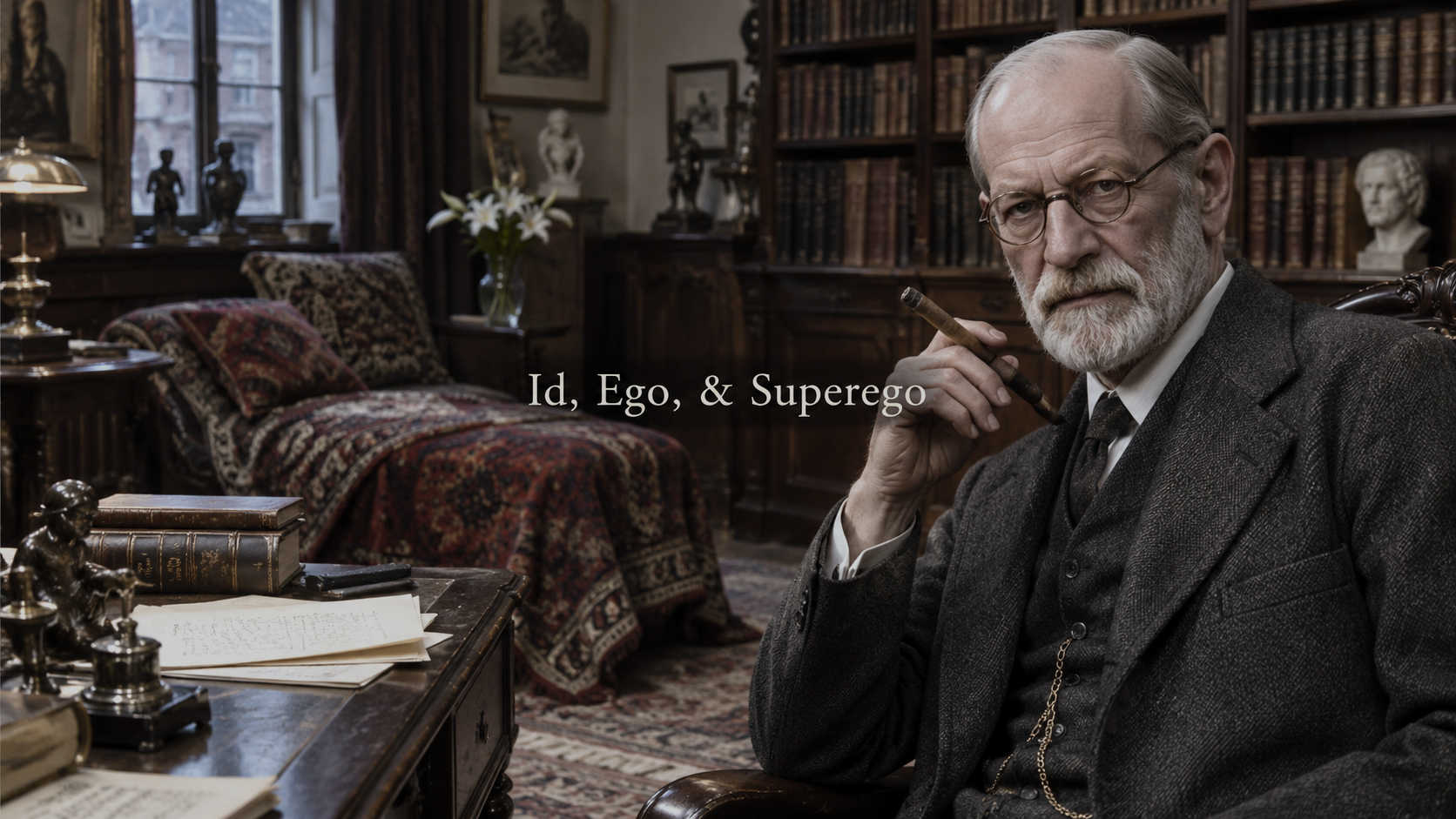
Sigmund Freud’s 1923 model of the mind has three interacting agents: the id, ego, and superego. There is some debate about how much agency he intended, but essentially the id represents our drives and immediate gratification. The ego mediates between those drives, the superego, and reality. The superego represents our internalized moral standards. To Freud, all three agents also operate subconsciously. 

Now, my thoughts. Modern models align more with traditions before Freud. They reject his model but appreciate his focus on the subconscious. His focus on the subconscious helped pave the way for our modern ideas, but I think his focus on something akin to agents was too strong. I also find his conclusions about unconscious childhood desires to have sex with your mother and kill your father to be wildly wrong, strange, and really just an overgeneralization of his own self-analysis. Scientifically, he stepped way out over his skis.

I think what Freud called the ego is better explored through the self. In my writing, I focus on the ideas of non-self, illusion, and impermanence. I think the id is more about the mechanics of animal minds. The evolution of things like drives, instincts, and other automatic or semi-automatic processes. Finally, the superego is better explored through applied philosophy: how one ought to live. In my writing, that’s about your worldview and identity, including your internalized value system.
— map / TST —

TST Tracker
✓ Reading recorded.
Freud helped bring the subconscious into focus and the need to take control of our own thoughts. However, his model gave too much agency to the processes of the mind. Bottom line, explore the ego through the nature of self, the id through evolved drives and instincts, and the superego through worldview and identity. Understanding these processes can help you better manage them and your life.
Michael Alan Prestwood
Natural Philosopher & Author
Prestwood explores science-first philosophy, with particular attention to the convergence of disciplines. Drawing on his TST Philosophy, his work emphasizes rational inquiry grounded in empirical observation while engaging questions at the edges of established knowledge. With TouchstoneTruth positioned as a living touchstone, this work aims to contribute reliable, evolving analysis in an emerging AI era where the credibility of information is increasingly contested.
The Prestwood Column
Menu
November 2026
Column Research….
1. Timeline Story
Fear-Based Ethics
2. Linked Quote
“A person is a person through other persons; you can’t be human in isolation; you are human only in relationships.”
3. Science FAQ »
Why do complex systems fail when proportionality is removed?
4. Philosophy FAQ »
How does TST Ethics handle the trolley problem?
5. Critical Thinking FAQ »
Why do people confuse rule-following with moral reasoning?
6. History FAQ!
How are original Daoism, Mohism, Confucianism, and Legalism related?
Bonus Deep-Dive Article
TST Moral Calibration: Legal, Moral, and Fair

Comments

Join the Conversation! Currently logged out.
NEW BOOK! NOW AVAILABLE!!

30 Philosophers: A New Look at Timeless Ideas

by Michael Alan Prestwood
The story of the history of our best ideas!
Scroll to Top