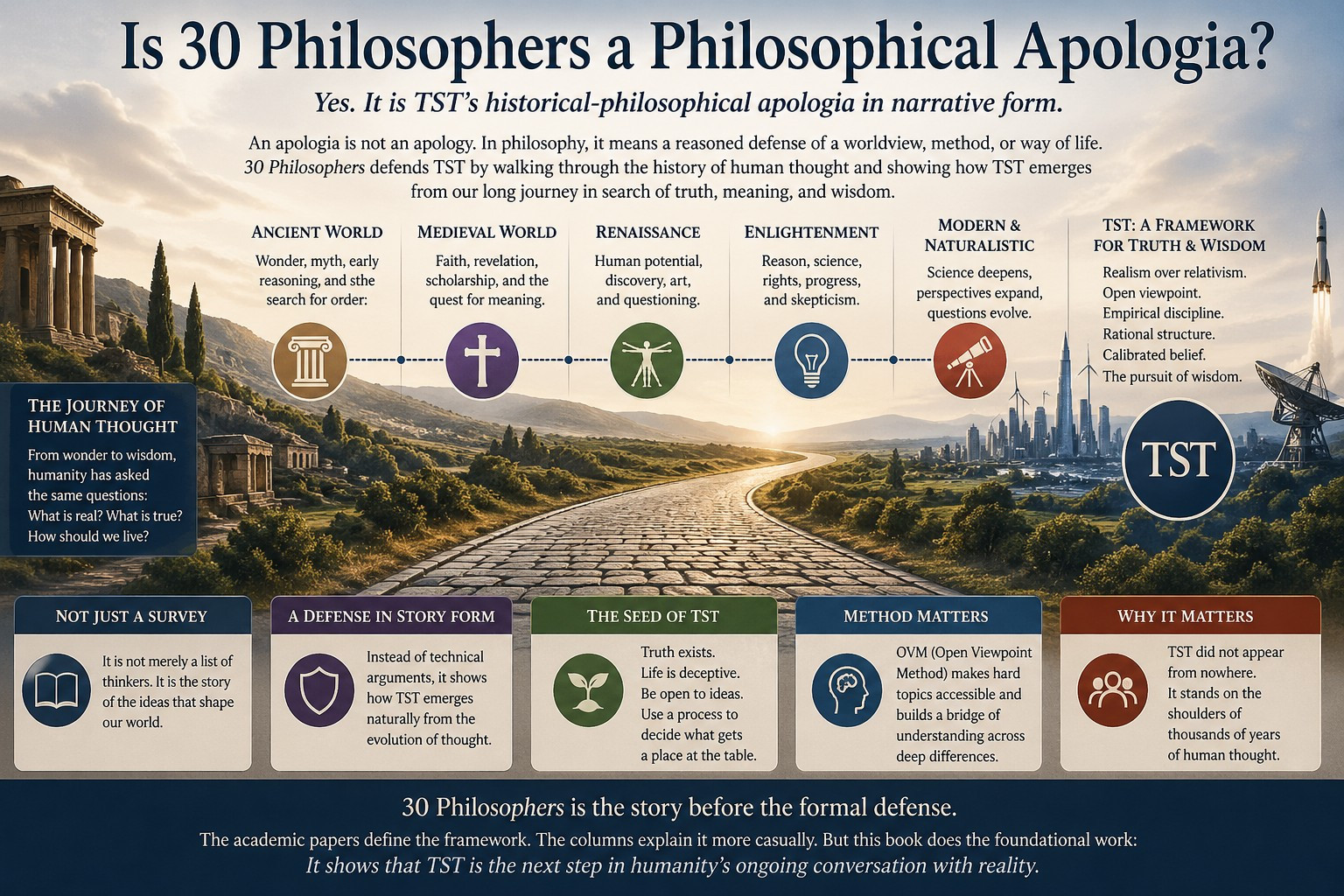
Yes. 30 Philosophers is the initial philosophical apologia for TST Philosophy in story format. An apologia is not an apology in the modern sense. In philosophy, an apologia is a reasoned defense of a tradition, philosophy, or belief system. The famous anchor example is Plato’s Apology, written after the execution of his mentor, Socrates. It presents a defense of Socrates’ worldview at his trial, but it also carries Plato’s quiet criticism of a city that condemned a man for questioning its assumptions.
30 Philosophers does not rigorously defend TST as a technical paper. It does not begin with a thesis, list objections, and answer them one by one. Instead, it walks through the history of human thought and shows how TST emerges naturally from that long journey. It follows humanity’s struggle with reality, truth, belief, perception, ethics, religion, science, and meaning. Along the way, it shows why a framework like TST is needed.
The book begins with a simple problem: truth exists, but life is deceptive. People believe many conflicting things. Some ideas are grounded in evidence. Some are grounded in reason. Some reach into the unknown or unknowable. If we are going to seek truth honestly, we need an open mind, but we also need a process for deciding what ideas we allow in.
That is the seed of TST.
So, 30 Philosophers is not merely a survey of famous thinkers. It is the first broad defense of the TST worldview. It defends realism over relativism. It defends open viewpoint over tribal certainty. It defends empirical discipline, rational structure, calibrated belief, and the pursuit of wisdom. It tells the story of how humanity built the tools TST now gathers into one framework.
In that sense, 30 Philosophers is best described as TST’s historical-philosophical apologia in narrative form.
It is the story before the formal defense. The academic papers define the framework more precisely. The columns explain it more casually. But 30 Philosophers does the foundational work: it shows that TST did not appear from nowhere. It stands on the shoulders of thousands of years of human thought.
For the academic defense of TST, refer to the TST Positions thread.