The three pillars of reasoning are deductive, inductive, and abductive, each serving as a unique tool to sharpen your thinking and enhance your cognitive abilities. In this article, we’ll explore these three pillars. For a review of how reasoning differs from logic, check out: An Overview of Reason and Logic.
Reasoning sits at the core of critical thinking and the three types of reasoning are one of the Five Thought Tools, essential skills for thinking, decision-making, and wisdom. Mastering deductive, inductive, and abductive reasoning techniques help you to transform information into wisdom, make informed decisions, and solve complex problems.
The human brain, with its remarkable capacity for logical thought, is capable of incredible feats of reasoning. However, our emotions and biases can sometimes lead us astray. By understanding and harnessing the power of reasoning, you can navigate the complexities of the world and make more informed decisions.
Three Pillars of Reason: Deductive, Inductive, and Abductive
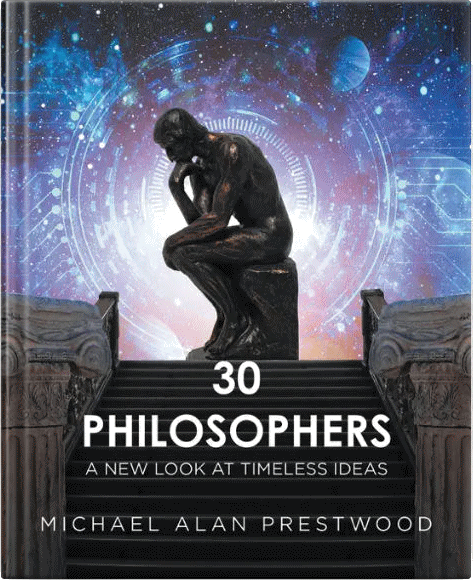
In “30 Philosophers: A New Look at Timeless Ideas,” we journey from Aristotle’s deduction through induction’s growth to abduction’s emergence. Aristotle’s syllogisms, Plato’s dialogues, and the dynamic interplay of reasoning have sharpened scientific inquiry and philosophical thought.
Deductive Reasoning: Connect the Dots
Deductive reasoning is logic in motion. It emphasizes the procedural and logical progression from general premises to a specific conclusion, capturing the dynamic nature of deductive reasoning. It is a process that concludes with certainty from the premises. If the premises are true, the conclusion must be true.
It is a top-down approach that starts with a general statement or hypothesis and moves towards a specific conclusion. It operates on the principle that if the premises are true, the conclusion must also be true. For example,
“All men are mortal. Socrates is a man. Therefore, Socrates is mortal.”
The Role of Deductive Reasoning in Decision-Making
Deductive reasoning enhances decision-making, offering a structured framework for assessing situations and ensuring decisions are grounded in logic. Aristotle’s work “Prior Analytics” formalized deductive reasoning with the introduction of the syllogism, structuring arguments into premises leading to a conclusion.
Deductive reasoning is invaluable in fields that require high levels of certainty and precision, such as mathematics, computer science, and formal logic. In these areas, the ability to derive specific truths from general axioms ensures that conclusions are not just probable, but guaranteed. For example, in mathematics, the Pythagorean theorem is a deductive system where the truth of the theorem (a² + b² = c²) is derived from the axioms of Euclidean geometry. This certainty is what makes deductive reasoning a cornerstone of scientific inquiry and technological development.
Moreover, deductive reasoning plays a critical role in everyday decision-making. When making important life choices, such as financial investments or legal judgments, employing deductive reasoning can help individuals and professionals arrive at sound conclusions based on established principles and verified facts. This logical rigor helps in minimizing errors and biases, leading to more reliable and trustworthy decisions.
Inductive Reasoning: Find Patterns
Inductive reasoning is the process of patterns to principles. It is the method of observing specific instances to formulate broader generalizations or principles. It generalizes from specific instances to broader generalizations with varying degrees of certainty.
It observes specific instances to form broader generalizations. It’s a bottom-up approach, building from particular observations to wider theories. While not guaranteeing the truth of the conclusion, it lays a strong foundation for probability.
“The sun has risen every day in recorded history, so the sun will rise tomorrow”
is an inductive reasoning example.
Inductive Reasoning: The Pattern Finder
Inductive reasoning, championed by Bacon, emphasizes the importance of observing nature to form general theories. It’s a bottom-up analysis, creating generalizations from specific observations, such as concluding all swans are white after observing only white swans. Unlike deduction, inductive reasoning’s strength lies in observation quality, with conclusions open to revision upon new evidence.
Inductive reasoning is especially powerful in scientific research and hypothesis formation. By observing phenomena and identifying patterns, scientists can formulate hypotheses that explain these observations and predict future occurrences. For instance, the development of the theory of gravity began with observations of falling objects and celestial bodies, leading to the formulation of a general principle that explains gravitational attraction. This method allows for the discovery of new laws and principles that can be tested and refined over time.
However, the inherent uncertainty of inductive reasoning means that its conclusions are always tentative. New observations can challenge existing generalizations, necessitating revisions or complete overhauls of the theories. This adaptability is both a strength and a limitation, requiring constant vigilance and openness to new evidence. Despite this, inductive reasoning remains a crucial tool for expanding our understanding of the world, driving innovation, and fostering scientific progress.
By appreciating the distinct roles and strengths of deductive and inductive reasoning, we can better navigate complex problems and make informed decisions. Each type of reasoning offers unique insights and methodologies that, when used together, provide a comprehensive approach to understanding and explaining the world around us.
Abductive Reasoning: Best Guess
Abductive reasoning uses inference as insight. It uses incomplete information to form the most plausible explanation. You essentially infer the best explanation with the given knowledge. The simplest and most likely explanation. It does not guarantee the truth of the conclusion but is a way of hypothesizing an explanation for the observations. For instance,
“if the road is wet, the most likely reason is recent rain.”
Understanding and applying different reasoning types not only enriches our cognitive abilities but also empowers us to approach complex problems with nuanced perspectives. Whether through deductive certainty, inductive probability, or the hypothesis formation of abduction, each reasoning type offers unique insights into the tapestry of human thought and the natural world.
–map / TST
For the full story of how logic, reasoning, and philosophy mesh, check out 30 Philosophers…
To fully understand the context of logic as part of the story of human thought, nothing can replace reading the full story. My book 30 Philosophers, my 15th, tells the story of our best and current ideas from 2600 BCE to today, all from our modern viewpoint and understanding.