

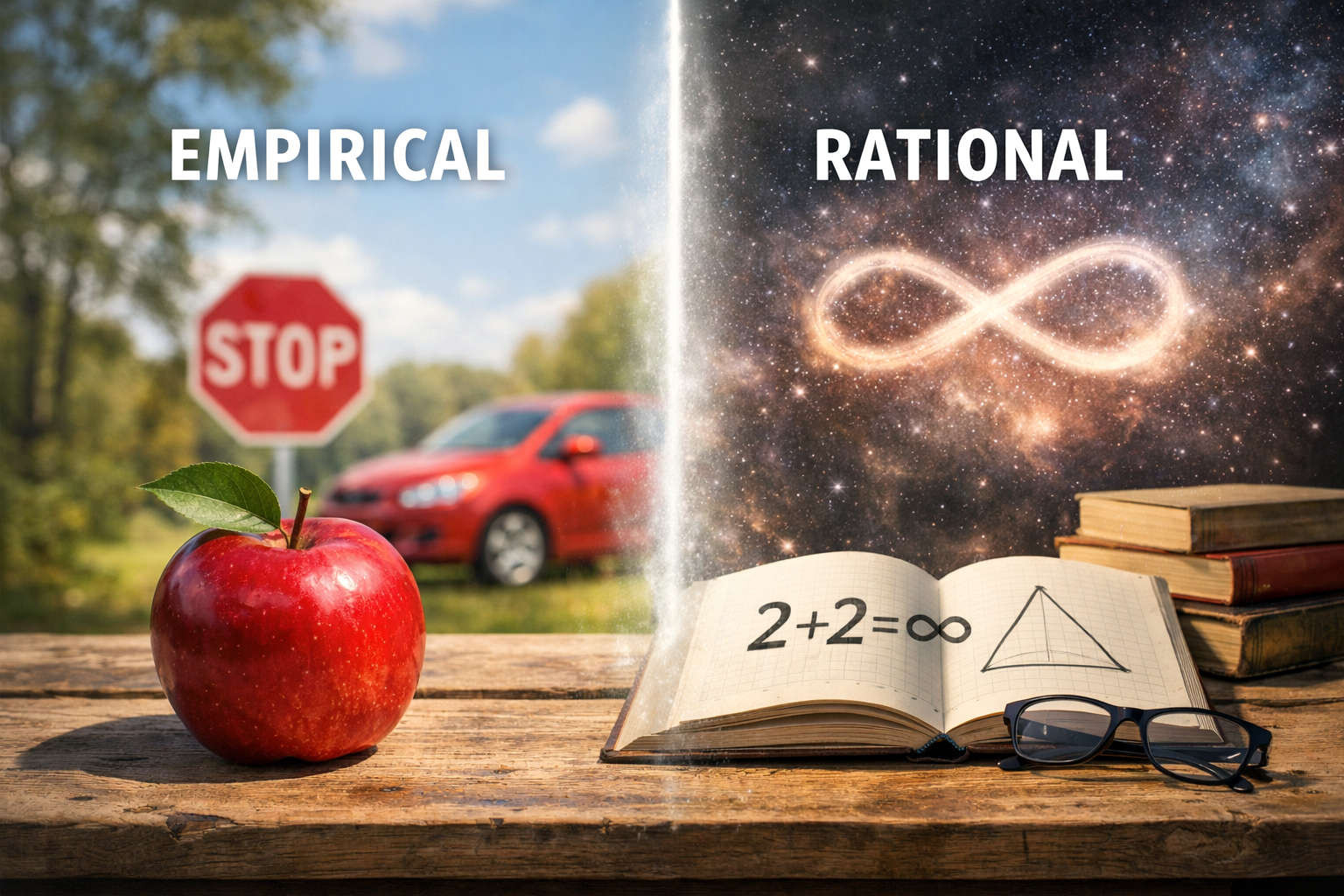
Yes, the color red is an empirical idea because it describes the material world directly. It describes what we sense, but it is an interesting example that demonstrates why are direct observations are never the complete story.
Red feels empirical because we really do see it. The color red is definitely an empirical idea that we see directly with our eyes. A red apple looks red. A stop sign looks red. Blood looks red. Something is clearly happening in the material world, and our experience is not imaginary. Light interacts with objects, some wavelengths are absorbed, others are reflected, and our eyes receive that reflected light.
But here is where the fine line appears between the empirical world and our rational-only ideas. The object is not carrying a little bucket of redness inside it. Rather, it reflects certain wavelengths, and our visual system turns that interaction into the color experience we call red. The band of visible light we call red is part of the material world, while the categorizing of that band into “red” belongs only to us.
Color is a good example of why we cannot perceive reality fully. Illusion in the West. Maya in the East.
Here are the details. In reality, a red apple is red because that is the dominant color the surface rejects. In a real way, one could say red is more accuratly the color a red apple is not.
The light band is real. The object is real. The perception is real. But the concept of “redness” is still a human idea about what is happening.
This is why color is such a useful metaphysical example. It shows how an idea can be deeply anchored in the material world and still not be identical to that world. It reminds us that even our most direct-seeming experiences are already partway into the human layer of thought. The world gives us something real through senses. The mind helps turn it into the world as we know it through perception.
Empirical ideas describe the material world through direct sensory contact or through tools that extend the senses, though those descriptions remain incomplete. Rational ideas describe the material world indirectly through abstraction, relation, pattern, and inference.

