

One goal: flourishing for all. The human aim of TST Philosophy: flourishing, responsibility, personal morality, group ethics, wisdom, meaning, and leaving the world better than we found it.
Academic Thread
TST Positions 2: Ethics
One goal: flourishing for all.
By Michael Alan Prestwood
Author and Natural Philosopher
Wed 15 Jul 2026
Published 5 months ago.
Updated 3 months ago.
Thread
TST Positions 2: Ethics
By Michael Alan Prestwood
1 of 8
Ethics
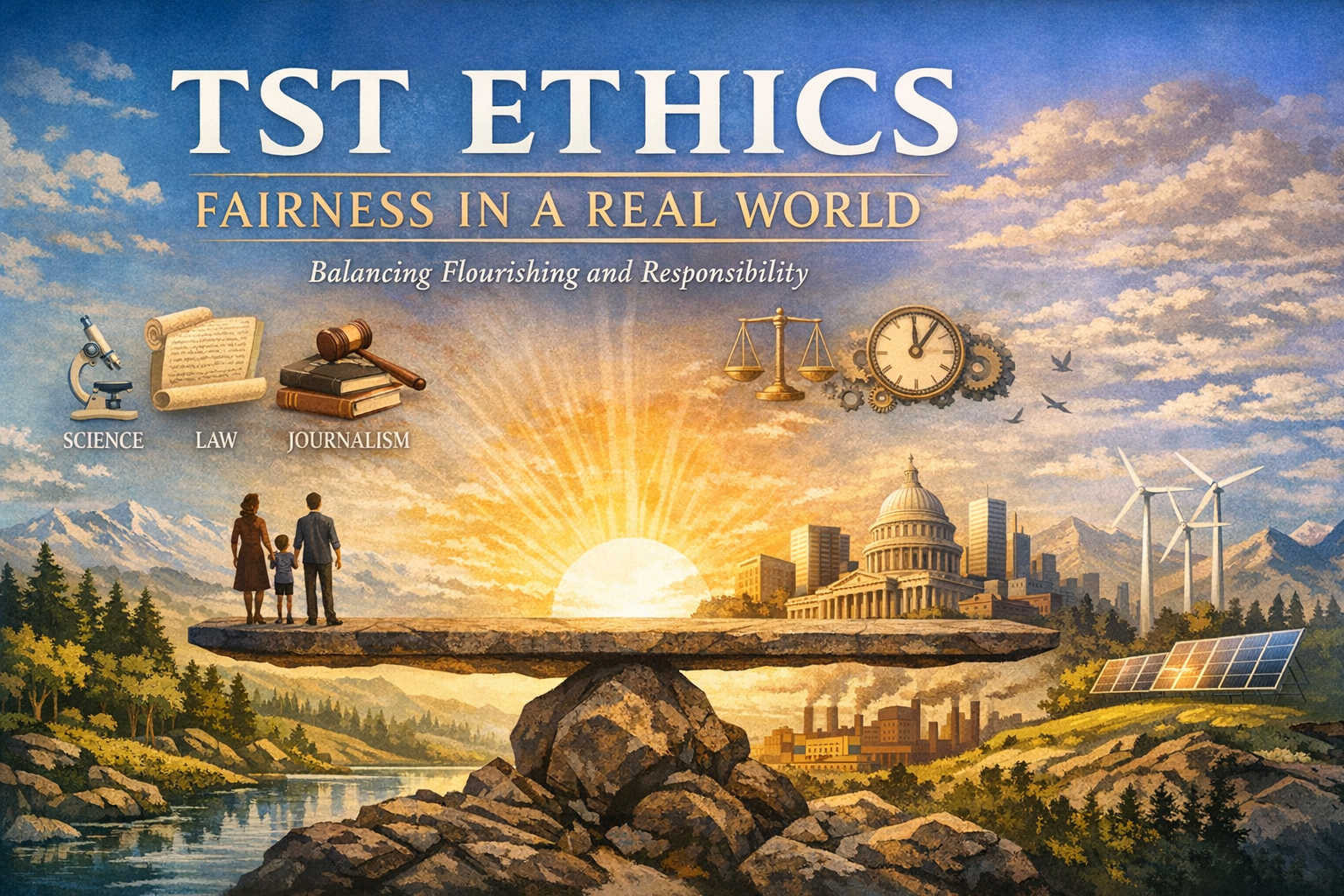
Most decisions need only one guiding principle: act in a way that supports flourishing for all. When more care is required, let Group Ethics guide, let Personal Morality choose, act with good intent, weigh the real-world result, and adjust. Ethics is not finished until reality answers.
2 of 8
Ethics
The paper defends a relational account of ethics in which flourishing depends partly on how persons regard and respond to the agency of others. Anger, reduction, reciprocity, and boundaries are treated not as peripheral concerns, but as central to ordinary moral life. In this way, TST Ethics places relationships—not abstractions alone—at the heart of ethical theory.
3 of 8
TST Ethics
Flourishing requires calibration. TST Ethics integrates intent, consequence, proportionality, and systemic impact within a two-layered reality. Respect law, reduce harm, and refine your responsibility as awareness grows. Personal morality and group ethics are not separate domains — they are scaled expressions of fairness lived within real constraints.
4 of 8
Scheduled
Philosophy
Article
Scheduled!
Available December 1, 2026!
TST Theory of Group Ethics
Group Ethics
A group is not ethical simply because its members feel loyal or mean well. Power increases responsibility. Ethical groups seek truth, act with honor, reduce harm, and build systems that help people flourish rather than merely protecting the group itself.
5 of 8
Scheduled
Philosophy
Article
Scheduled!
Available February 1, 2027!
TST Theory of Personal Morality
Personal Morality
Every choice trains the self. Over time, your actions shape your character, and your character shapes your future choices. Personal morality asks more than “What should I do right now?” It asks, “Who am I becoming, and am I becoming that person with truth and honor?”
6 of 8
Scheduled
Philosophy
Paper
Scheduled!
Available March 1, 2027!
TST Good Intent Theory
Ethics and Morality
Choose responsibly, then act with an honest commitment to flourishing, fairness, rights, conscience, and reduced harm. Good intent matters, but it is not a moral shield. Prepare carefully, consider foreseeable consequences, carry out the choice faithfully, and remain willing to weigh the result and adjust.
7 of 8
Scheduled
Philosophy
Article
Scheduled!
Available April 1, 2027!
TST Theory of Less Harm
Less Harm Theory
Situational ethics becomes most important when every available choice carries a moral cost. TST Less Harm Theory embraces Mill’s Harm Principle while confronting the lesser-of-two-evils problem: avoid unnecessary harm, reduce unavoidable harm, protect rights and conscience, and choose the option that leaves the most room for repair, recovery, and future flourishing.
8 of 8
Scheduled
Philosophy
Paper
Scheduled!
Available May 1, 2027!
TST Ethics of Results: Weigh and Adjust
Ethics and Morality
A decision is not ethically finished when the action ends. Weigh the real result: who benefited, who was harmed, and whether flourishing, fairness, rights, and responsibility were served. Then adjust. Ethical maturity means observing honestly, repairing what can be repaired, learning from reality, and evolving.