
Weekly Insights for Thinkers

Science  Philosophy  Critical Thinking  History  Politics RW  AI  Physics  •  Evolution  Astronomy 30 Phil Book More…
Science  Phil  Cr. Think  Hist 

STORY

Black Dwarf Sun

By Michael Alan Prestwood

Wed 27 Mar 2024
Published 2 years ago.
Updated 2 years ago.
Share :
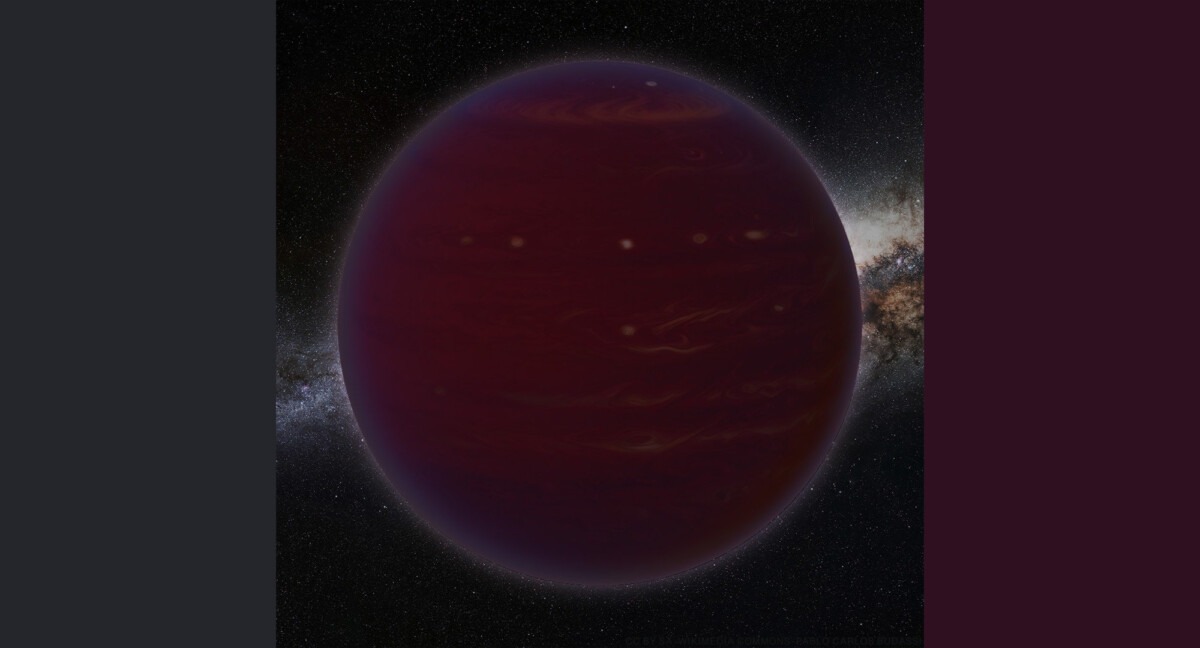
Brown dwarfs (also called failed stars) are substellar objects that are not massive enough to sustain nuclear fusion of ordinary hydrogen into helium in their cores, unlike a main-sequence star. Instead, they have a mass between the most massive gas giant planets and the least massive stars, approximately 13 to 80 times that of Jupiter. However, they can fuse deuterium and the most massive ones (> 65 MJ) can fuse lithium. Astronomers classify self-luminous objects by spectral class, a distinction intimately tied to the surface temperature, and brown dwarfs occupy types M, L, T, and Y. As brown dwarfs do not undergo stable hydrogen fusion, they cool down over time, progressively passing through later spectral types as they age. Despite their name, to the naked eye, brown dwarfs would appear in different colors depending on their temperature. The warmest ones are possibly orange or red, while cooler brown dwarfs would likely appear magenta or black to the human eye. Brown dwarfs may be fully convective, with no layers or chemical differentiation by depth. As brown dwarfs have relatively low surface temperatures, they are not very bright at visible wavelengths, emitting most of their light in the infrared. However, with the advent of more capable infrared detecting devices, thousands of brown dwarfs have been identified. The nearest known brown dwarfs are located in the Luhman 16 system, a binary of L- and T-type brown dwarfs about 6.5 light-years from the Sun. Luhman 16 is the third closest system to the Sun after Alpha Centauri and Barnard's Star. Image created by Pablo Carlos Budassi in 2023 (pablocarlosbudassi.com)

Black Dwarf Sun

1 to 37 Quadrillion Years From Now
Highly speculative. Rationally deduced.

Over an incredibly long timescale, the Sun’s white dwarf remnant could cool enough to become a black dwarf, a theoretical stellar remnant that emits no light. Although speculative, theoretical models give us insight into the lifespan of the Sun as a white dwarf. After transitioning into a white dwarf, the Sun is expected to cool and fade over an extraordinarily long period. It is theorized that, eventually, it will become a black dwarf — a cold, dark stellar remnant that no longer emits significant heat or light. This transformation could take place sometime after 1 quadrillion years — that’s 1,000 sets of a trillion years! Moreover, some estimates extend this timeline by a factor of up to 37, pushing the boundaries of our understanding of stellar evolution and the future of the cosmos. The eventual cessation of white dwarf stars, including our Sun, represents one of the universe’s far future events. However, these estimates are highly speculative, reliant on theoretical models of stellar cooling that project far beyond our current empirical observations. Given that the universe itself is not yet old enough for any black dwarfs to exist, this prediction is rooted more in our extrapolation of physical laws than in direct evidence.
— map / TST —

Michael Alan Prestwood
Author & Natural Philosopher
Prestwood writes on science-first philosophy, with particular attention to the convergence of disciplines. Drawing on his TST Framework, his work emphasizes rational inquiry grounded in empirical observation while engaging questions at the edges of established knowledge. With TouchstoneTruth positioned as a living touchstone, this work aims to contribute reliable, evolving analysis in an emerging AI era where the credibility of information is increasingly contested.
TST Weekly Column
January 21, 2026
This Week:
»Edition Archive
The column…
Copernicus, Societal Blindness, and Worldview
WWB Research….
1. Story of the Week
Nicolas Copernicus
2. Quote of the Week
“The movement of the planets agrees best with actual observations.”
3. Science FAQ »
Did Copernicus prove that Earth moves around the Sun?
4. Philosophy FAQ »
Did Copernicus remove humanity from the center of the universe?
5. Critical Thinking FAQ »
Why do intelligent people defend bad ideas?
6. History FAQ!
Was Copernicus famous during his life?
Bonus Deep-Dive Article
The Universe Before the Telescope
Scroll to Top