

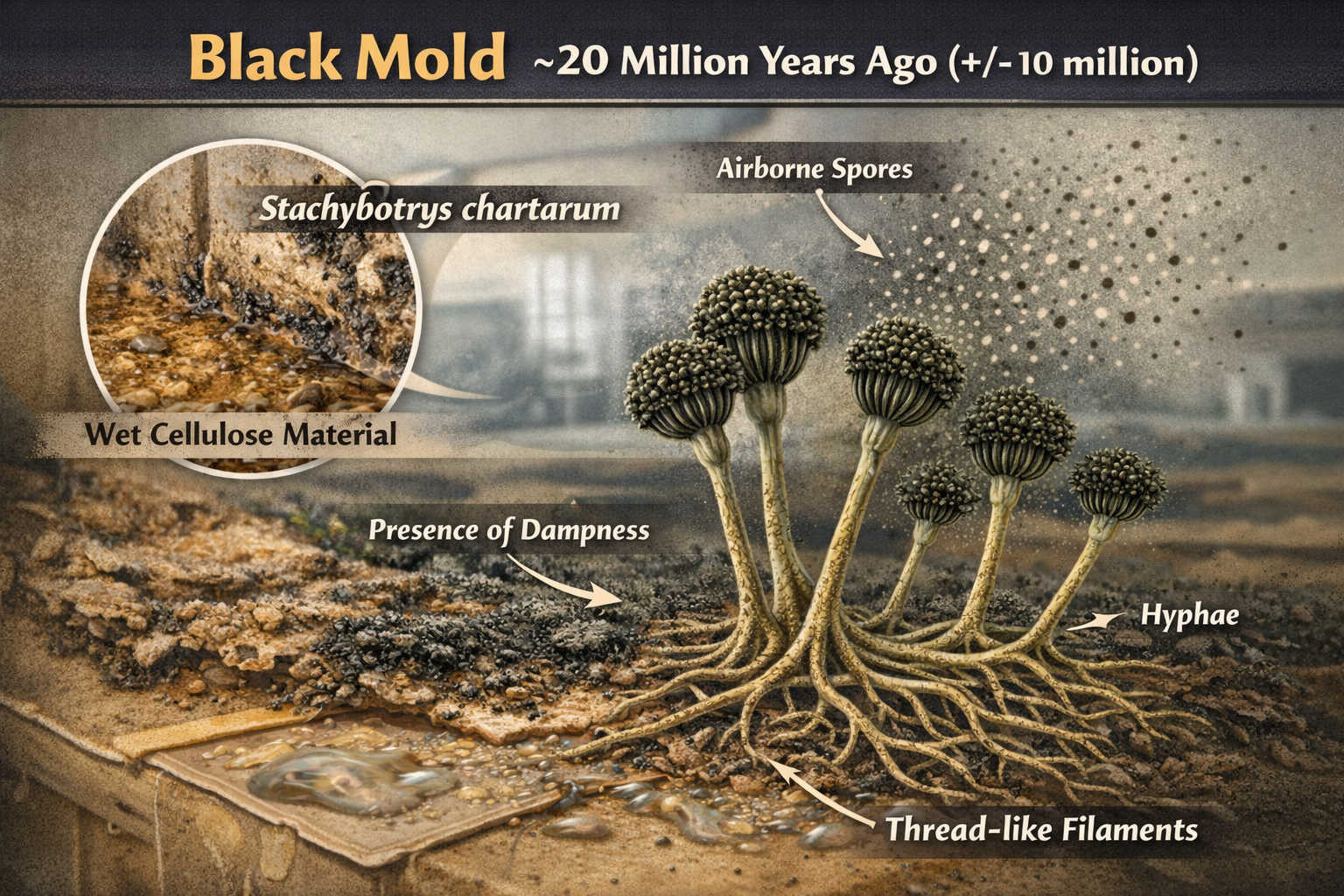
Black mold is a dark, spore-producing fungus that grows in damp places rich in organic material. A well-known example is Stachybotrys chartarum, a black or greenish-black mold often associated with wet drywall, paper, wood products, and other water-damaged surfaces. Like other molds, it grows as tiny thread-like filaments and releases spores to spread. In everyday life, people often use the phrase black mold loosely for many dark molds, but in science, Stachybotrys chartarum is one specific fungus within the much older mold line.
The date here is a best guess, not a settled fact. Research is ongoing, and I could not verify a direct study dating the exact origin of Stachybotrys chartarum itself. So the estimate of about 20 million years ago (+/- 10 million) is an inference based on broader fungal family history. The reasoning is simple: the larger family Stachybotryaceae appears to be far older, with estimates around 141–142 million years old, and a modern species within that family would likely have emerged much later. That makes a rough species-level guess in the tens of millions of years range reasonable, even if the precise date remains uncertain.
Black mold does not mark the beginning of molds, and it does not mark the beginning of fungi. Instead, it gives a familiar modern face to a very ancient fungal strategy. Long before humans worried about damp walls and bathroom corners, molds were already spreading by spores, digesting dead material, and helping recycle nutrients back into the wider environment. Black mold is one later chapter in that much older story.
Black mold is often talked about like a horror creature, but the reality is more grounded. The popular idea of “deadly black mold” is mostly overblown. The dark mold we all see in the shower or damp room is usually just a fungus growing because moisture allowed it to grow. For many healthy people, small household mold exposure causes no noticeable problems, though sometimes it does cause irritation or allergy symptoms. In more extreme cases, it can be worse. Bottom line: clean up small areas and do not worry too much about it. For larger colonies, clean them out well, find out why it is damp, fix that problem, and after the area is fully cleaned and dried, paint if you like and move on.
