

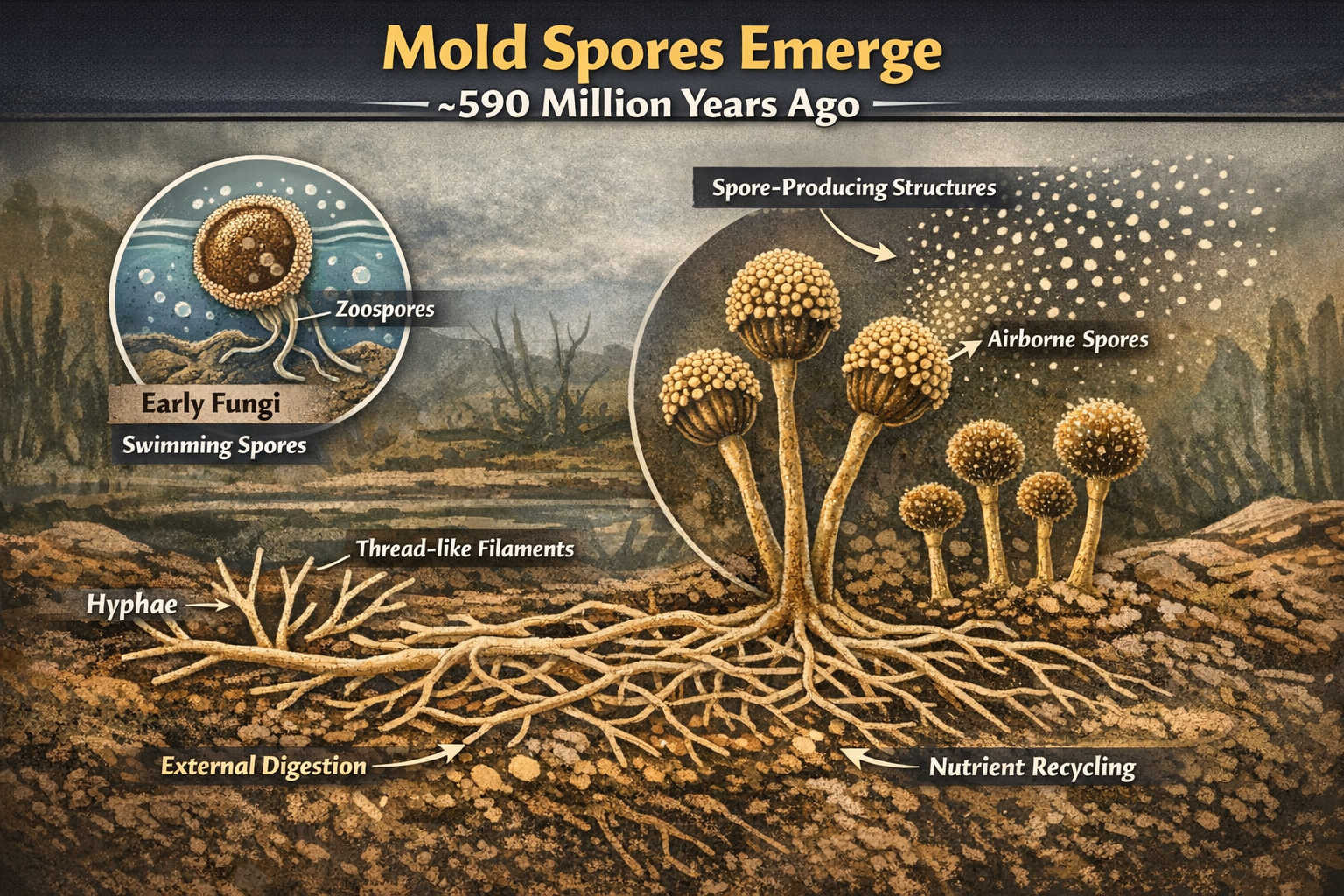
Mold spores are the tiny reproductive particles released by the thread-like fungi we call molds. Unlike chytrids, which likely spread with swimming spores in water, molds seem built for a different world. They grow outward as fine feeding threads, digest food outside their bodies, and then send huge numbers of spores into the air, water, or nearby surfaces. They do not chase food. They spread into it, break it down, and cast their offspring outward like tiny drifting settlers.
The timing here is a bit fuzzy, and that is okay. Early fungi were likely experimenting with different ways of living and reproducing for a long time. So the move from more aquatic, chytrid-like fungi to familiar mold-style fungi was probably not one clean moment. That is why placing mold spores at about 610 million years ago (+/- 30 million) works nicely beside chytrids at about 600 million years ago (+/- 20 million). The overlap tells a more honest evolutionary story. Nature often works in transitions, not neat starting lines.
This was a big step in fungal success. Spores gave molds reach. A fungus no longer had to stay where it began. It could release countless microscopic spores and let wind, water, or plain accident carry them elsewhere. Combined with external digestion, this helped make fungi some of Earth’s great recyclers. They could settle onto dead material, break it down, and return nutrients to the wider environment. Quietly, steadily, molds helped prepare the world beneath larger life.
Not all fungi are molds, and not all fungal spores are mold spores. Yeasts usually live as single cells. Chytrids kept their ancient swimming spores. But molds became one of the fungal kingdom’s great success stories — a multicelled, filamentous way of life built for spreading, feeding, and reproducing with remarkable efficiency. That is why mold spores deserve their own place on the timeline. They do not mark the beginning of fungi, but they do mark the rise of one of fungi’s most successful strategies.

