

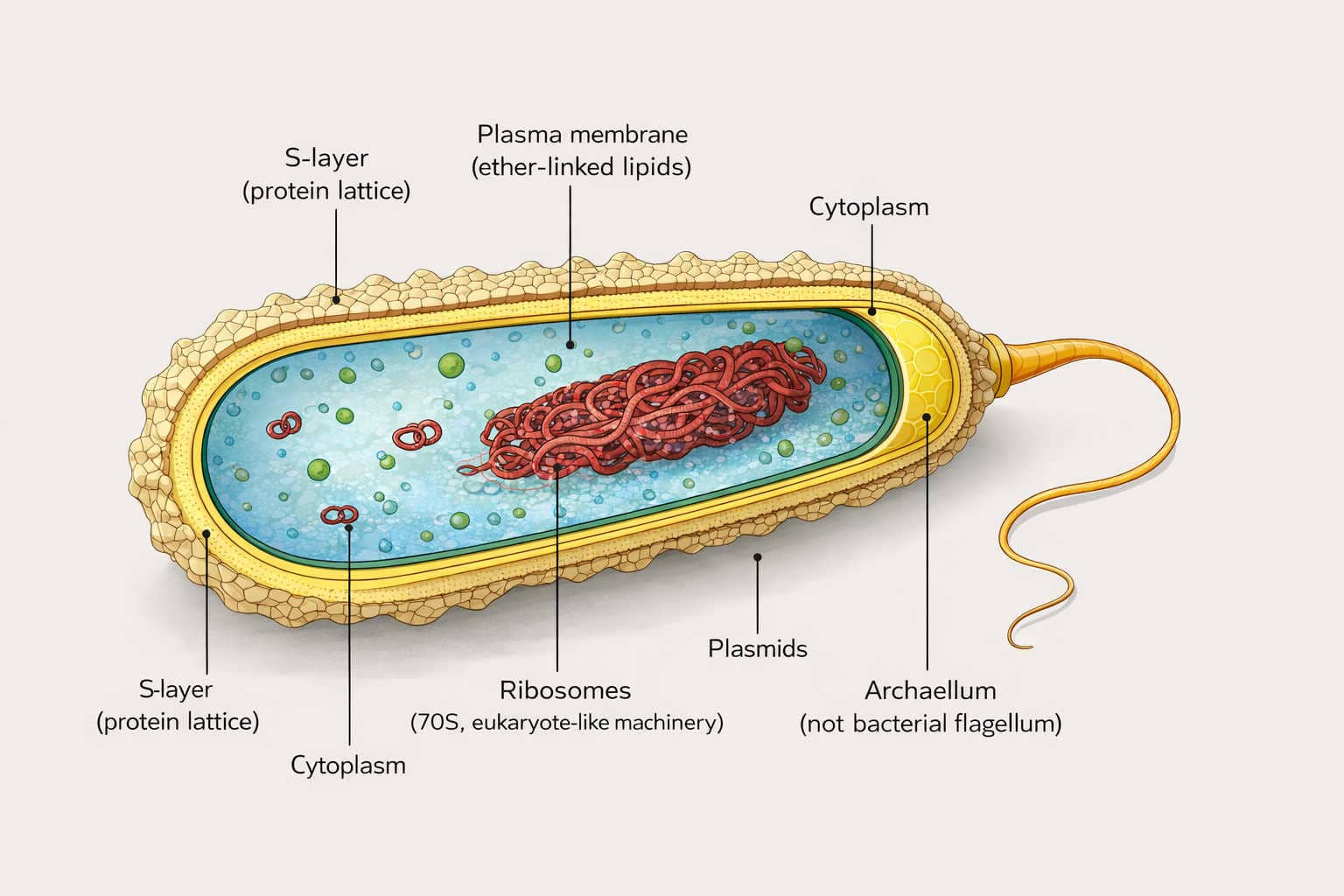
Archaea emerged as one of the two primary cellular lineages after LUCA. Though often grouped with bacteria as “prokaryotes,” archaea are genetically distinct. Modern evidence suggests that eukaryotes — and therefore plants, fungi, and animals — evolved from within an archaeal lineage that later incorporated a bacterium as mitochondria.
Archaea look like bacteria at first glance — small, simple, and lacking a nucleus. But they are fundamentally different. Unlike bacteria, archaea have unique ether-linked membrane lipids, often a protein S-layer instead of a peptidoglycan cell wall, and molecular machinery for DNA replication and transcription that more closely resembles eukaryotes. Their whip-like structure, the archaellum, is built differently from a bacterial flagellum, even though it performs a similar function.
Both archaea and bacteria are prokaryotes — cells without nuclei. But archaea are not just “primitive bacteria.” They represent a distinct domain of life and are now understood to be the lineage from which eukaryotes ultimately emerged.
LUCA
→ Bacteria
→ Archaea
→ Eukaryotes
→ Plants / Fungi / Animals

