
Phil • Cr. Think • Science • Hist •

The Philosophy Website

STORY

The Senegal Bichir: A Living Fossil

☐ Read
☑ Read
You’ve read this 0 times.
You’ve listened to this 0 times.

By Michael Alan Prestwood

Thu 19 Feb 2026
Published 6 months ago.
Updated 4 months ago.
Related Stories
The P-T Extinction
Cenozoic Era: Age of Mammals & Birds
Bilaterian Split: The Origin of Agency
Long-Term Memory Evolves: Tiktaalik
Mesozoic Era: Age of Dinosaurs
Stem Selachians: Modern Sharks LCA
Share :
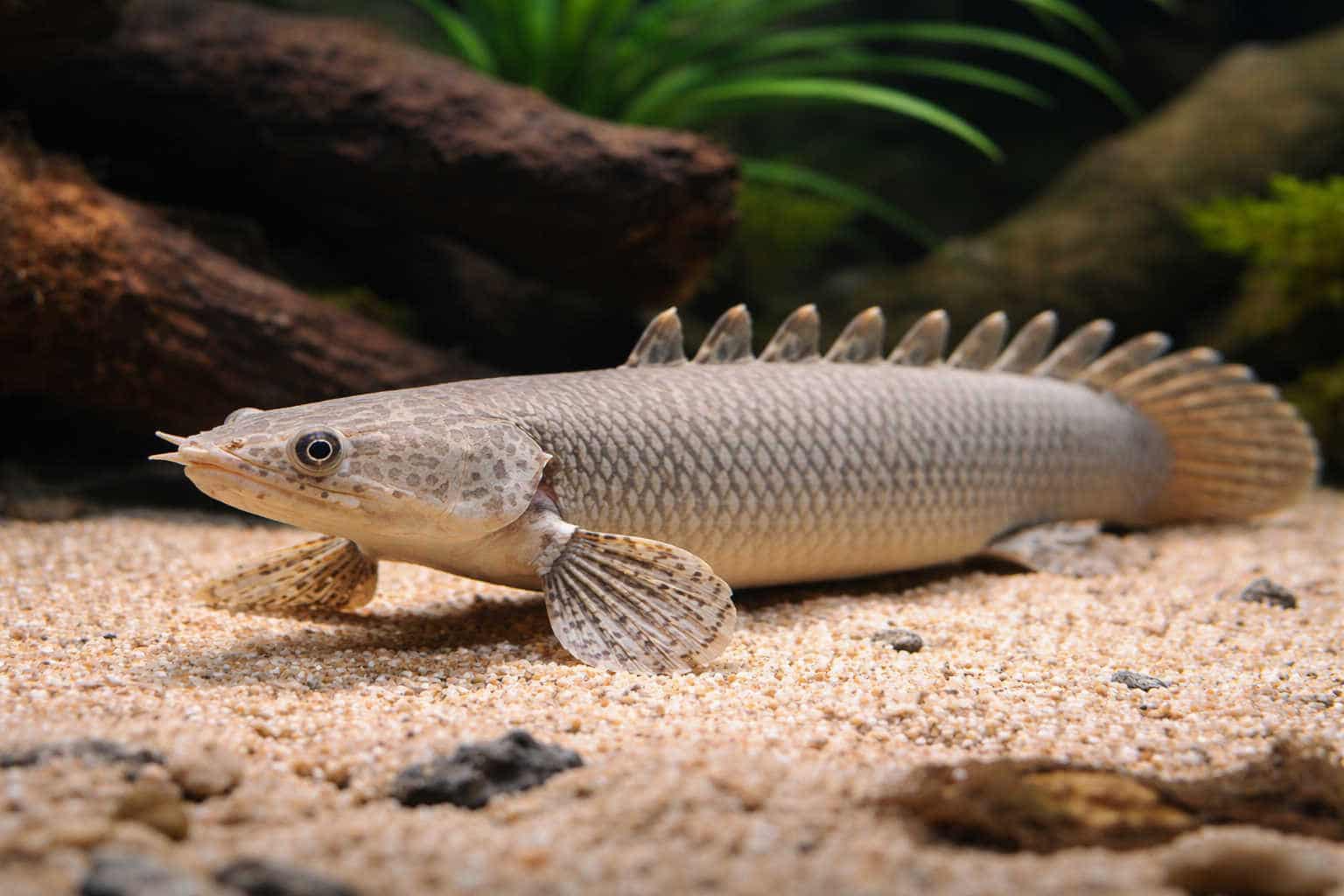
An early-diverging ray-finned fish whose lobed pectoral fins and paired lungs reflect an ancient branch of bony fish evolution.

The Senegal Bichir: A Living Fossil

~380 million years ago (± 15 million)
Air breathing lungs and lobed pectoral fins

The Senegal bichir represents an ancient ray-finned lineage that split from the lobe-finned line long before vertebrates moved onto land.

Polypterus Lineage: About 380 million years ago, during the Devonian Period — often called the “Age of Fishes” — the lineage leading to today’s bichirs branched off from other ray-finned fishes (Actinopterygii). This branch occurred early, very early, near the base of the ray-finned radiation. The Senegal bichir, Polypterus senegalus, is a modern descendant of that deep split.

Pictured: The Senegal bichir still breathes air. It possesses paired lungs in addition to gills and can survive in low-oxygen waters by gulping at the surface. Its thick, diamond-shaped ganoid scales resemble armor more than fish scales. Along its back runs a series of small dorsal finlets — each with its own spine — a feature that looks almost prehistoric because it is.

— map / TST —

TST Tracker
✓ Reading recorded.

Annotated References:

Calling the bichir a “living fossil” is shorthand. It has evolved, adapted, and survived like every other species. But it represents an early branch of ray-finned fish that changed far less dramatically than its cousins. It gives us a glimpse into what early actinopterygians may have looked like before the explosive radiation of modern fish.

When a Senegal bichir rises to the surface for air in a modern aquarium, it is performing a behavior that predates the dinosaurs, predates flowering plants, and reaches back toward the first forests of Earth.

It is not frozen in time. It is a survivor of deep time.

Michael Alan Prestwood
Author & Natural Philosopher
Prestwood writes on science-first philosophy, with particular attention to the convergence of disciplines. Drawing on his TST Framework, his work emphasizes rational inquiry grounded in empirical observation while engaging questions at the edges of established knowledge. With TouchstoneTruth positioned as a living touchstone, this work aims to contribute reliable, evolving analysis in an emerging AI era where the credibility of information is increasingly contested.
Email
Print
The Prestwood Column
Menu
August 2026
»COLUMN ARCHIVE
--COLUMN--
Column Research….
1. Timeline Story
Ethical Roadmap
2. Linked Quote
“The greatest weapon against stress is our ability to choose one thought over another.”
3. Science FAQ »
Did morality evolve?
4. Philosophy FAQ »
Is the Me Too movement consistent with TST Ethics?
5. Critical Thinking FAQ »
When should you stop following the crowd?
6. History FAQ!
What did the Nuremberg Trials clarify about moral agents?
Bonus Deep-Dive Article
TST Ethical Roadmap: A Process Model for Ethical Guidance and Moral Choice

Comments

Join the Conversation! Currently logged out.

Leave a Reply

NEW BOOK! NOW AVAILABLE!!

30 Philosophers: A New Look at Timeless Ideas

by Michael Alan Prestwood
The story of the history of our best ideas!
Scroll to Top