

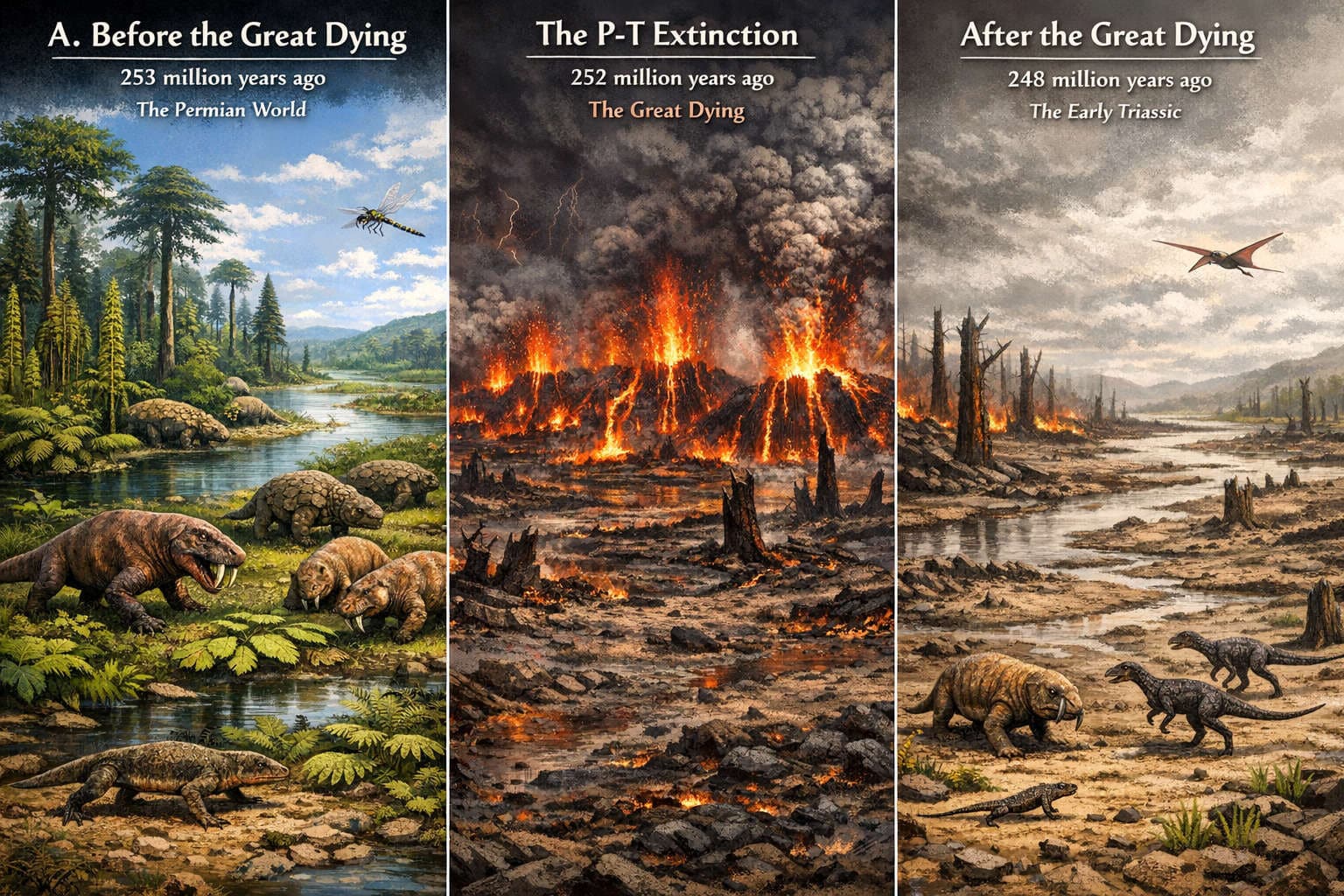
One million years before the end of the Permian world, it was full, stable, and alive. Vast river systems braided across Pangea’s lowlands, feeding dense forests of Glossopteris, towering horsetails, and early conifers. The land belonged to synapsids, our mammalian ancestors. Synapsids ranged from saber-toothed gorgonopsids to tusked dicynodont herds and heavy, armored pareiasaurs. Very large insects filled the air, and ecosystems, though different from today, were mature and deeply interconnected. It was a world that had been building for tens of millions of years. An alien landscape somewhat familiar to us, but not.
Then the Earth broke. Around 251,902,000 years ago, the Siberian Traps erupted in a series of colossal fissure events, pouring out unimaginable volumes of lava and gases. Carbon dioxide and methane drove rapid warming, while sulfur aerosols darkened the skies and acid rain stripped the land. Global warming on a scale never seen before. Oceans stagnated and lost oxygen, poisoning marine life. On land and in the seas, ecosystems collapsed. Roughly 90–96% of all species vanished—the most devastating mass extinction in history, so far. This was not a single moment, but a prolonged unraveling, where survival itself became rare.
In the first million years after, the world was quiet, harsh, and unstable. The great seed-fern forests of the time were gone. Glossopteris-dominated woodlands, along with towering horsetails and early conifers, were reduced to ash and memory, replaced by sparse ferns and low vegetation struggling across eroding floodplains. Rivers shrank and wandered across barren floodplains. Life persisted, but barely. Lystrosaurus and a few other hardy survivors dominated simply because so little else remained. Food webs were short, ecosystems fragile, and the climate still volatile. It was a recovery phase in the most literal sense—a planet relearning how to live.
Over the next tens of millions of years, that empty world became opportunity. New lineages spread into the abandoned niches, experimenting with form and function. Among them were early archosaurs—small, agile reptiles with more upright postures and improved breathing efficiency. These traits would prove decisive. As ecosystems slowly rebuilt through the Triassic, these archosaurs diversified, giving rise to the ancestors of dinosaurs, pterosaurs, and eventually birds. The Great Dying did not just end an age—it cleared the stage for an entirely new one.

