

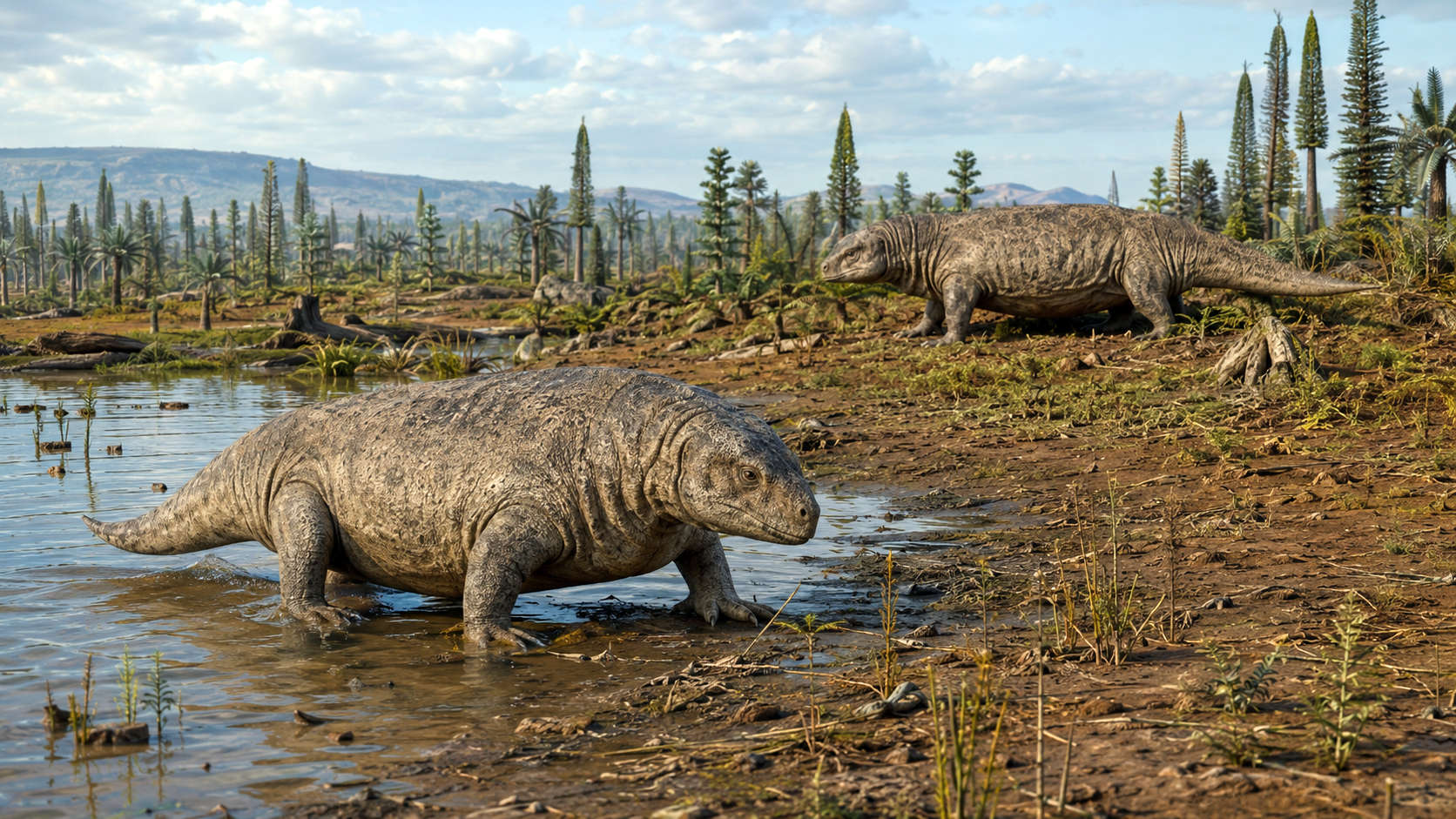
The last of the original synapsid line did not yet have the therapsid-grade body plan: more upright limbs, more specialized teeth, and a more mammal-like skull. Late caseids are a good example of basal, non-therapsid synapsids that persisted into the Middle Permian. The last known forms lived around the Roadian–Wordian range, before disappearing as therapsids took over.
Picture a setting in the Middle Permian. A wetland or seasonal floodplain on Pangaea, perhaps around 265 million years ago. It is not the lush coal-swamp world of the earlier Carboniferous; it is more open, warmer, and seasonally drier, with muddy banks, shallow water, sparse ground cover, seed ferns, horsetails, early conifer-like trees, and patchy vegetation. Picture a transitional world: still wet enough for ponds and river margins, but no longer the dense, humid jungle of the earliest synapsids. This just might be the habitat for late caseids—large herbivorous synapsids feeding near water while the more advanced therapsids were beginning to reshape the mammal-side story.
Picture a Lalieudorhynchus gandi, a late caseid synapsid. Think a bulky, low-slung herbivore with a barrel-shaped body, short sprawling limbs, thick tail, small head, and heavy skin folds. That was likely the general caseid body plan of the last non-therapsid synapsids.
Now picture a Ennatosaurus tecton about 20 feet behind it. That’s another late caseid. Both animals were on the “mammal-side” of the amniotes, but lack the therapsid-grade body plan: no upright posture, no clearly mammal-like skull, and no advanced mammal-line anatomy. They are old-line synapsids near the end of that earlier phase.

