

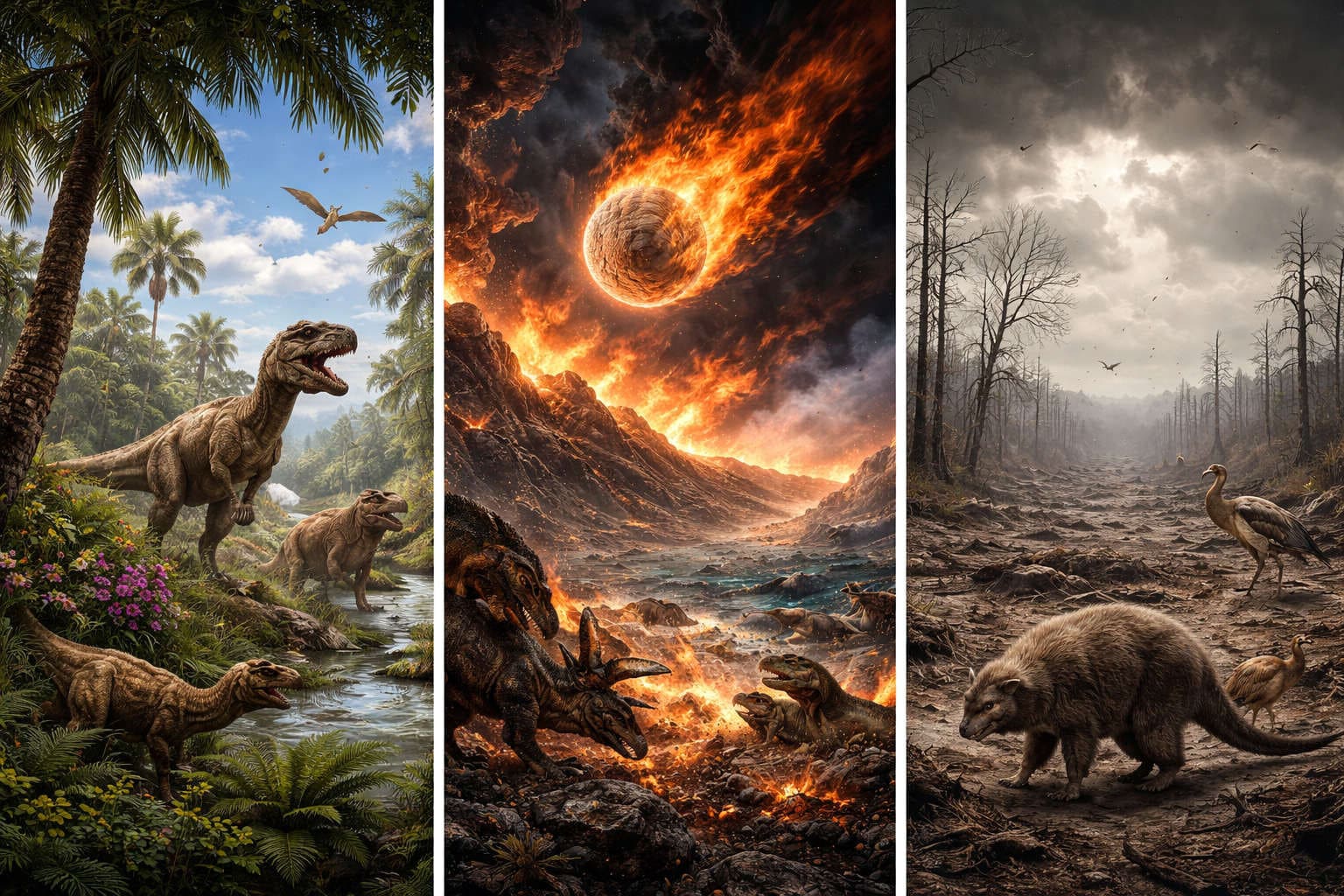
One million years before the end of the Cretaceous world, it was full, stable, and alive. Flowering plants had spread across much of the land, joined by conifers, ferns, and broad river plains that supported rich ecosystems on nearly every continent. The land belonged to dinosaurs. Tyrannosaurs, hadrosaurs, ceratopsians, titanosaurs, and countless smaller species filled the forests, floodplains, and coastlines. Pterosaurs still ruled parts of the sky, while birds, already true avian dinosaurs, were diversifying alongside them. Small mammals lived mostly in the margins, and the seas were dominated by mosasaurs, plesiosaurs, sharks, ammonites, and vast schools of fish. It was a world both strange and familiar, mature and thriving, with deep ecological roots stretching back tens of millions of years.
Then the Earth was struck. Around 66 million years ago, a large asteroid slammed into what is now the Yucatán Peninsula, releasing more energy than any volcanic eruption or nuclear arsenal in human history. The impact triggered shockwaves, earthquakes, tsunamis, and a global rain of superheated debris. Forests burned, skies darkened, and sunlight collapsed under a shroud of dust, soot, and aerosols. Photosynthesis faltered. Food chains unraveled from the bottom up. In the oceans, plankton crashes rippled outward into the loss of larger life. On land, non-avian dinosaurs, pterosaurs, and many other lineages vanished. Roughly 75% of all species disappeared. Unlike the Great Dying, this extinction was geologically sudden—a brutal interruption where survival depended not on dominance, but on luck, flexibility, and endurance.
In the first million years after, the world was dim, damaged, and unevenly recovering. The great dinosaur-dominated ecosystems were gone. Many forests had been burned back or shattered, and in some places fern spikes marked the early return of plant life, as hardy colonizers spread across devastated ground. The largest animals on land had vanished. Survivors were mostly small: birds, mammals, crocodilians, turtles, amphibians, and other lineages able to shelter, scavenge, or live on limited resources. Rivers still flowed and forests slowly returned, but the old food webs were broken. It was a quieter world, stripped of the giant bodies that had defined the Late Cretaceous. Recovery had begun, but the planet was still living in the shadow of sudden catastrophe.
Over the next tens of millions of years, that emptied world became a new evolutionary stage. Mammals, once small and mostly hidden, diversified into runners, climbers, burrowers, swimmers, and eventually into large herbivores and predators. Birds spread into many of the aerial and terrestrial niches left behind by other dinosaurs and pterosaurs. Flowering plants continued to reshape the land, and grass would later become one of the defining plants of the modern world. Through the Paleocene and Eocene, ecosystems grew richer, more layered, and increasingly familiar in outline. The K–Pg extinction did not end the age of dinosaurs completely—birds remained—but it ended the age of non-avian dinosaur dominance and opened the door to the Cenozoic world, the age of mammals, modern birds, and eventually us.

