
Phil • Cr. Think • Science • Hist • …
TST PRACTICE

The Philosophy Website

STORY

Pteranodons Emerge

☐ Read
☑ Read
You’ve read this 0 times.
You’ve listened to this 0 times.

By Michael Alan Prestwood

Wed 18 Mar 2026
Published 7 months ago.
Updated 2 months ago.
Related Stories
Proceratosaurus (T.Rex ancestor)
Styracosaurus
Marasuchus lilloensis
Amniotes Emerge: Amniotic Eggs
Triceratops
Diplodocid LCA: The Age of Giant Necked Sauropods
Share :
Pteranodon was one of the great soaring pterosaurs of the Late Cretaceous, but it was only one branch in a much larger pterosaur story.

Pteranodons Emerge

~88 million years ago (+/- 4 million)

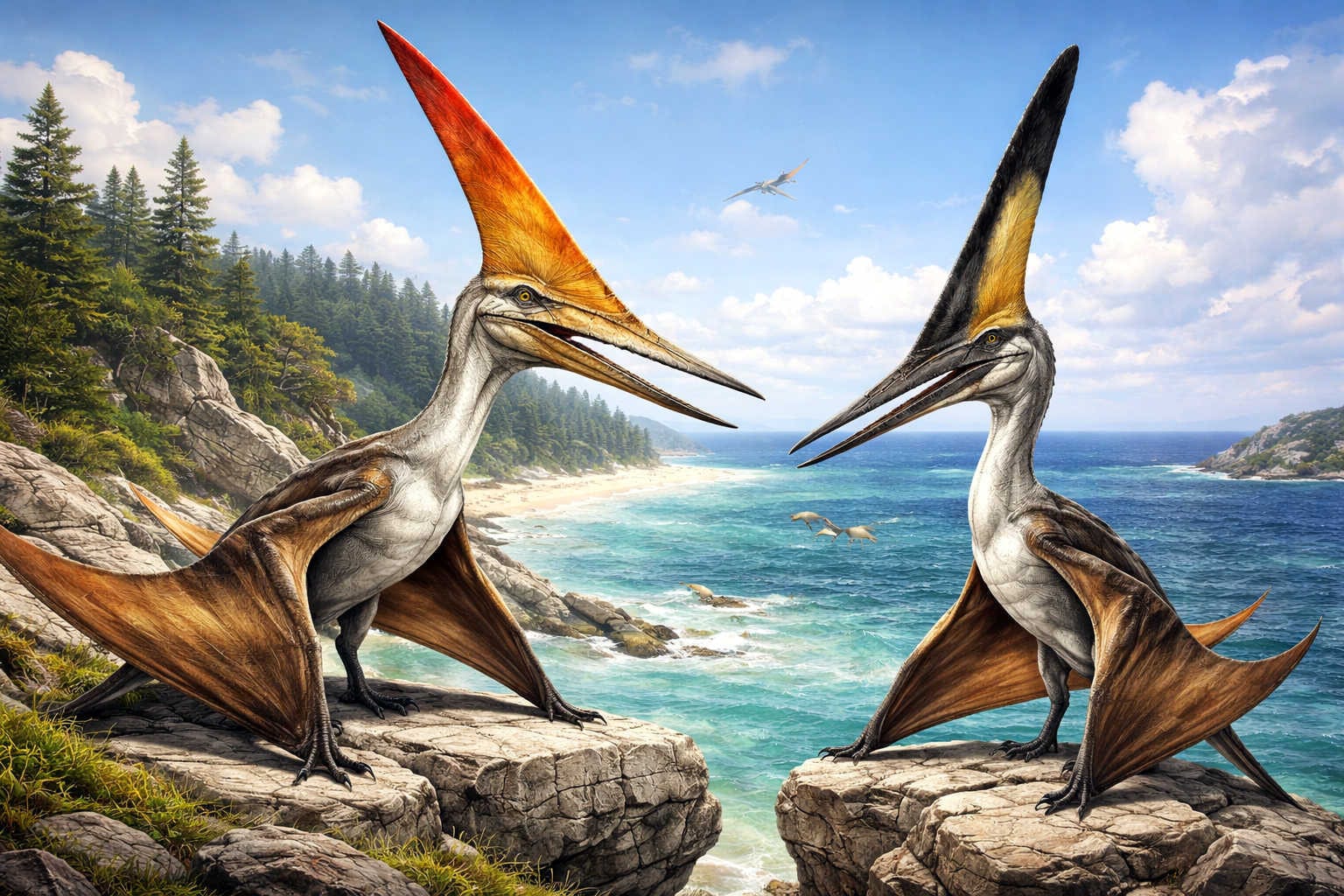
Pteranodon was a large, toothless pterosaur of Late Cretaceous North America, best known from the shores of the Western Interior Seaway. It had a long beak, a dramatic head crest, narrow wings built for soaring, and strong sexual dimorphism, with males larger and more extravagantly crested than females. The two commonly recognized species, P. longiceps and P. sternbergi, seem to differ mainly in crest shape, with sternbergi tending toward a taller, more upright crest and longiceps a longer, more backward-swept one. These were not dinosaurs, but highly specialized flying reptiles, likely spending much of their lives gliding above coastal waters and feeding largely on fish and other marine prey.

Its deeper ancestry reaches much farther back. Pterosaurs as a whole originated near the dinosaur line within Ornithodira, and the more advanced pterodactyloids—the shorter-tailed, long-skulled branch that includes Pteranodon—were already established by the Jurassic. Research on early pterodactyloids suggests that this advanced branch likely originated in terrestrial environments, long before some of its descendants, like Pteranodon, became famous as giant marine soarers. Within that later pterodactyloid history, pteranodontids emerged as one Cretaceous branch, with early records appearing before classic Pteranodon itself.

What happened next is important. Pteranodon itself did not continue to the very end of pterosaur history. It disappeared in the Late Cretaceous, while other pterosaur branches carried on after it. So later pterosaurs were not its direct descendants in the simple storytelling sense; they were better thought of as cousins on nearby branches of the larger pterosaur family tree. By the final chapter of pterosaur history, other advanced forms such as nyctosaurids and azhdarchids were still around, and pterosaurs as a whole lasted until the K–Pg extinction about 66 million years ago.

— map / TST —

TST Tracker
✓ Reading recorded.
Michael Alan Prestwood
Author & Natural Philosopher
Prestwood writes on science-first philosophy, with particular attention to the convergence of disciplines. Drawing on his TST Framework, his work emphasizes rational inquiry grounded in empirical observation while engaging questions at the edges of established knowledge. With TouchstoneTruth positioned as a living touchstone, this work aims to contribute reliable, evolving analysis in an emerging AI era where the credibility of information is increasingly contested.
Email
Print
The Prestwood Column
Menu
September 2026
Column Research….
1. Timeline Story
Hume’s Is–Ought Problem
2. Linked Quote
“I meet with no proposition that is not connected with an ought, or an ought not.”
3. Science FAQ »
Can science prove flourishing should be our goal?
4. Philosophy FAQ »
What is the difference between a normative aim and a normative directive?
5. Critical Thinking FAQ »
Is flourishing for all just utilitarianism?
6. History FAQ!
What is the history of the idea of flourishing in philosophy?
Bonus Deep-Dive Article
TST Normative Ethics: Flourishing as a Philosophical Goal

Comments

Join the Conversation! Currently logged out.

Leave a Reply

NEW BOOK! NOW AVAILABLE!!

30 Philosophers: A New Look at Timeless Ideas

by Michael Alan Prestwood
The story of the history of our best ideas!
Scroll to Top