
Explore Science-first Philosophy

STORY

The Last Theropods

By Michael Alan Prestwood

Mon 16 Mar 2026
Published 4 weeks ago.
Updated 3 weeks ago.
Related Stories
Theropod Line Diverges Within Dinosaria (from Saurischia)
Bird-line Archosaur: Nyasasaurus parringtoni
Marasuchus lilloensis
Hesperornithiformes Birds Emerge (Now Extinct)
Argentinosaurus
The K-Pg Extinction
Share :
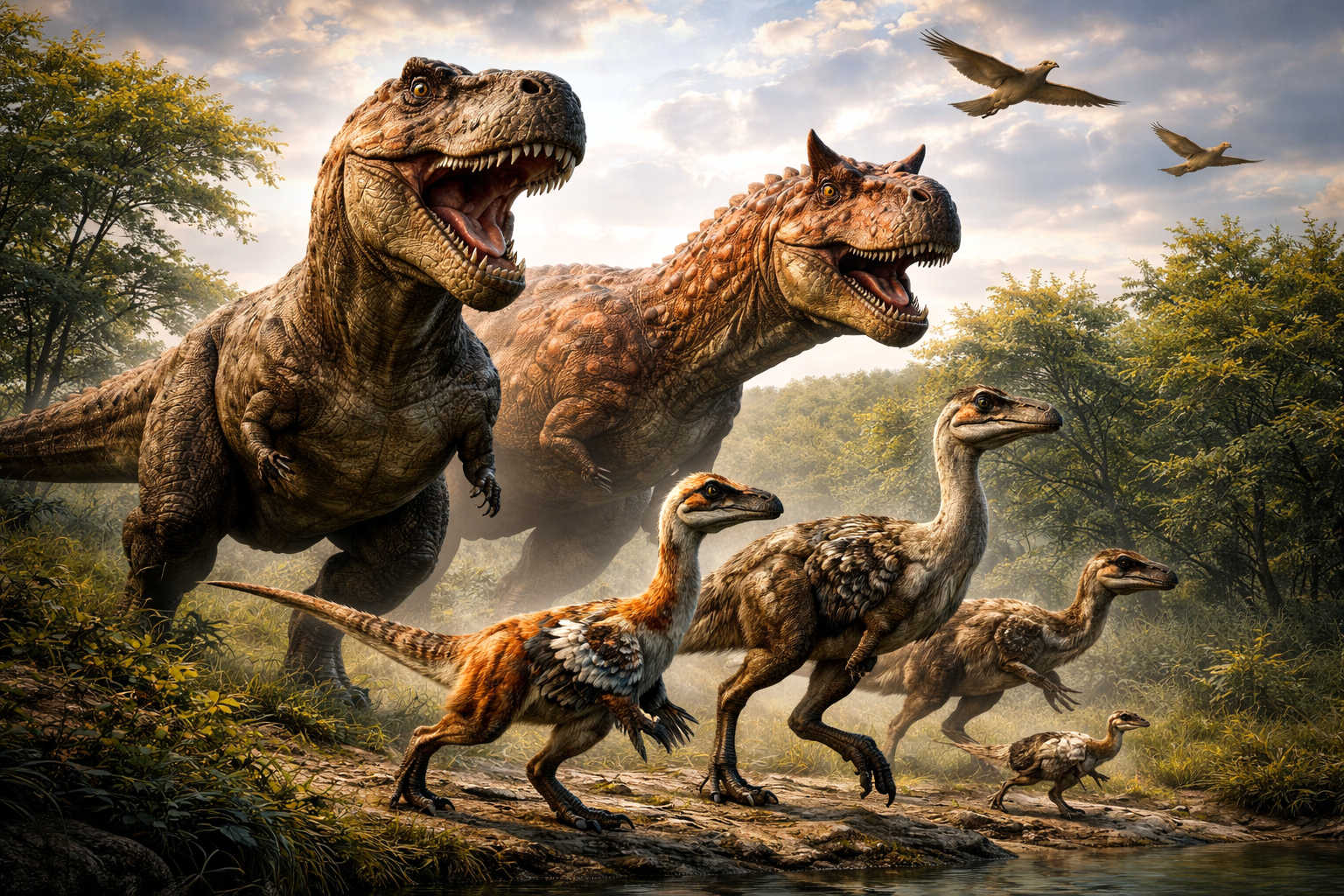
The last theropods still ranged from giant apex predators to smaller runners and hunters, while birds overhead carried the theropod branch beyond the extinction event.

The Last Theropods

66.04 Million years ago (K–Pg extinction)

By the end of the Cretaceous, the last theropods still ranged from giant bone-crushing hunters to smaller, lighter, faster forms, with birds overhead carrying the branch into the future.

Their lifestyles reflected that variety. Some were giant ambush or pursuit predators with massive skulls and powerful bites. Others were built for speed, agility, or smaller prey. Some likely chased, some scavenged, some snapped up little animals, and some had begun leaning fully into the avian way of life. Even near the end, theropods were still experimenting within their winning blueprint: strong hind legs, balancing tails, grasping forelimbs or winged descendants, sharp senses, and body plans tuned for active lives. The latest European record in particular points to several small-bodied theropod niches existing side by side rather than one generic “last raptor” type.

Their broader journey is one of the great stories in evolution. Theropods began in the Late Triassic and, including birds, have lasted roughly 170 million years. Over that immense stretch of time, they produced towering predators, strange beaked forms, feathered runners, and finally the only dinosaurs still alive today: birds.

Long before the end, by about 180 million years ago, Asia and North America were no longer part of one seamless northern landmass, sending their animals into separate evolutionary experiments. In evolution, this kind of geographic split is called vicariance. Well over 100 million years later, the tyrannosaurid body plan proved so successful that you can still clearly see the family resemblance on both continents. By the end, 66 million years ago, Tyrannosaurus rex in North America and Tarbosaurus bataar in Asia looked strikingly similar, and both stood among the top predators on their continents.

— map / TST —

Michael Alan Prestwood
Author & Natural Philosopher
Prestwood writes on science-first philosophy, with particular attention to the convergence of disciplines. Drawing on his TST Framework, his work emphasizes rational inquiry grounded in empirical observation while engaging questions at the edges of established knowledge. With TouchstoneTruth positioned as a living touchstone, this work aims to contribute reliable, evolving analysis in an emerging AI era where the credibility of information is increasingly contested.
Email
Print
This Week @ TST
April 8, 2026
»Column Archive
WWB Research….
1. Story of the Week
Pragmatism
2. Quote of the Week
“Our statements about the external world face the tribunal of sense experience not individually, but only as a corporate body.”
3. Science FAQ »
Why do scientific models work if they aren’t literally true?
4. Philosophy FAQ »
Is agnosticism a ludicrous position to occupy?
5. Critical Thinking FAQ »
Do my people and culture help or harm my critical thinking?
6. History FAQ!
Did Berger and Luckmann really say reality is just made up?
Bonus Deep-Dive Article
TST Doxastic Formation: Public Belief, Tribe, and Worldview
Scroll to Top