

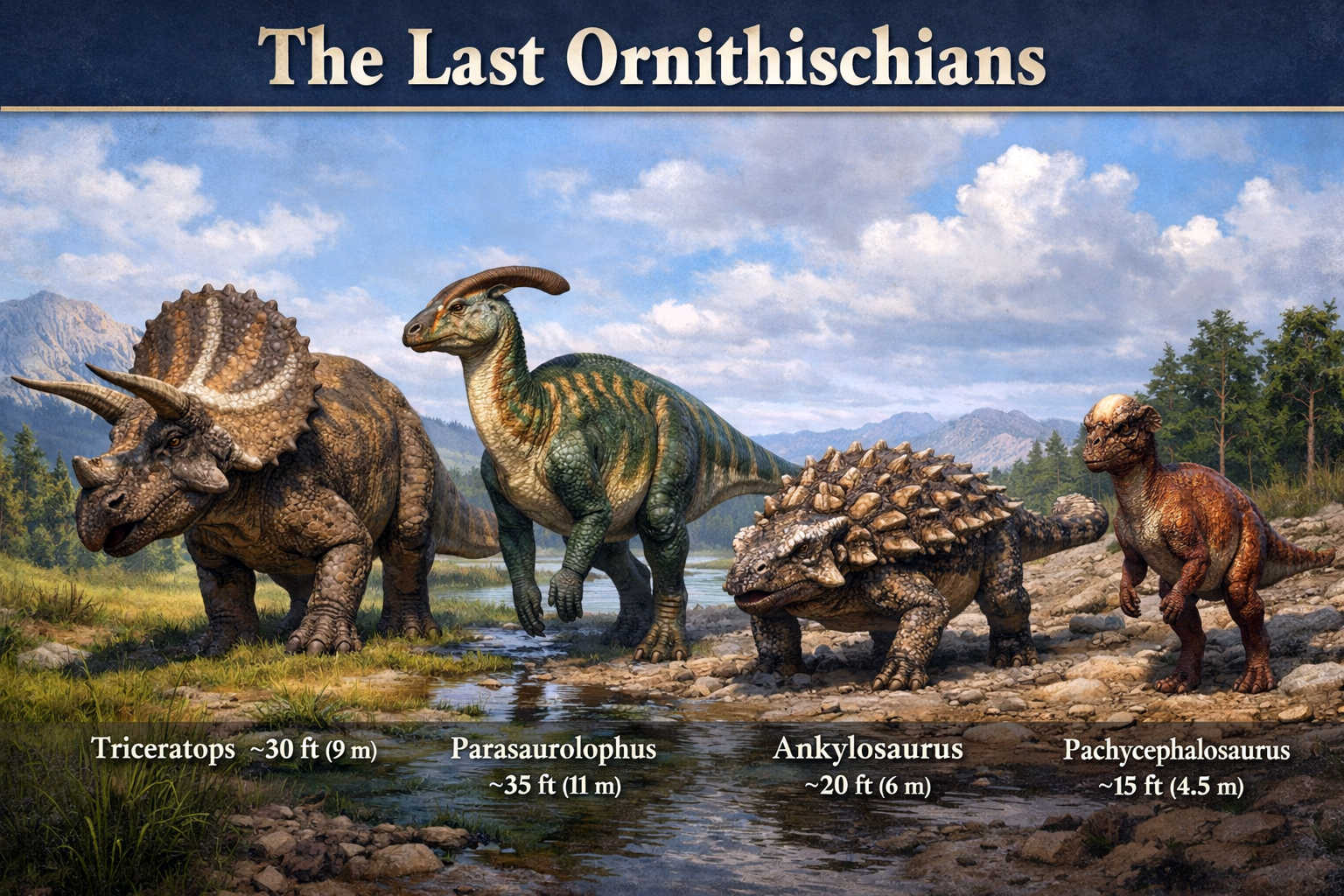
By the end of the Cretaceous, the last ornithischians still filled the landscapes with a striking variety of forms. Horned ceratopsians like Triceratops moved as heavy, powerful quadrupeds with massive skulls, sharp facial horns, and broad defensive frills. Hadrosaurids, the duck-billed dinosaurs, came in deep-bodied forms with beaks, dental batteries, and in some cases elaborate crests. Ankylosaurs stayed low and tank-like, covered in armor with heavy tails built for defense. Pachycephalosaurs remained the odd little bruisers of the group, often bipedal, with thickened skull roofs and compact, muscular builds. By then, stegosaurs were long gone, so the final ornithischian picture seems dominated by these four great body plans: horned, duck-billed, armored, and dome-headed.
Over roughly 170 million years, ornithischians made a long career out of being some of the most successful plant-eaters on Earth. Most were herbivores, though they did not all live alike. Some likely traveled in herds, some relied on armor, some on horns and bulk, and others on speed, agility, or social behavior. Their jaws, beaks, and teeth evolved again and again to handle different plant foods, and in hadrosaurids that chewing machinery became especially sophisticated. They were not built like the theropod hunters, but they were no less impressive. Ornithischians explored the plant-eating side of dinosaur life with just as much creativity as theropods explored predation.
Their broader journey is one of experimentation within a winning blueprint. Early ornithischians began as smaller, simpler forms, but over time the branch produced some of the most recognizable dinosaurs of all: plated stegosaurs, horned ceratopsians, duck-billed hadrosaurs, armored ankylosaurs, and dome-headed pachycephalosaurs. Like the other great branches, what we know is only a glimpse, and the fossil record surely hides countless species still lost to time. Even so, the known record already shows a breathtaking variety of shapes and lifestyles. At the end, ornithischians may have been narrower in overall range than across their whole history, but they were still a vivid and successful part of the dinosaur world right up until the mass extinction 66 million years ago.

