

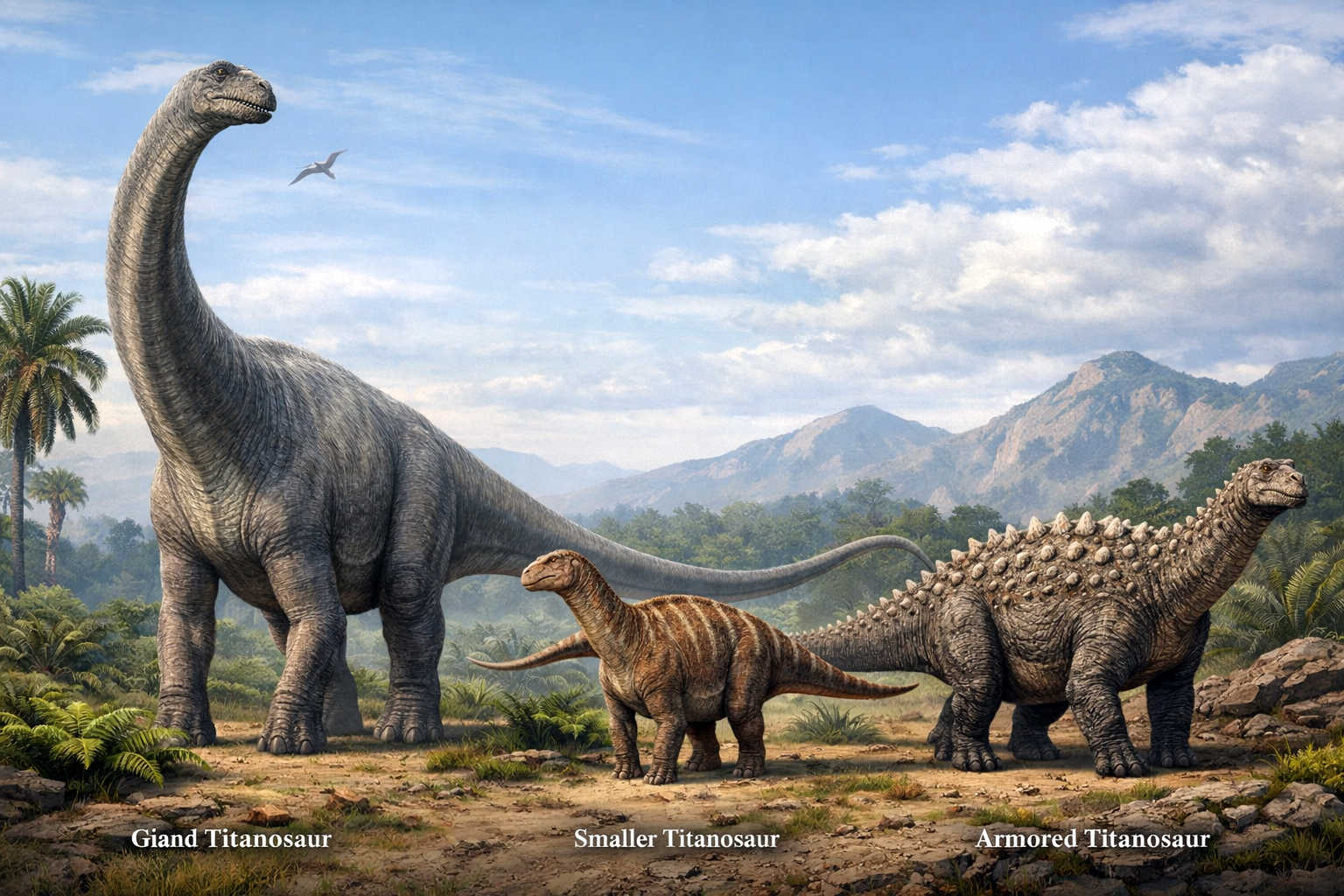
By the end of the Cretaceous, the last sauropods were titanosaurs, the final surviving branch of the great long-necked dinosaurs. They still appeared across parts of South America, Africa, Europe, Asia, and even North America, though not in the same abundance everywhere. Some were giants with towering necks and immense barrel-shaped bodies. Others were smaller, more compact forms, and some even carried bony armor embedded in the skin. So while the last sauropods no longer displayed the full range of earlier sauropod history, they were not all carbon copies of one another. Titanosaurs still showed real variation in size, build, and defense.
Their lifestyle was the old sauropod lifestyle refined and carried into the final age of dinosaurs. These were large-bodied plant-eaters, built to move steadily across broad landscapes, cropping vegetation with small heads and processing huge amounts of food through sheer volume rather than chewing. Some likely fed higher, some lower, and their body sizes alone would have shaped the environments around them. Even among the final titanosaurs, the mix of giant forms, smaller forms, and armored forms suggests that the long-necked blueprint was still being adjusted to different ecological pressures rather than simply fading into one last uniform type. The osteoderms seen in some titanosaurs add an extra layer of strangeness to their final chapter.
Their broader journey is one of astonishing endurance. Sauropods arose early in dinosaur history and persisted until the Cretaceous–Paleogene extinction, but by the end only titanosaurs remained. That means the final sauropods were both a narrowing and a continuation: the last survivors of a once much more varied dynasty, yet still diverse enough to remind us how powerful that body plan had been. We will never know the full number of species or every strange local form lost to time, but the fossils we do have show that even in their final act, sauropods were still majestic, varied, and very much part of the dinosaur world.

