
Explore Science-first Philosophy

STORY

Palaeognathae Birds Emerge

By Michael Alan Prestwood

Sun 15 Mar 2026
Published 2 months ago.
Updated 2 days ago.
Related Stories
The Last Pterosaurs
The Last Theropods
The Last Ornithischians
Pangaea Splitting Starts Splitting Evolution
Triceratops
Neoaves Birds Emerge (from Neognathae)
Share :
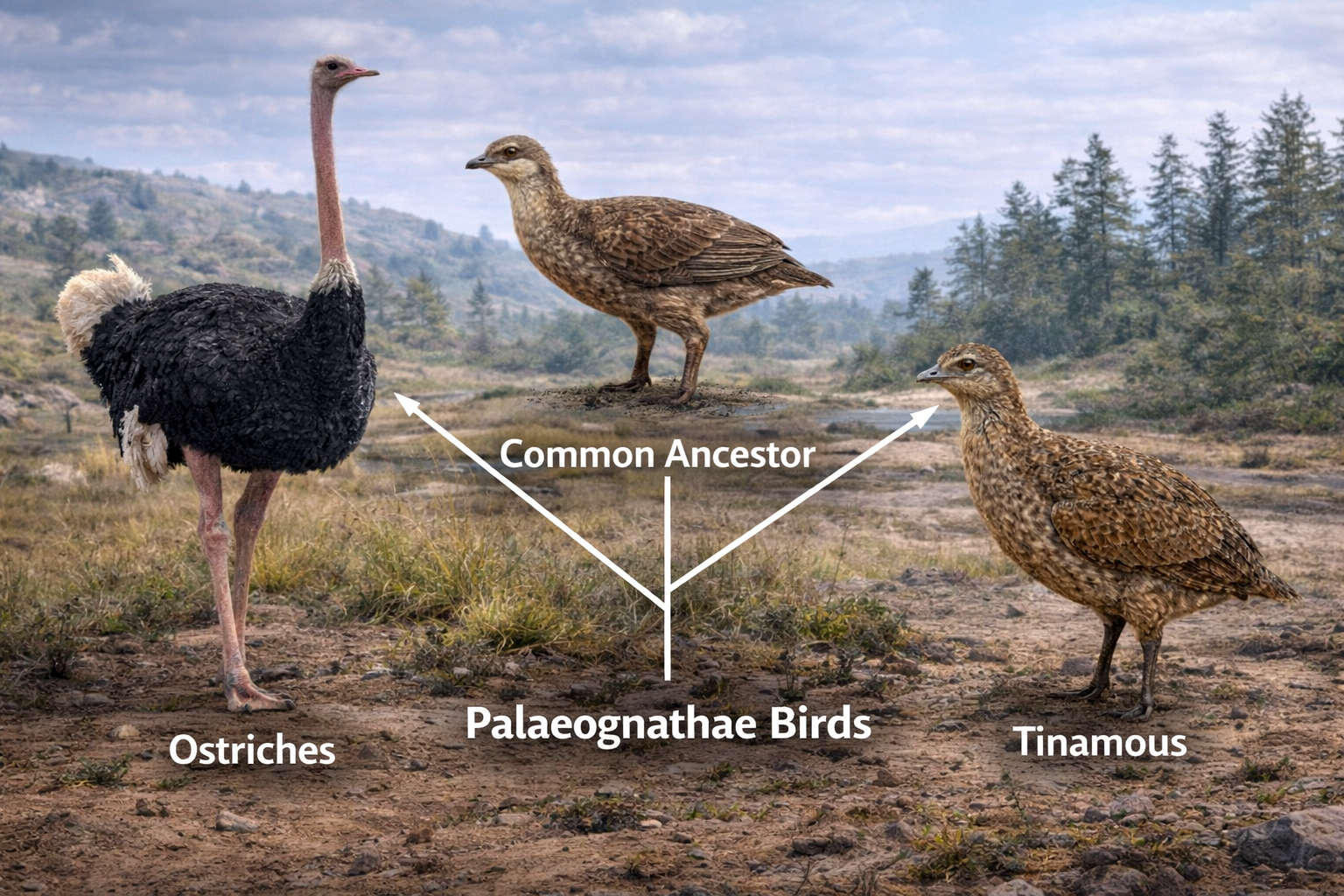
Palaeognathae is the living bird branch that includes ostriches, emus, cassowaries, rheas, kiwis, and tinamous.

Palaeognathae Birds Emerge

~85 Million years ago (+/- 10 million).
Ground birds: ostriches, emus, tinamous, etc.

Palaeognathae is the living bird branch that includes ostriches, emus, cassowaries, rheas, kiwis, and tinamous. Most of its best-known members today are large ground birds, and several are flightless, but tinamous remind us that this branch was not simply “the flightless bird line.” In fact, modern genetic work has helped show that the palaeognath story is more complicated than older textbook pictures suggested, with living ratites and tinamous all belonging to the same deeper branch of crown birds.

The genetic clock has often hinted that this branch is older than its earliest clear fossils suggest. That is why an estimate like ~85 million years ago, plus or minus 10 million years works as a reasonable DNA-leaning timeline choice. Older molecular studies often placed palaeognath divergences deep in the Late Cretaceous, and even newer analyses still tend to put the origin of crown Palaeognathae near the end of the Cretaceous rather than much later. In that sense, this estimate represents the “clocks” side of the rocks-vs.-clocks debate.

The fossil record is what keeps the issue open. The K–Pg extinction event occurred about 66 million years ago, and the earliest clear fossil palaeognaths are generally Paleocene or younger, with flying lithornithids often serving as the first strong fossil reference points after the extinction. That means the fossil evidence does not yet cleanly prove that crown palaeognaths were already diversified long before the boundary, even though DNA-based studies often suggest they were. So the debate continues: the clocks tend to push the branch back toward the Late Cretaceous, while the rocks still show the clearest palaeognath record mostly after the extinction.

— map / TST —

Michael Alan Prestwood
Author & Natural Philosopher
Prestwood writes on science-first philosophy, with particular attention to the convergence of disciplines. Drawing on his TST Framework, his work emphasizes rational inquiry grounded in empirical observation while engaging questions at the edges of established knowledge. With TouchstoneTruth positioned as a living touchstone, this work aims to contribute reliable, evolving analysis in an emerging AI era where the credibility of information is increasingly contested.
Email
Print
TST Column
April 22, 2026
Column Research….
1. Timeline Story
Augustine of Hippo
2. Linked Quote
“In order for a war to be just, three things are necessary.”
3. Science FAQ »
Why do we overreact and escalate?
4. Philosophy FAQ »
How does TST Ethics handle the trolley problem?
5. Critical Thinking FAQ »
How do you prevent yourself from overreacting?
6. History FAQ!
What is the history of ethical war?
Bonus Deep-Dive Article
1 Goal: Flourish (TST Ethics)

Comments

Join the Conversation! Currently logged out.

Leave a Reply

NEW BOOK! NOW AVAILABLE!!

30 Philosophers: A New Look at Timeless Ideas

by Michael Alan Prestwood
The story of the history of our best ideas!
Scroll to Top