
Explore Science-first Philosophy

STORY

Neornithes (Crown Birds) emerge

By Michael Alan Prestwood

Sun 15 Mar 2026
Published 1 month ago.
Updated 1 month ago.
Related Stories
Amniotes Emerge: Amniotic Eggs
Neoaves Birds Emerge (from Neognathae)
The K-Pg Extinction
Ornithischians Diverge Within Dinosauria “Bird Hipped”
Triceratops
Archosauria Diverge Within Reptiles
Share :
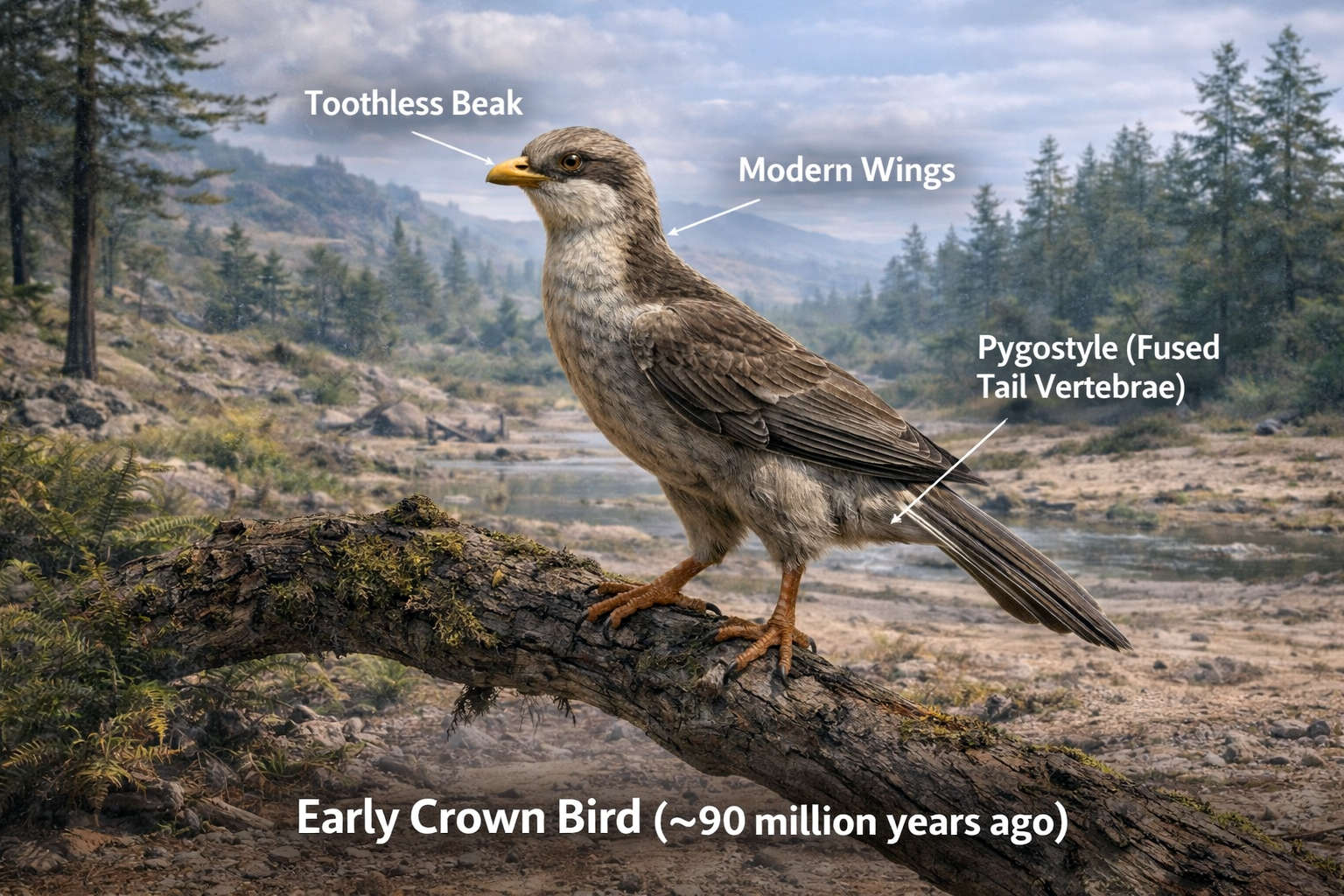
Three branches of modern birds evolved from within neornithes: Struthio camelus (the ostrich), Gallus gallus (chickens), and Passer domesticus (the house sparrow is a good one).

Neornithes (Crown Birds) emerge

~90 Million years ago (+/- 10 million).

Neornithes, or crown birds, are the branch that includes all living birds today. Once the “Crown Bird” body plan was perfected, it became an incredibly stable design.

From here, evolution did its thing. That means the ostrich, the chicken, and the house sparrow all belong here, along with every duck, eagle, hummingbird, penguin, and parrot alive now. In broad terms, living birds fall into three great groups within Neornithes: Palaeognathae (ostriches, emus, kiwis, and tinamous), Galloanserae (landfowl and waterfowl), and Neoaves (nearly all other living birds).

The deeper story comes from the genetic clock. DNA-based studies often suggest that crown birds began diverging well before the asteroid impact, with some major analyses placing the common ancestor of modern birds around 95 million years ago. That is why a timeline label such as ~90 mya ±10 million years is a fair, DNA-leaning estimate: it reflects the idea that the modern bird line may have already existed for tens of millions of years before the end-Cretaceous extinction, even if those early crown birds did not yet look like today’s familiar forms.

The fossil record, however, is what keeps the debate alive. The K–Pg extinction event happened about 66 million years ago, and the clearest Late Cretaceous fossils close to or within crown birds, such as Asteriornis from 66.8–66.7 mya and Vegavis from roughly 69.2–68.4 mya, sit right near that boundary. That leaves paleontologists still debating whether these dates reflect the true emergence of crown birds, their survival through the extinction, or simply the earliest fossils we have so far. In other words, the argument continues because the rocks point to a late appearance, while the clocks often hint at a deeper origin.

— map / TST —

Michael Alan Prestwood
Author & Natural Philosopher
Prestwood writes on science-first philosophy, with particular attention to the convergence of disciplines. Drawing on his TST Framework, his work emphasizes rational inquiry grounded in empirical observation while engaging questions at the edges of established knowledge. With TouchstoneTruth positioned as a living touchstone, this work aims to contribute reliable, evolving analysis in an emerging AI era where the credibility of information is increasingly contested.
Email
Print
This Week @ TST
April 8, 2026
»Column Archive
WWB Research….
1. Story of the Week
Pragmatism
2. Quote of the Week
“Our statements about the external world face the tribunal of sense experience not individually, but only as a corporate body.”
3. Science FAQ »
Why do scientific models work if they aren’t literally true?
4. Philosophy FAQ »
Is agnosticism a ludicrous position to occupy?
5. Critical Thinking FAQ »
Do my people and culture help or harm my critical thinking?
6. History FAQ!
Did Berger and Luckmann really say reality is just made up?
Bonus Deep-Dive Article
TST Doxastic Formation: Public Belief, Tribe, and Worldview
Scroll to Top