

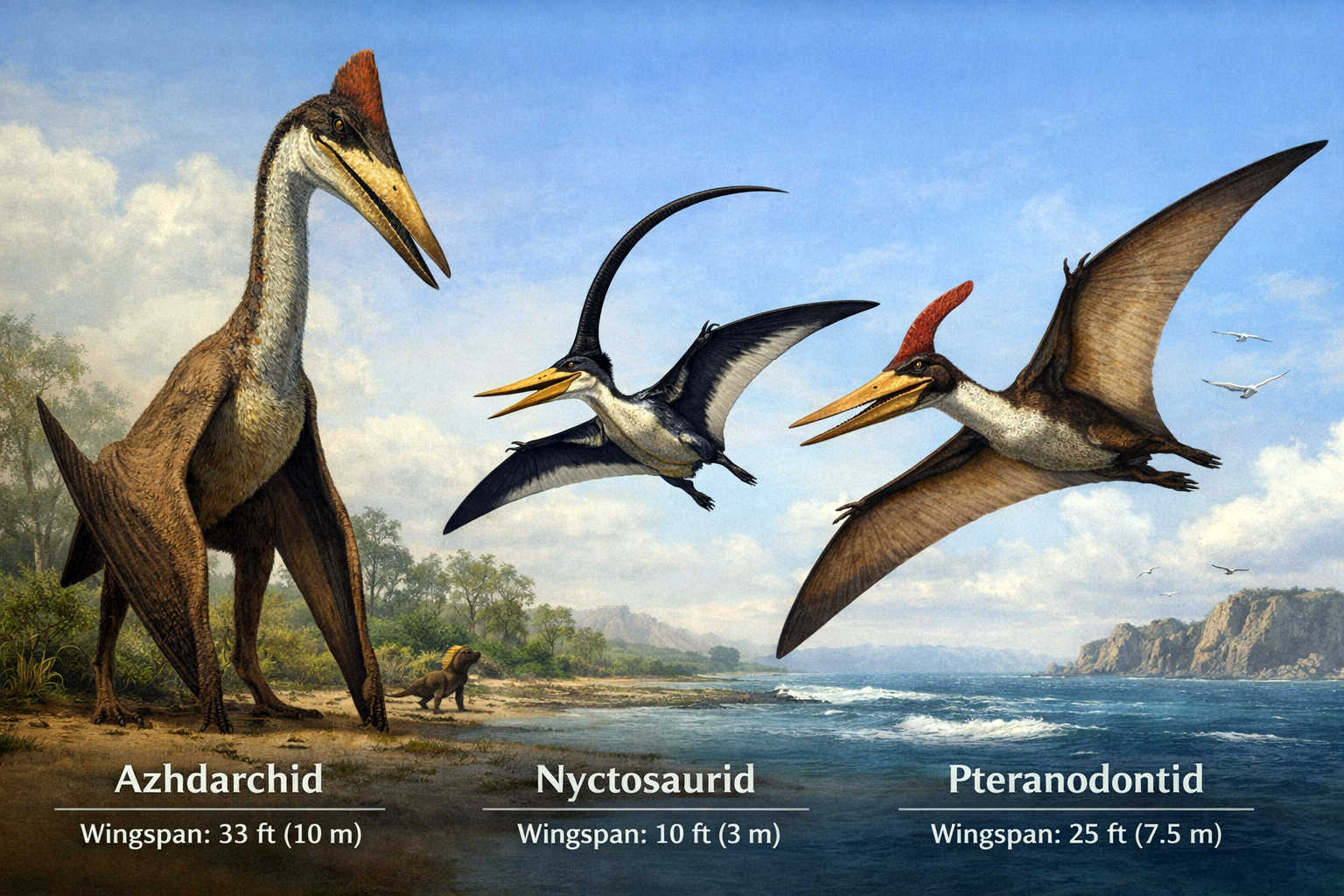
By the end of the Cretaceous, the last pterosaurs were still spread across parts of Africa, Europe, Asia, and the Americas, though the fossil record is frustratingly patchy. They were not the old toothy forms many people picture. The final survivors were advanced, mostly toothless pterodactyloids, including azhdarchids, nyctosaurids, and pteranodontids. Some had giant wingspans, long stiff necks, narrow skulls, and huge flight membranes stretched along an elongated fourth finger. In other words, the last pterosaurs were still strange, specialized, and impressive right up to the end.
Their lifestyles seem to have varied. The giant azhdarchids were likely not just seabird-like fishers, but often terrestrial stalkers, walking on land and picking off small animals, carrion, and other easy meals. Nyctosaurids and pteranodontids appear more tied to coastal and marine settings, soaring over shorelines and open water. So while the surviving body plans had narrowed compared with earlier pterosaur history, they were still not all doing the same thing. The last pterosaurs seem to have converged on a handful of highly successful designs, each fitted to a different way of living.
Their overall journey is one of the great experiments in vertebrate evolution. Pterosaurs were the first vertebrates to achieve powered flight, and they lasted for more than 150 million years. Over that immense stretch of time, they evolved from small early flyers into giants unlike anything alive today. For a while, people pictured their end as a slow, tired decline, but the newer view is more interesting: they were likely still diverse and ecologically important at the close of the Cretaceous. Then, about 66 million years ago, the final pterosaurs vanished in the same catastrophe that ended the non-avian dinosaurs. What we know is still incomplete, but even the fragmentary record gives us a vivid glimpse of a branch that spent millions of years mastering the skies in its own way.

