
Explore Science-first Philosophy

STORY

The Last Stegosaurus: Wuerhosaurus

By Michael Alan Prestwood

Mon 16 Mar 2026
Published 4 weeks ago.
Updated 4 weeks ago.
Related Stories
Pterosaurs Diverge From Dinosaur Ancestors (within Ornithodira)
The Last Pterosaurs
Proceratosaurus (T.Rex ancestor)
Marasuchus lilloensis
Hesperornithiformes Birds Emerge (Now Extinct)
Bilaterian Split: The Origin of Agency
Share :
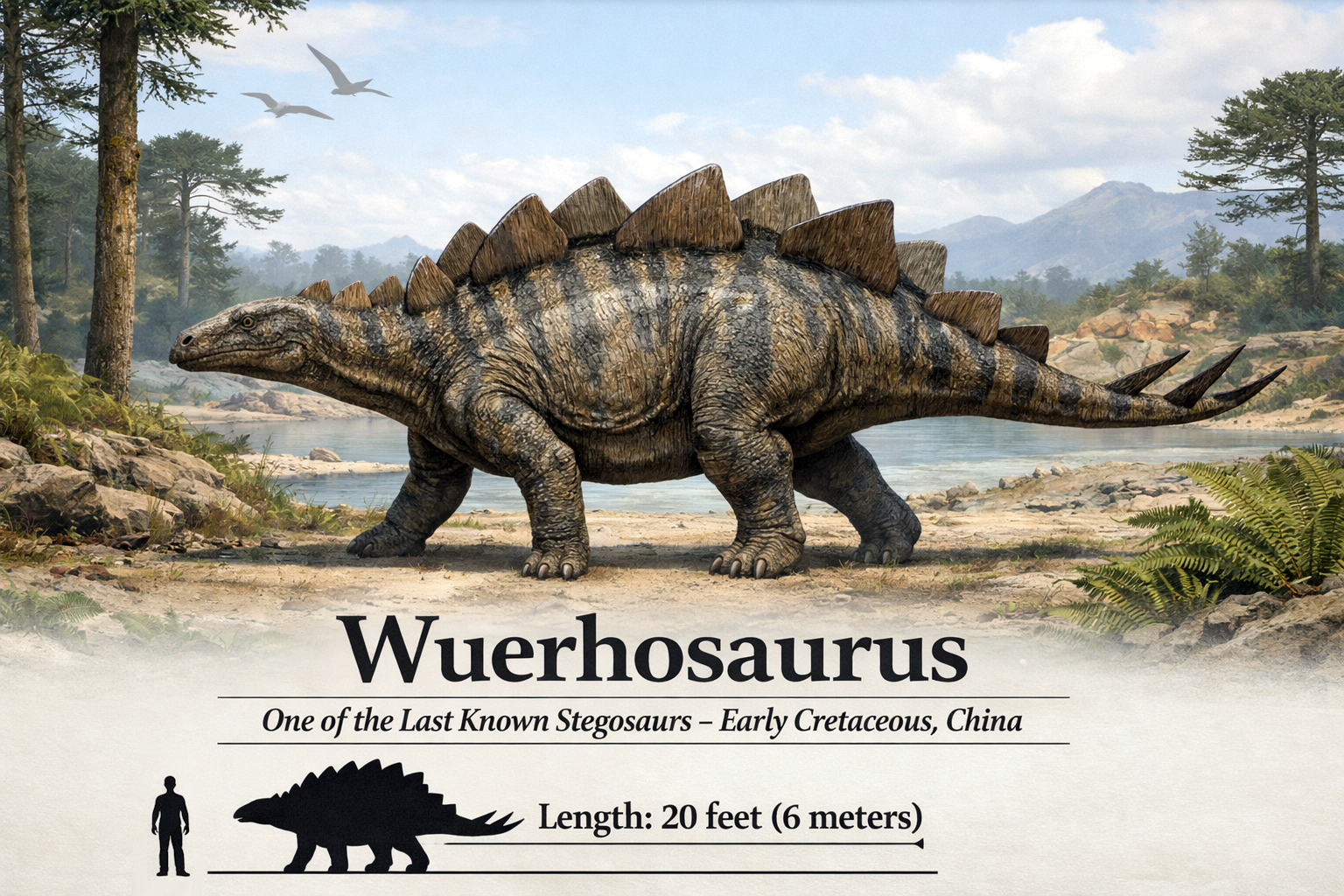
Wuerhosaurus was one of the last known stegosaurs, carrying the classic plated-and-spiked body plan into the Early Cretaceous of what is now China.

The Last Stegosaurus: Wuerhosaurus

110 Million years ago (+/- 10 million)

Wuerhosaurus was a late Early Cretaceous stegosaur from what is now northwestern China, with fossils known from Xinjiang and related material from Inner Mongolia. It lived roughly 135 to 125 million years ago, making it one of the youngest known stegosaurs. Unlike the taller, more dramatic image many people carry of Stegosaurus, Wuerhosaurus seems to have been a broader, lower-slung animal, likely adapted for feeding on low-growing plants. It still had the classic stegosaur look—plates along the back and a spiked tail—but it appears to have carried that old design in a somewhat flatter, heavier form.

Behind Wuerhosaurus stood a much wider stegosaur story. Earlier stegosaurs had spread across parts of North America, Europe, Africa, and Asia, and over time they explored a range of sizes and plate arrangements while keeping the same basic blueprint: small heads, arched backs, back plates, and a defensive tail. Some were taller and more iconic, like Stegosaurus. Others were built differently, showing that even within one recognizable body plan, evolution kept experimenting. Wuerhosaurus was one of the final echoes of that long, successful branch.

The frustrating truth is that late stegosaur fossils are scarce, which makes their ending harder to reconstruct than the endings of some other dinosaur groups. A few fragmentary finds hint that stegosaurs may have lingered later in the Cretaceous than once thought, but the mainstream view is still that no definitive stegosaur evidence is known from deposits close to the K–Pg boundary. In other words, stegosaurs seem to have disappeared tens of millions of years before the asteroid impact ended the non-avian dinosaurs.

— map / TST —

Michael Alan Prestwood
Author & Natural Philosopher
Prestwood writes on science-first philosophy, with particular attention to the convergence of disciplines. Drawing on his TST Framework, his work emphasizes rational inquiry grounded in empirical observation while engaging questions at the edges of established knowledge. With TouchstoneTruth positioned as a living touchstone, this work aims to contribute reliable, evolving analysis in an emerging AI era where the credibility of information is increasingly contested.
Email
Print
This Week @ TST
April 8, 2026
»Column Archive
WWB Research….
1. Story of the Week
Pragmatism
2. Quote of the Week
“Our statements about the external world face the tribunal of sense experience not individually, but only as a corporate body.”
3. Science FAQ »
Why do scientific models work if they aren’t literally true?
4. Philosophy FAQ »
Is agnosticism a ludicrous position to occupy?
5. Critical Thinking FAQ »
Do my people and culture help or harm my critical thinking?
6. History FAQ!
Did Berger and Luckmann really say reality is just made up?
Bonus Deep-Dive Article
TST Doxastic Formation: Public Belief, Tribe, and Worldview
Scroll to Top