
Explore Science-first Philosophy

STORY

Pterosaurs Diverge From Dinosaur Ancestors (within Ornithodira)

By Michael Alan Prestwood

Sat 14 Mar 2026
Published 1 month ago.
Updated 4 weeks ago.
Related Stories
The Last Ornithischians
Palaeognathae Birds Emerge
The Last Pterosaurs
Sauropodomorph Line Diverges Within Dinosaria (from Saurischia)
First True Bird: Archaeopteryx
Dinosauria Emerge: True Dinosaurs!
Share :
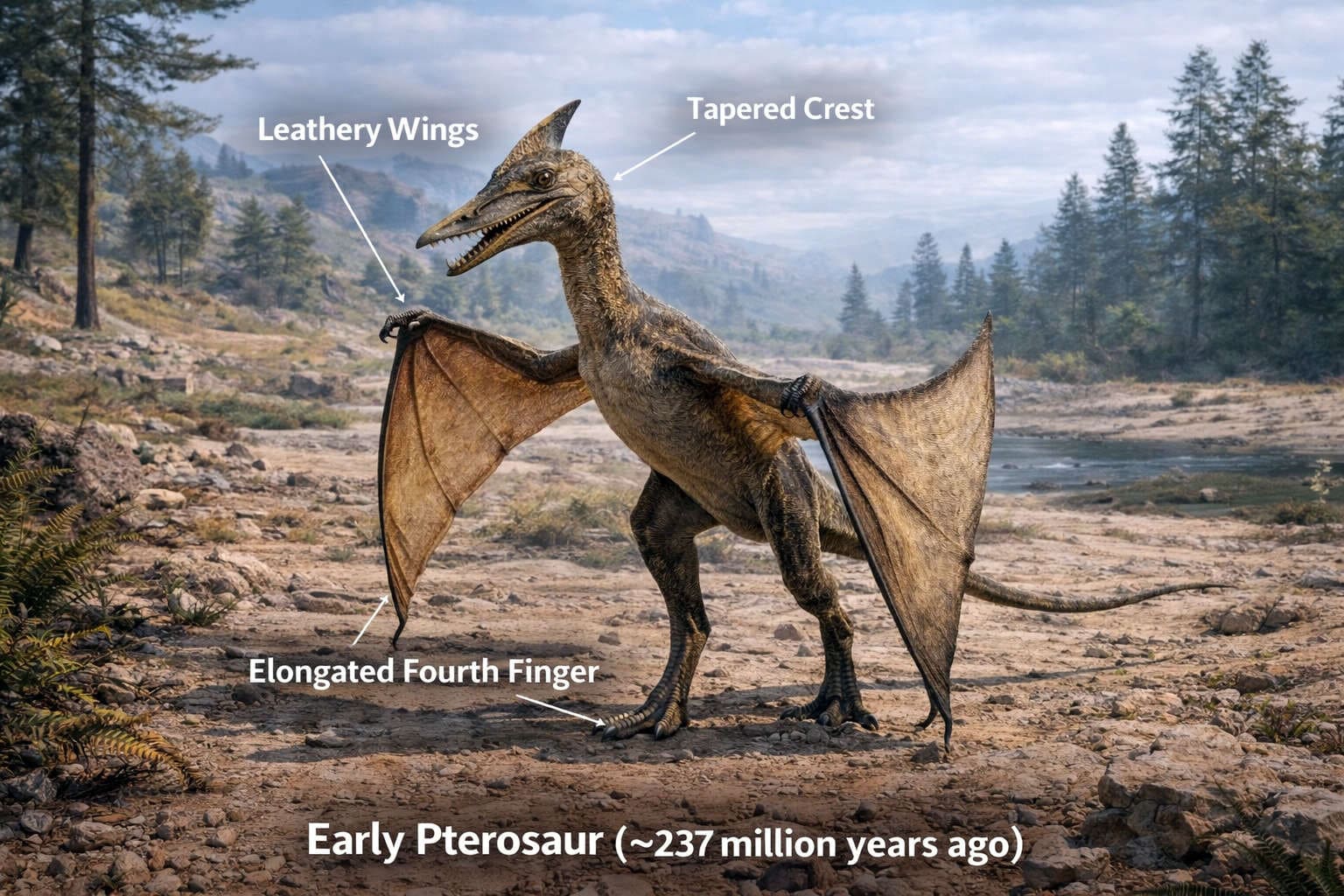
Pterosaurs were the first vertebrates to conquer the air, evolving a unique "finger-wing" anatomy that allowed them to dominate the skies for 160 million years.

Pterosaurs Diverge From Dinosaur Ancestors (within Ornithodira)

~237 million years ago (+/- 2 million)
Pterosauria line: Not in dinosauria (split first).

While they lived alongside the dinosaurs, pterosaurs were a distinct evolutionary experiment that mastered the air long before the first bird took flight. They emerged from the Ornithodira, a major branch of the archosaur family tree that also produced the dinosaurs. This divergence created two sister groups: one destined to dominate the land, and the other—the pterosaurs—destined to conquer the vertical frontier. They were the first vertebrates to achieve true powered flight, evolving a biological architecture unlike anything seen before or since.

The defining feature of the pterosaur was a wing membrane (patagium) supported by an incredibly elongated fourth finger. Unlike the feathered wings of birds or the hand-wings of bats, the pterosaur wing was a sophisticated structural sail made of skin, muscle, and reinforcing fibers. To stay airborne, they evolved ultralight, hollow bones—some with walls as thin as a playing card—and a specialized respiratory system that pumped oxygen with high efficiency. From the sparrow-sized Anurognathus to the giraffe-tall Quetzalcoatlus, their bodies were fine-tuned for a life of soaring, skimming, and high-speed aerial maneuvers.

The legacy of the pterosaurs is one of supreme aerial dominance that lasted for over 160 million years. They filled every conceivable niche, from coastal fish-eaters to inland scavengers, and developed elaborate bony crests likely used for display and temperature regulation. Though they vanished entirely during the K-Pg mass extinction, leaving no living descendants, they remain a testament to the versatility of the archosaurian line. They proved that the “ruling reptiles” were not merely earth-bound giants, but were capable of transcending the terrestrial world to own the very air itself.

— map / TST —

Michael Alan Prestwood
Author & Natural Philosopher
Prestwood writes on science-first philosophy, with particular attention to the convergence of disciplines. Drawing on his TST Framework, his work emphasizes rational inquiry grounded in empirical observation while engaging questions at the edges of established knowledge. With TouchstoneTruth positioned as a living touchstone, this work aims to contribute reliable, evolving analysis in an emerging AI era where the credibility of information is increasingly contested.
Email
Print
This Week @ TST
April 8, 2026
»Column Archive
WWB Research….
1. Story of the Week
Pragmatism
2. Quote of the Week
“Our statements about the external world face the tribunal of sense experience not individually, but only as a corporate body.”
3. Science FAQ »
Why do scientific models work if they aren’t literally true?
4. Philosophy FAQ »
Is agnosticism a ludicrous position to occupy?
5. Critical Thinking FAQ »
Do my people and culture help or harm my critical thinking?
6. History FAQ!
Did Berger and Luckmann really say reality is just made up?
Bonus Deep-Dive Article
TST Doxastic Formation: Public Belief, Tribe, and Worldview
Scroll to Top