

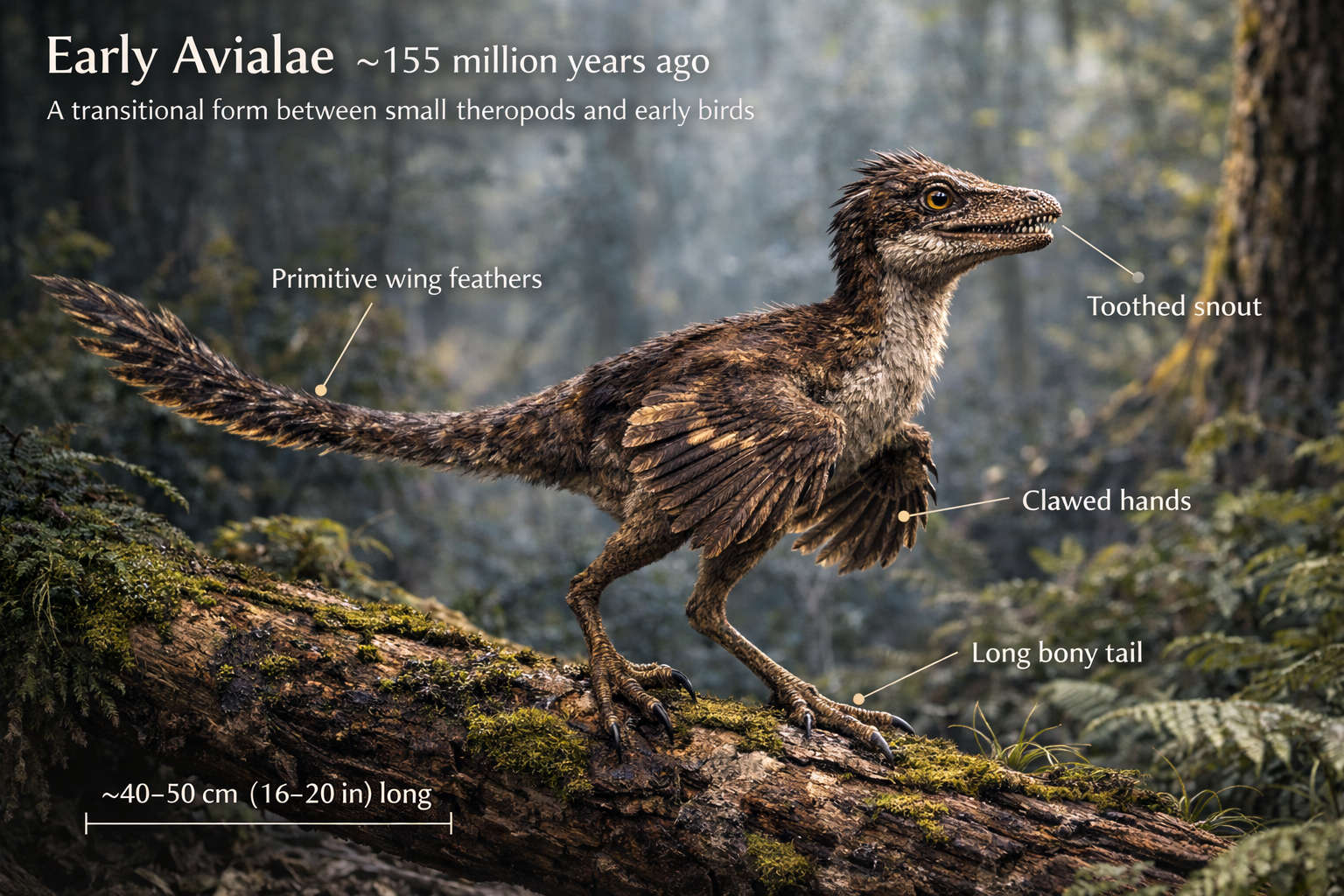
From within the therapods, birds emerged about 155 million years ago. These early birds still had teeth, a tail, and claws on their wings, but they were feathered.
Although the exact early avialan boundary is famously messy, we do know birds evolved from theropods. After the “Great Divide” of dinosaur classification into lizard hipped and bird hipped, it was the lizard hipped branch that gave rise to birds. The accidentally miss-labeled bird-hipped dinosaurs includes Stegosaurus, Ankylosaurus, and Triceratops, as well as the duck-billed dinosaurs. The bird-hipped dinosaurs are Ornithischia. The Ornithischia split into the armed dinosaurs called Thyreophorans, the duck-billed dinosaurs called Ornithopods, and the domed and horned ones called Marginocephalians.
Meanwhile, the lizard-hipped dinosaurs of the Saurischia branch, split into the Theropods and Sauropodomorphs. The Sauropodomorphs are the massive, quadrupedal herbivores with long necks and tails, such as the Brachiosaurus and Diplodocus. The Theropods are the terrifying bipedal carnivores such as the Tyrannosaurus rex, Velociraptor, and every bird that has ever existed. Birds emerged from a specific subgroup of small, feathered maniraptoran theropods.
Of interest, birds are not part of the pterosaur line. Pterosaurs were not even dinosaurs, they stemmed from a much earlier flying reptile branch.
A bird from about 155 million years ago would likely have looked broadly Archaeopteryx-like, but not in the polished way popular art often suggests. It would still have been very much a small feathered theropod: long-tailed, toothed, clawed, and only partly birdlike in overall impression. In other words, if it truly belonged on the avialan branch, it was probably already close to that classic transitional look, because Archaeopteryx itself was not yet a fully modern bird but a remarkably dinosaurian one, with feathers layered onto a body plan that still retained many ancestral theropod traits.
About 6 million years after this, the world of Archaeopteryx appears more clearly in the fossil record. By then, the outline of the bird story is easier to see: feathered forelimbs are more visibly functioning as wings, the body is more balanced for aerial maneuvering, and the ancient dinosaur frame is beginning to read, at a glance, like the first true bird experiment. Yet even there, the future is only beginning. The beak is not yet modern, the tail is still long, the claws are still prominent, and the age of birds has barely lifted off.

