

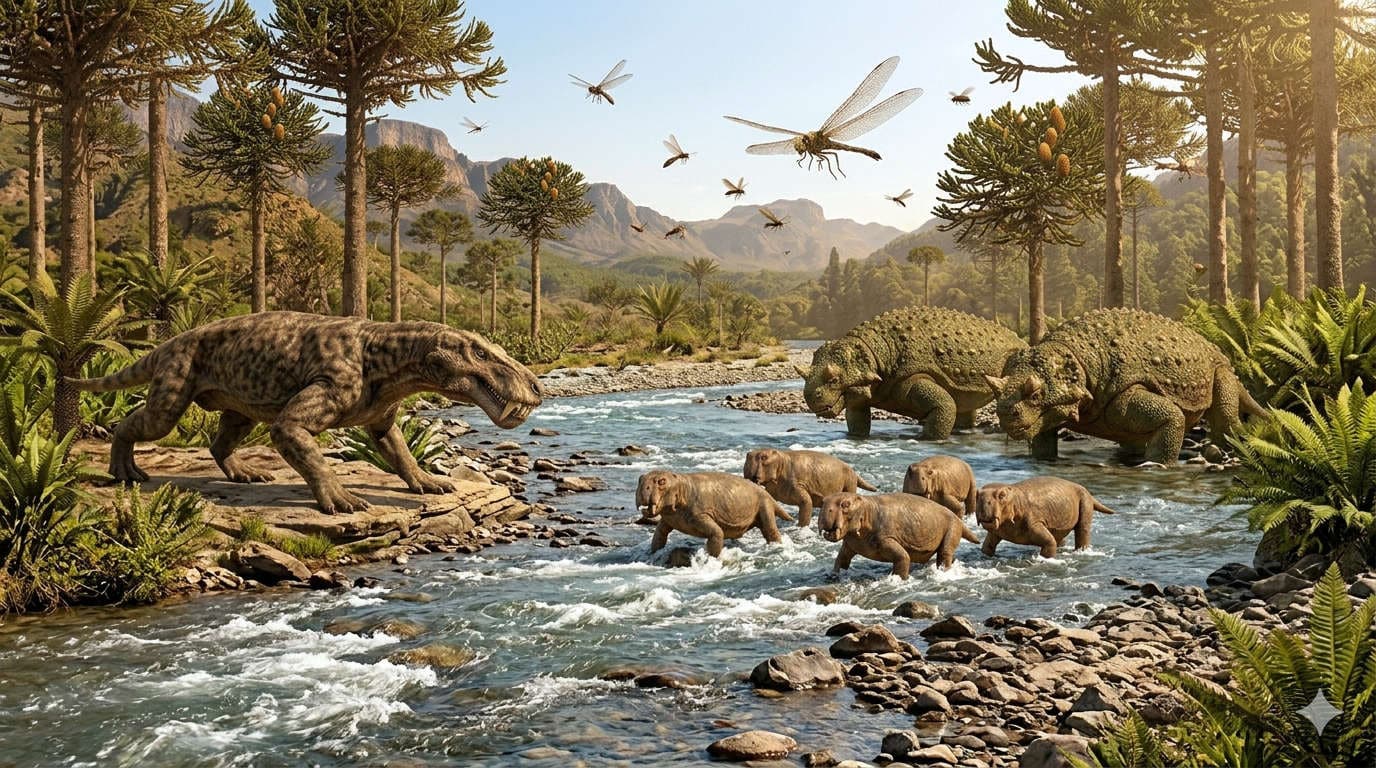
Around 255 million years ago, the land was ruled not by dinosaurs, but by synapsids. This was the age of gorgonopsids, dicynodonts, and many other mammal-line animals that dominated Late Permian ecosystems. Gorgonopsids were among the top predators, with long saber-like teeth and powerful bodies built for hunting large prey. Dicynodonts were among the most successful herbivores, often tusked and beaked, and they spread across huge parts of the world. In a real sense, this was a world where the ancestors of mammals, not the ancestors of dinosaurs, held center stage.
But the Late Permian was not just a synapsid story. Other lines were everywhere. Large pareiasaurs lumbered through the landscape as heavily built reptilian herbivores. Amphibians still thrived, especially in wetter habitats along rivers, lakes, and floodplains. Large insects buzzed through the air, though not the giant dragonflies of the much earlier Carboniferous at their peak. Plant life looked different too. There was no grass-covered world yet. Instead, the land was shaped by seed ferns such as Glossopteris, conifer-like trees, horsetails, ferns, and other hardy plants suited to a warm, often seasonal climate. It was a rich world, but one with a very different cast of life than what most people picture when they think of ancient Earth.
What makes this world especially fascinating is how much of the familiar future was still missing. True mammals had not yet appeared. Dinosaurs were still in the future. Birds were far beyond the horizon. Grass had not yet evolved, and neither had flowering plants, so there were no meadows, no flowers, and no bird-filled skies. The Late Permian was a kind of before-time for the modern world: a planet full of successful, complex life, but built on older evolutionary experiments. Then came the end-Permian extinction, and after that catastrophe, the world would reset. Out of that long recovery would eventually come the first true mammals, the rise of dinosaurs, and much later still, the birdsong and grassy fields we know today.

