

The 5-million-year-old great white swims in a body design already recognizable 300 million years ago. Around 300 million years ago, in the late Carboniferous to early Permian, the lineage that would give rise to all modern sharks was already swimming through Earth’s oceans. The fossil record points to early “stem selachians” — shark-like fish such as Cladoselache — as close approximations of the last common ancestor (LCA) of living sharks. While we cannot identify the exact species that sits at the branching point, fossils from this time capture the body plan that unites all sharks today: cartilaginous skeletons, replaceable teeth, paired fins, and streamlined forms built for predation.
STORY
Stem Selachians: Modern Sharks LCA
☐ Read
☑ Read
You’ve read this 0 times.
You’ve listened to this 0 times.
By Michael Alan Prestwood
Thu 19 Feb 2026
Published 8 months ago.
Updated 5 months ago.
Share :
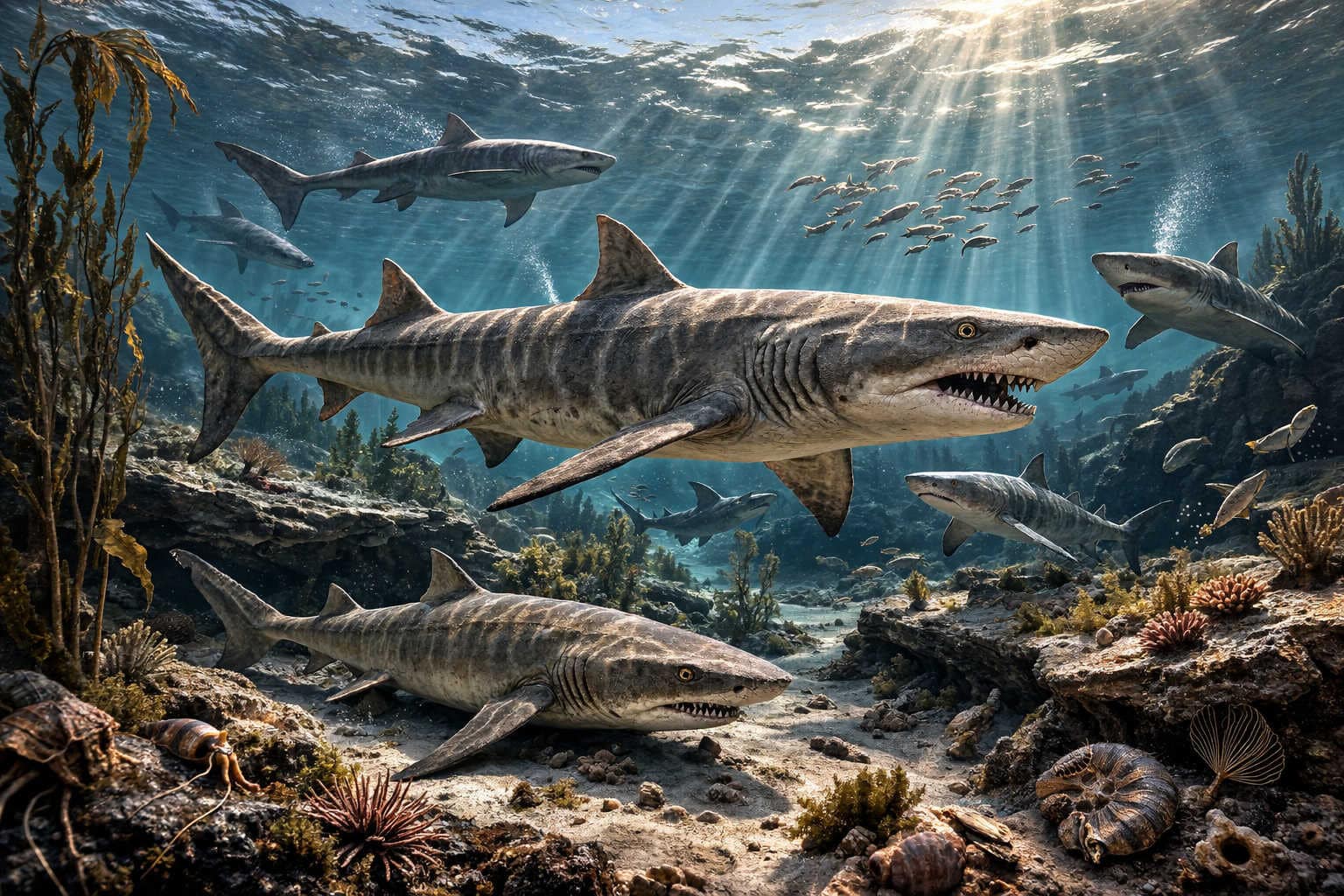
Stem Selachians: Modern Sharks LCA
~300 million years ago (± 10 million years)
- < 1 minute read
Annotated References:
This was long before dinosaurs. Forests of giant ferns covered the continents, and amphibians ruled the wetlands. In the seas, early sharks were already experimenting with hydrodynamic efficiency. Unlike many bony fish, their skeletons were made of cartilage — lighter, flexible, and surprisingly durable. That design would prove evolutionary gold.
What makes this lineage remarkable is not rapid change, but stability. Over hundreds of millions of years — through mass extinctions that wiped out most marine life — sharks persisted. Their form was already efficient. Natural selection had little reason to reinvent it.
When we look at a modern great white or hammerhead, we are not seeing a “primitive” creature. We are seeing a design that worked so well 300 million years ago that evolution mostly left it alone.
Sharks are not living fossils in the strict sense — they have diversified dramatically — but their shared ancestry reaches deep into Paleozoic oceans. The shark body plan is one of evolution’s enduring masterpieces.

Michael Alan Prestwood
Author & Natural Philosopher
Author & Natural Philosopher
Prestwood writes on science-first philosophy, with particular attention to the convergence of disciplines. Drawing on his TST Framework, his work emphasizes rational inquiry grounded in empirical observation while engaging questions at the edges of established knowledge. With TouchstoneTruth positioned as a living touchstone, this work aims to contribute reliable, evolving analysis in an emerging AI era where the credibility of information is increasingly contested.
Email
Print
The Prestwood Column
Menu
October 2026
»COLUMN ARCHIVE
--COLUMN--
Column Research….
NEW BOOK! NOW AVAILABLE!!
30 Philosophers: A New Look at Timeless Ideas
by Michael Alan Prestwood
