
Explore Natural Philosophy

Phil • Cr. Think • Science • Hist •

FAQ

Is secular spirituality supported in history and science?

Mon 1 Jun 2026
Published 2 months ago.
Updated 2 weeks ago.
Related FAQs
What is Eastern “chee,” or qi?
Why do intelligent people defend bad ideas?
Who was the first female philosopher?
Why do people confuse explanations with reality?
What is Ontology and why is it important?
What is TST Ethics?
Share :
Email
Print

Is secular spirituality supported in history and science?

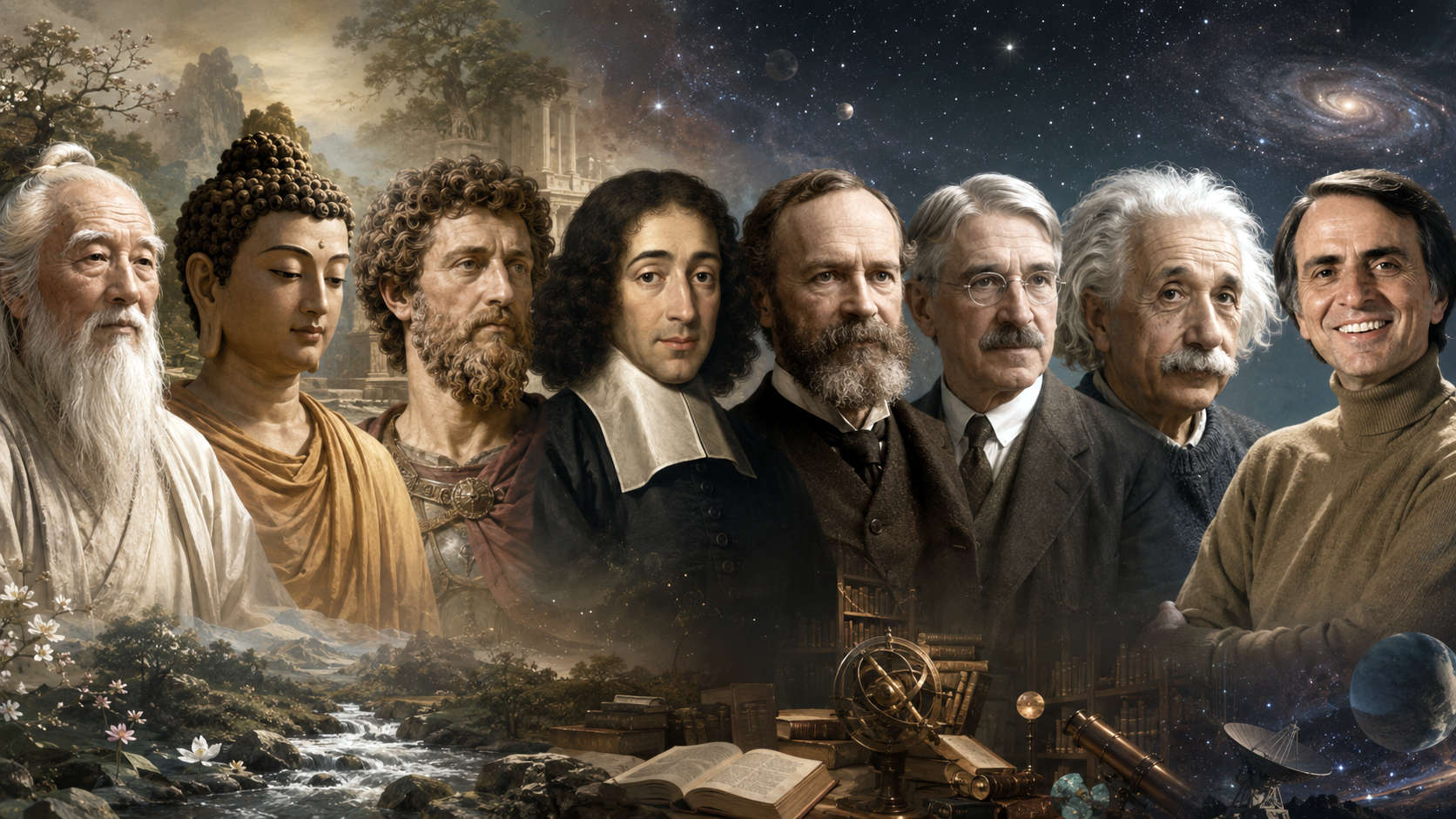
Yes. Secular spirituality sits in a long tradition: Laozi found reverence with alignment in the way of nature, the Buddha in disciplined experience focused on this realm, the Stoics refined strict alignment with reality, Spinoza found spirituality in nature itself, James and Dewey in lived human transformation and being, and Einstein and Sagan in cosmic awe grounded in scientific observations.

In ancient thought, secular spirituality shows up again and again. Laozi pointed toward the Dao, the deep way of nature that words can never fully capture. The Buddha focused on suffering, impermanence, and disciplined inner practice. The Stoics taught people to live according to nature, accept what they cannot control, and shape what they can. These are not lab sciences, but they are deeply rooted in the observation of life, mind, and nature.

In modern thought, the same thread continues. Spinoza found sacredness in nature itself rather than in a supernatural ruler outside it. William James studied spiritual experience as lived human experience. John Dewey separated religious institutions from the deeper “religious” quality of devotion, purpose, and moral seriousness. Einstein and Sagan talked openly about how science-first spirituality deepens awe.

So yes, secular spirituality is supported across history. Many serious thinkers chose not to ignore human experience, nature, mystery, or our limits. Science-first spirituality does not mock belief or drain life of wonder. It simply lets reality push back. It honors awe without pretending to know what it does not know.
— map / TST —

Deep-Dive Article: Historical lineup for Secular Spirituality
From Laozi to Spinoza, Einstein, and Sagan, many find awe not by escaping nature, but by entering it more deeply. True spirituality lies in the depths of reality. And it all starts with reverence for the world we actually share.
Michael Alan Prestwood
Author & Natural Philosopher
Prestwood writes on science-first philosophy, with particular attention to the convergence of disciplines. Drawing on his TST Framework, his work emphasizes rational inquiry grounded in empirical observation while engaging questions at the edges of established knowledge. With TouchstoneTruth positioned as a living touchstone, this work aims to contribute reliable, evolving analysis in an emerging AI era where the credibility of information is increasingly contested.
The Prestwood Column
Menu
July 2026
»COLUMN ARCHIVE
--COLUMN--
Column Research….
1. Timeline Story
The famous Lewis “Truth in Fiction” Paper
2. Linked Quote
“Truth is stranger than fiction…[which] is obliged to stick to possibilities;”
3. Science FAQ »
Why does fiction feel real?
4. Philosophy FAQ »
Can authors create fiction beyond our universe?
5. Critical Thinking FAQ »
How do we know what is true in a fictional world?
6. History FAQ!
What is the history of philosophy of fiction?
Bonus Deep-Dive Article
TST Philosophy of Fiction: Imaginative Realism

Comments

Join the Conversation! Currently logged out.
NEW BOOK! NOW AVAILABLE!!

30 Philosophers: A New Look at Timeless Ideas

by Michael Alan Prestwood
The story of the history of our best ideas!
Scroll to Top