
Explore Natural Philosophy

Phil • Cr. Think • Science • Hist •

STORY

LECA: Likely Sexual Reproduction

By Michael Alan Prestwood

Sun 22 Feb 2026
Published 5 months ago.
Updated 2 days ago.
Related Stories
Long-Term Memory Evolves: Tiktaalik
The Senegal Bichir: A Living Fossil
Mold Spores Emerge
Archosauria Diverge Within Reptiles
Bird-line Archosaurs: Asilisaurus kongwe (within Ornithodira)
Bird-line Archosaur: Nyasasaurus parringtoni
Share :
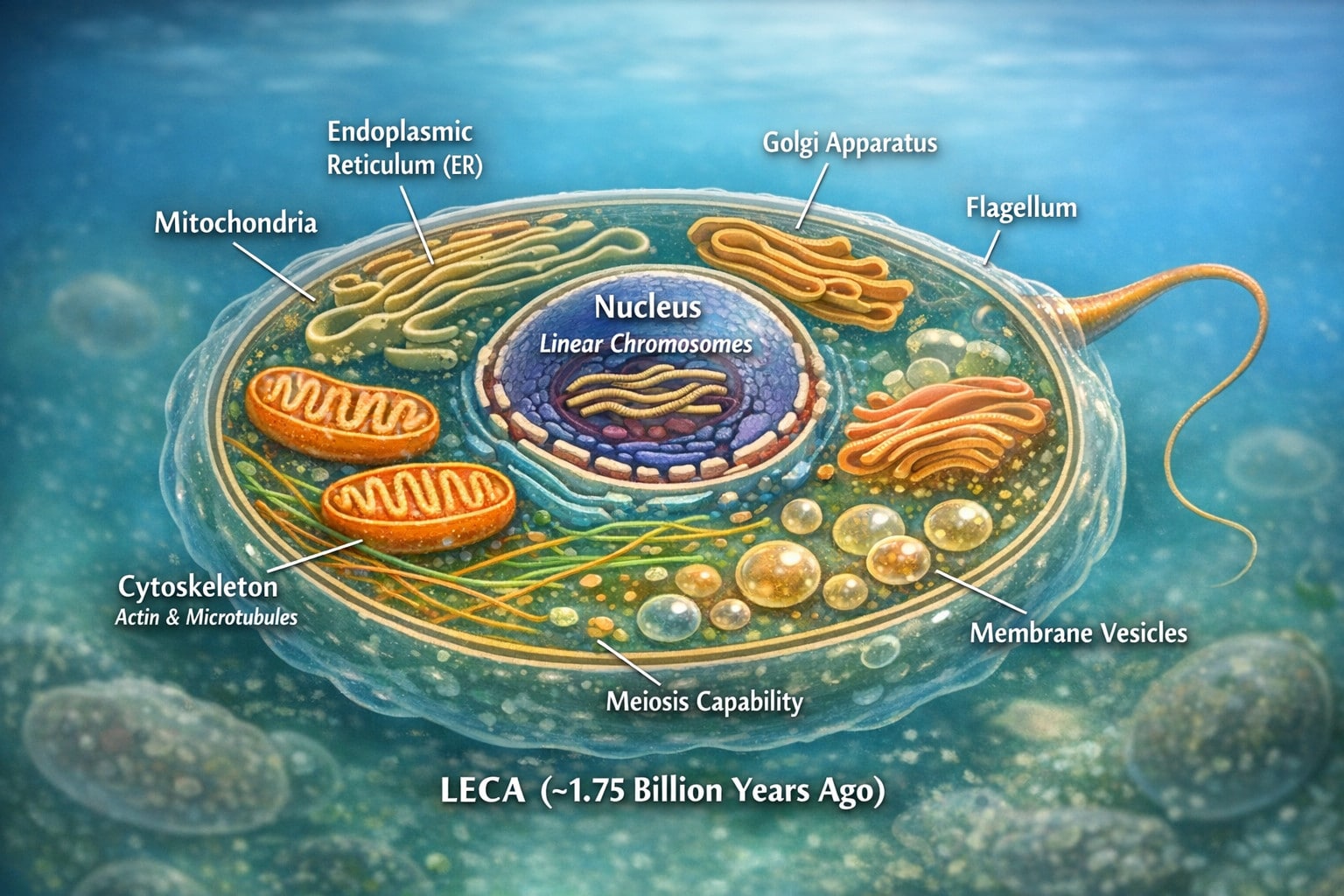
LECA is the Last Eukaryotic Common Ancestor. LECA reproduced sexually pushing the mixing of DNA back before 1.75 billion years ago.

LECA: Likely Sexual Reproduction

~1.75 billion years ago (+/- 50 million)
Last Eukaryote Common Ancestor

Every animal begins with a partnership between two single cells — and from that tiny union comes a body, a mind, and a life.

Eukaryotes are the plants, fungi, and animal direct-line common ancestor. That’s what makes Eukaryotes so special when studying modern life. We even have their single-celled descendants in protists today!

LECA is the name for the Last Eukaryotic Common Ancestor. That’s the ancestral population from which all modern eukaryotes descended. And this is the group that includes sexual reproduction. This is when and where the core machinery evolved. This is a time long ago:  1.75 billion years ago. We know because of the meiotic genes across widely separated groups, including red algae, green plants, fungi, and animals. This is when their shared ability to recombine and reshuffle DNA evolved.

Bacteria and viruses also replicate, and bacteria can exchange genetic material, but they do not reproduce through meiosis and the fusion of specialized reproductive cells. The eukaryotic sexual cycle introduced something more systematic: genetic material from compatible cells could be combined, recombined, and be passed into new lineages. This marked a major evolutionary transition from copying DNA to reshuffling it.

These early sexual systems were not divided into male and female. There were, and are, many more sexes than just two. Many single-celled eukaryotes used mating types, which are genetically defined compatibility groups. A species may have two mating types, but it may also have three, seven, dozens, or even thousands of compatible combinations. However, there might be a tendency for evolution to evolve toward male and female. The familiar male-female system evolved later in some lineages, especially animals and many plants.

Fish, wolves, and humans as well as many plants, all begin the same way: two tiny cells, and then the long miracle of becoming.

— map / TST —

Michael Alan Prestwood
Author & Natural Philosopher
Prestwood writes on science-first philosophy, with particular attention to the convergence of disciplines. Drawing on his TST Framework, his work emphasizes rational inquiry grounded in empirical observation while engaging questions at the edges of established knowledge. With TouchstoneTruth positioned as a living touchstone, this work aims to contribute reliable, evolving analysis in an emerging AI era where the credibility of information is increasingly contested.
Email
Print
The Prestwood Column
Menu
July 2026
»COLUMN ARCHIVE
--COLUMN--
Column Research….
1. Timeline Story
The famous Lewis “Truth in Fiction” Paper
2. Linked Quote
“Truth is stranger than fiction…[which] is obliged to stick to possibilities;”
3. Science FAQ »
Why does fiction feel real?
4. Philosophy FAQ »
Can authors create fiction beyond our universe?
5. Critical Thinking FAQ »
How do we know what is true in a fictional world?
6. History FAQ!
What is the history of philosophy of fiction?
Bonus Deep-Dive Article
TST Philosophy of Fiction: Imaginative Realism

Comments

Join the Conversation! Currently logged out.

Leave a Reply

NEW BOOK! NOW AVAILABLE!!

30 Philosophers: A New Look at Timeless Ideas

by Michael Alan Prestwood
The story of the history of our best ideas!
Scroll to Top