

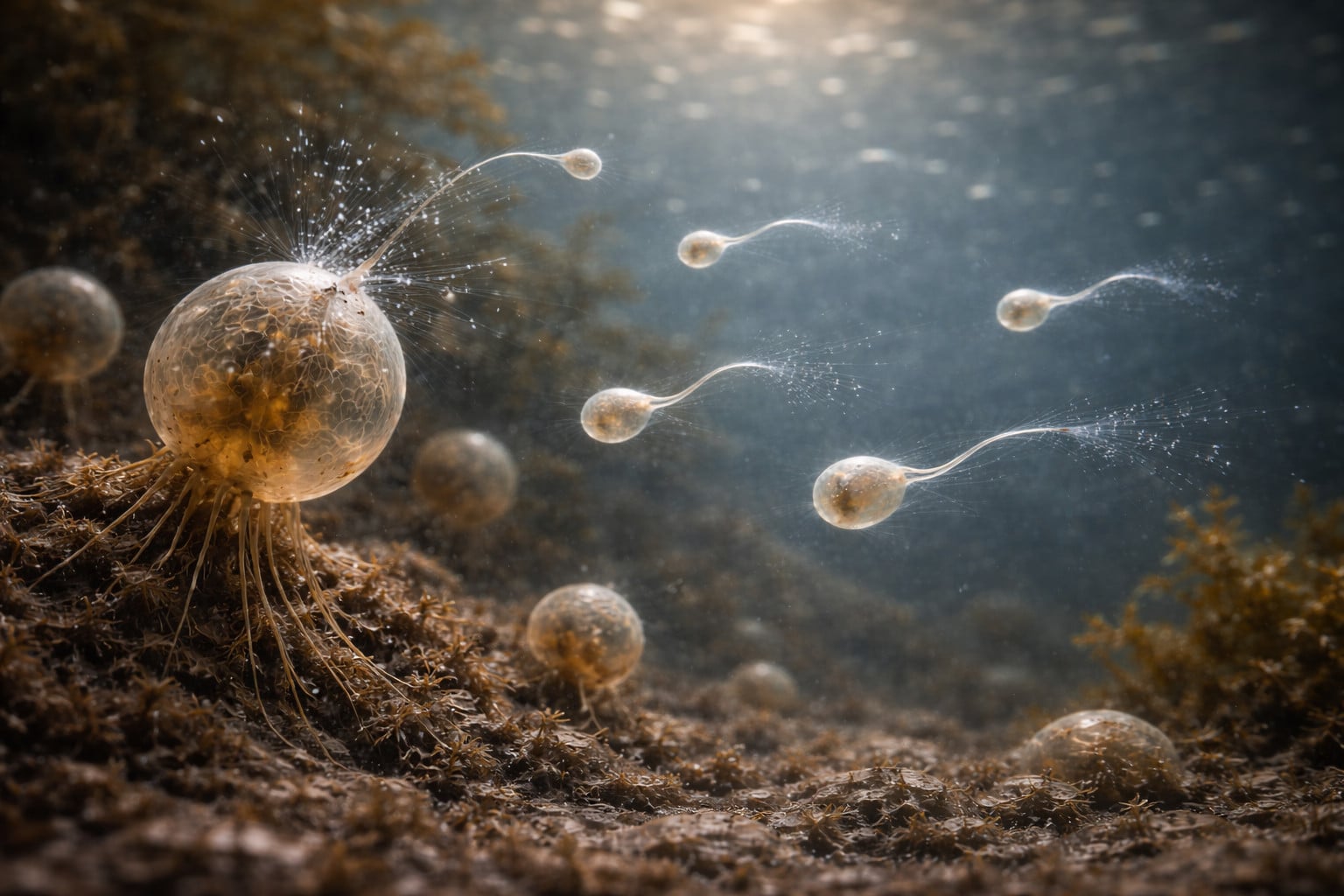
There is one group of “primitive” fungi called Chytrids (Chytridiomycota) that still lives in water or moist soil. They are the only fungi that still have the posterior flagellum. Their spores, called zoospores, actually swim exactly like human sperm cells to find new food sources.
The “tail” on a human sperm cell is literally the same posterior flagellum from our Opisthokont ancestors. It hasn’t changed its basic design in over a billion years.
The Unicellular Swimmers: In their simplest form, these chytrids live a lifestyle remarkably similar to human sperm. They begin as zoospores, tiny independent cells that use a single rear-mounted flagellum to “push” themselves through films of water or moist soil. Once this microscopic scout finds a suitable food source—like a piece of pollen or a dead leaf—it undergoes a dramatic transformation: it reabsorbs its tail, settles down, and grows into a stationary, bulbous “eating” cell called a thallus. At this stage, the flagellum is gone, but it has already fulfilled its mission as the primary engine of discovery.
The Anchored Explorers: The “almost” multicellular chytrids take the single-cell blueprint and add a structural upgrade. While they still start life as swimming zoospores driven by that signature posterior motor, their stationary phase is more ambitious. Upon settling, they grow thin, root-like filaments called rhizoids. These aren’t true multi-cell tissues, but rather extensions of the main cell that allow the fungus to anchor itself firmly. Even though the “tail” is lost during settlement, the energy gained through these rhizoids eventually powers the creation of a new generation of swimming, flagellated spores to continue the cycle.
The Web-Like Giants: The most advanced chytrids hint at the future of all “higher” fungi by forming a mycelium, a branching network of thread-like structures. These are essentially “super-cells”; they lack the internal walls (septa) found in mushrooms, allowing nutrients to flow freely through one continuous, web-like body. Even at this massive scale, the ghost of the posterior flagellum remains: when it comes time to reproduce, this large network concentrates its resources to pump out thousands of tiny, “push-motor” zoospores. It is the last time in fungal history we see a large, complex body still relying on an ancient swimming tail to spread its offspring.

