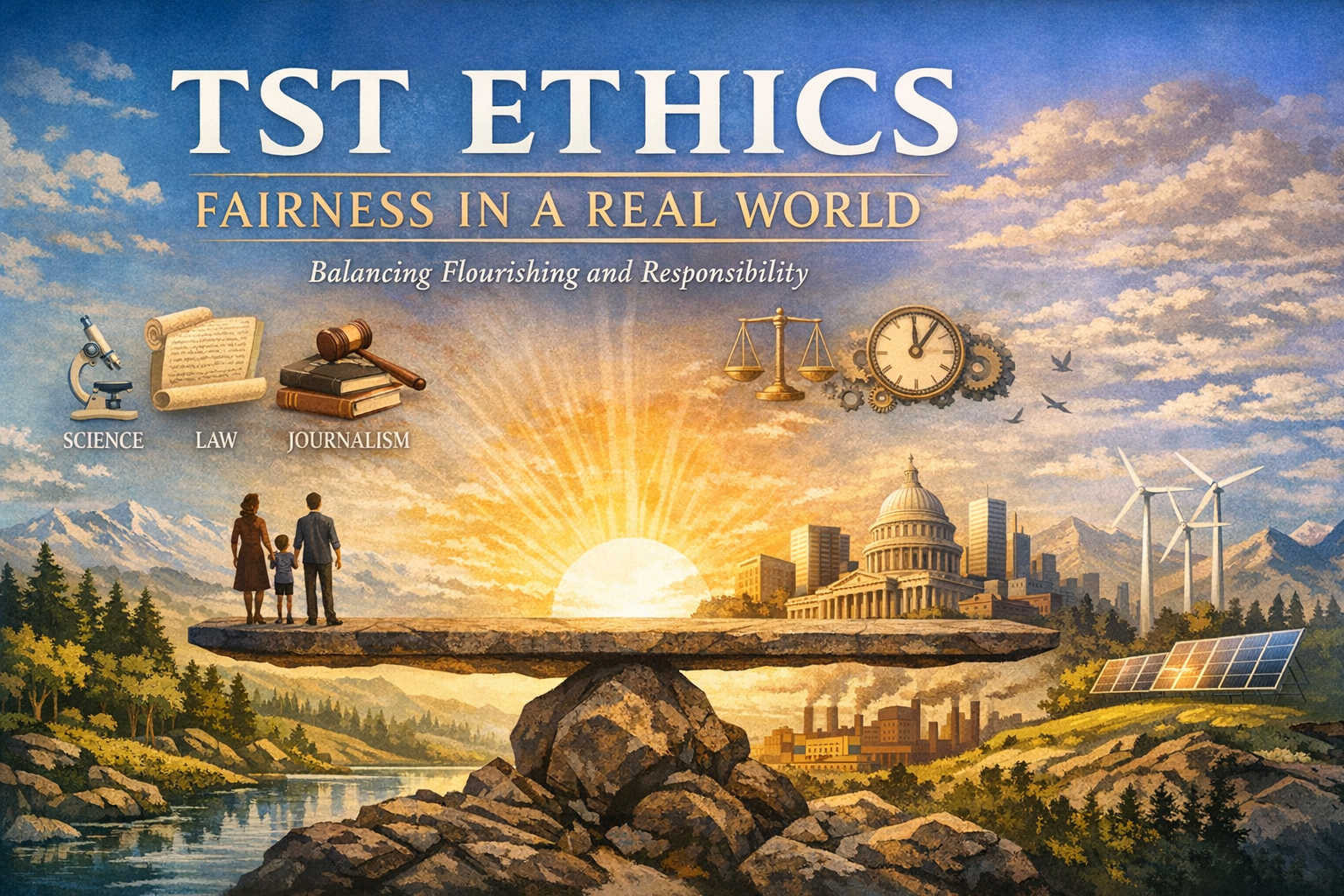
Science cannot prove that flourishing ought to be our goal, at least not by itself. Hume was right about that. Science describes what is. It can tell us what keeps bodies healthy, what damages minds, what strengthens relationships, what destabilizes societies, and what conditions help people function well. But the step from “this helps humans flourish” to “therefore humans ought to flourish” still requires a value judgment. That value does not come secretly from science. We have to state it.
In TST Philosophy, the normative aim is explicit:
flourishing.
Once we say that out loud, science becomes enormously useful. It can measure the difference between health and disease, resilience and breakdown, connection and isolation, stability and collapse. It can study purpose, relationships, autonomy, mental health, physical health, and the conditions that help people live better. Science cannot choose the destination for us, but once the destination is chosen, it can tell us a great deal about whether we are actually moving toward it.
This also keeps us from turning biology into morality. Evolution does not command us to be good. Nature includes cooperation, but it also includes competition, deception, parasitism, and destruction. Survival alone is not flourishing either. A person can survive for decades while living in fear, misery, or isolation. So the argument is not that nature itself whispers,
“You ought to flourish.”
The argument is that flourishing is a rationally chosen ethical aim that can then be tested against the reality in which we actually live.
That gives science a powerful but disciplined role. Philosophy states the ought: flourish. Ethics gives us principles and a process for acting toward it. Science helps us figure out what actually works. Then reality pushes back.