
Explore Science-first Philosophy

STORY

Snowball Earth: When Ice Reached the Equator

By Michael Alan Prestwood

Mon 13 Apr 2026
Published 1 day ago.
Updated 1 day ago.
Related Stories
Mesozoic Era: Age of Dinosaurs
Opposable Thumb Emerges
Diplodocid LCA: The Age of Giant Necked Sauropods
Internal Fluid Transport in Early Animals
Archosauria Diverge Within Reptiles
Bird-line Archosaur: Nyasasaurus parringtoni
Share :
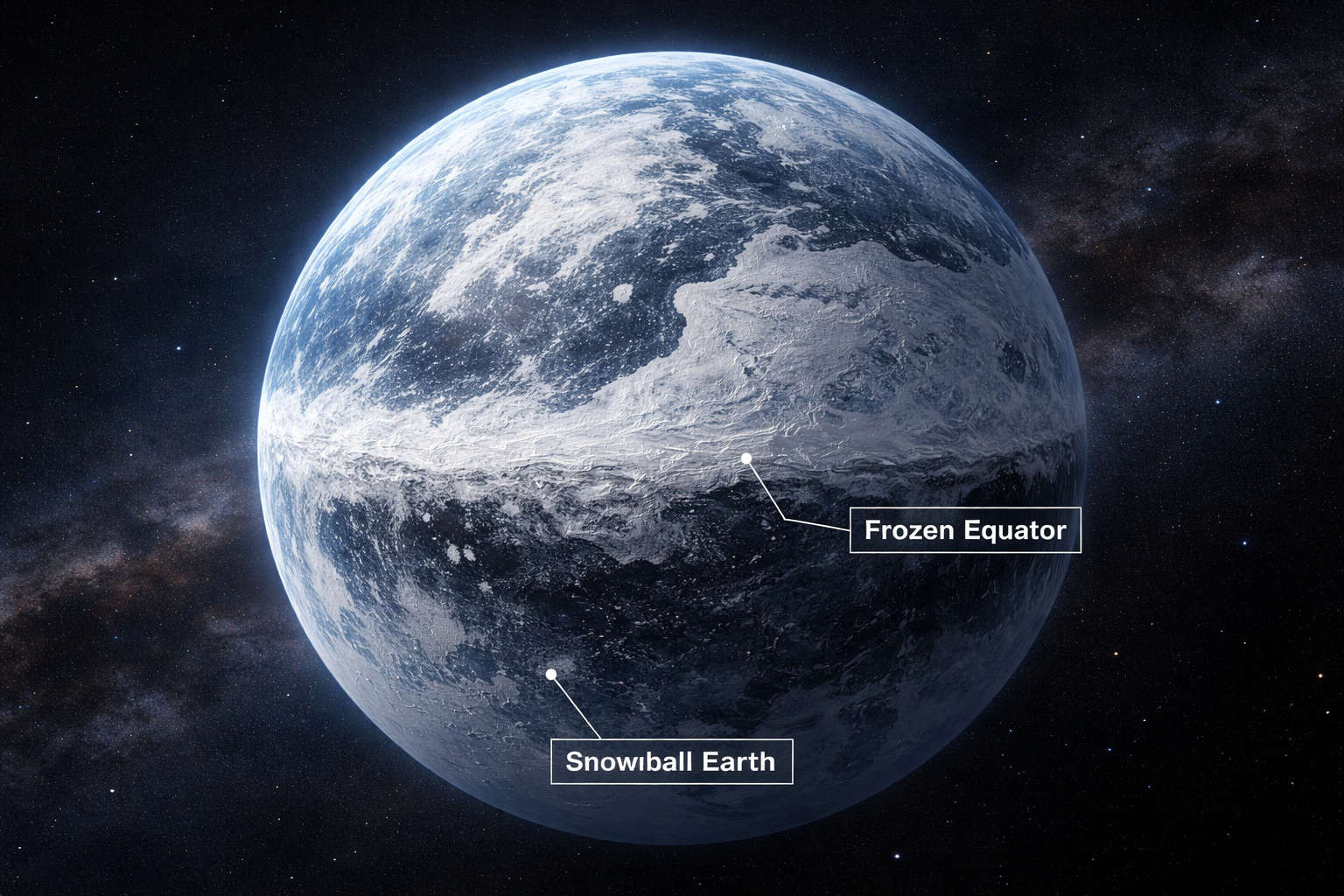
For tens of millions of years, Earth plunged into its deepest known freeze. Ice sheets reached sea level at low latitudes, perhaps even the equator, turning the planet into a near-global ice world and reshaping the path toward complex life.

Snowball Earth: When Ice Reached the Equator

From 717 million years ago through 635.
Cause: Continental Drift, Falling CO₂

Before Snowball Earth, before about 717 million years ago, Earth was already changing in big ways. The supercontinent Rodinia was breaking apart. Volcanic activity exposed vast stretches of fresh rock, and as that rock weathered, it pulled carbon dioxide from the atmosphere. With less greenhouse warming, the planet became more vulnerable to a runaway freeze. Life was still mostly microbial, along with simple eukaryotes, but the groundwork for later complexity was already quietly taking shape.

Then came the deep freeze. During the Cryogenian, Earth endured two immense glaciations: the Sturtian and the Marinoan. Geological evidence shows ice-related deposits formed at very low latitudes, strongly suggesting that ice reached close to the equator. Some researchers still debate whether Earth became a hard “Snowball” or a softer “Slushball,” but either way, it was one of the most extreme climate crises in the history of our planet.

When the ice finally retreated, Earth entered the Ediacaran world. The post-glacial planet was different. Its oceans, chemistry, and ecosystems had been shaken hard. Many researchers think these brutal Cryogenian conditions, along with the refuges life found during the freeze, helped drive a burst of evolutionary experimentation. Not long after, the fossil record begins to show a wider expansion of multicellular life, making Snowball Earth one of the great turning points in the long story of animals.

— map / TST —

Michael Alan Prestwood
Author & Natural Philosopher
Prestwood writes on science-first philosophy, with particular attention to the convergence of disciplines. Drawing on his TST Framework, his work emphasizes rational inquiry grounded in empirical observation while engaging questions at the edges of established knowledge. With TouchstoneTruth positioned as a living touchstone, this work aims to contribute reliable, evolving analysis in an emerging AI era where the credibility of information is increasingly contested.
Email
Print
This Week @ TST
April 8, 2026
»Column Archive
WWB Research….
1. Story of the Week
Pragmatism
2. Quote of the Week
“Our statements about the external world face the tribunal of sense experience not individually, but only as a corporate body.”
3. Science FAQ »
Why do scientific models work if they aren’t literally true?
4. Philosophy FAQ »
Is agnosticism a ludicrous position to occupy?
5. Critical Thinking FAQ »
Do my people and culture help or harm my critical thinking?
6. History FAQ!
Did Berger and Luckmann really say reality is just made up?
Bonus Deep-Dive Article
TST Doxastic Formation: Public Belief, Tribe, and Worldview
Scroll to Top