
Phil • Cr. Think • Science • Hist •
TST PRACTICE

The Philosophy Website

STORY

Fungi Ancestors Split Off: (aquatic Holomycota)

☐ Read
☑ Read
You’ve read this 0 times.
You’ve listened to this 0 times.

By Michael Alan Prestwood

Sun 22 Feb 2026
Published 7 months ago.
Updated 4 months ago.
Related Stories
Unikonts: Single-Motor flagella Reform
Fungal Survivors of Extinction
Triassic–Jurassic Extinction: Volcanoes Open the Age of Dinosaurs
Bacterial Endosymbiosis: Origin of Eukaryotes
LECA: Likely Sexual Reproduction
Intracellular Flow and Nutrient Exchange
Share :
By 950 million years ago, fungi ancestors used growth over motion to survive.

Fungi Ancestors Split Off: (aquatic Holomycota)

~950 Million Years Ago (+/- 50 million)
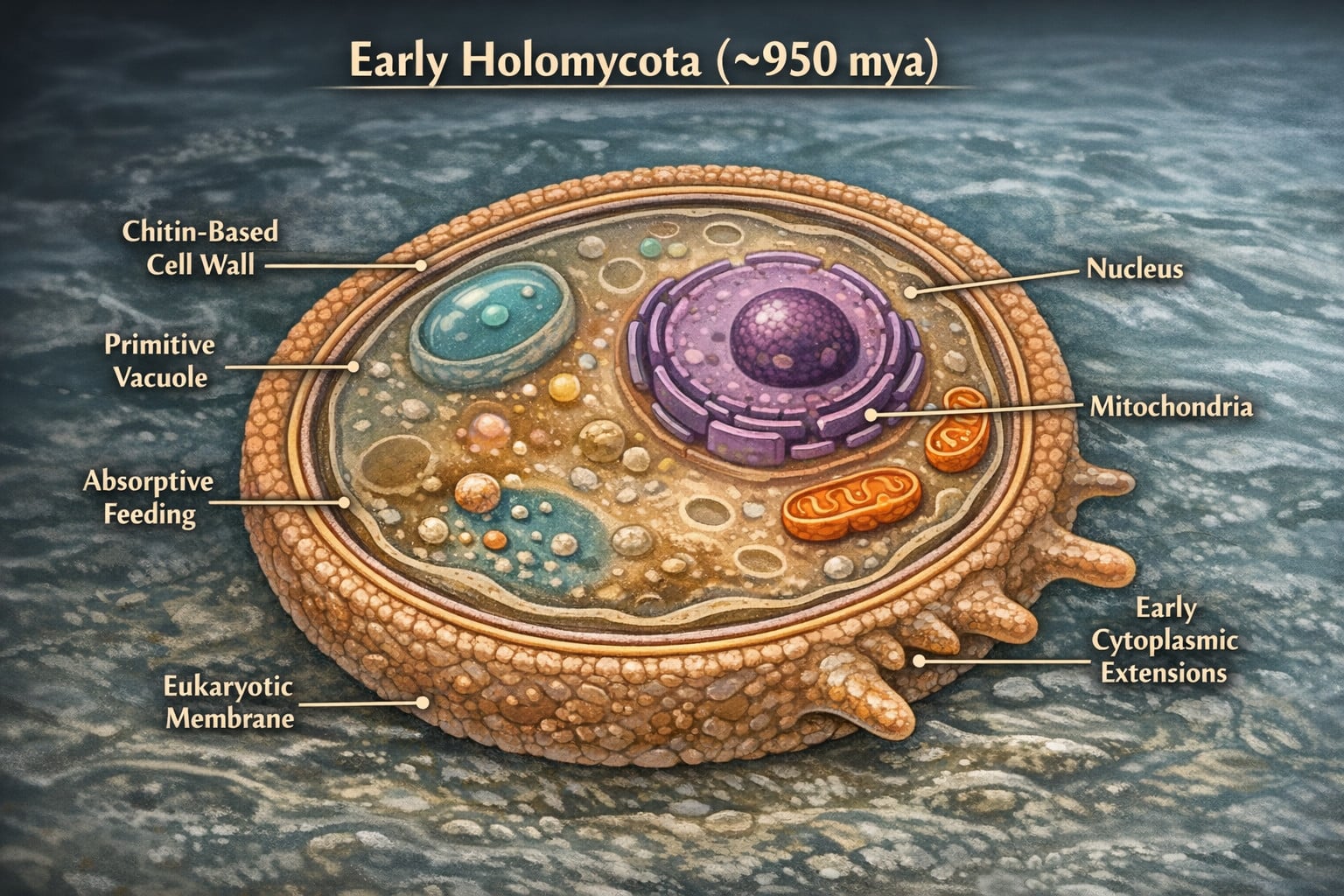
External digestion + chitin cell walls

The earliest true fungal lineages likely resembled modern chytrids. Aquatic Produced flagellated (swimming) spores Fed by external digestion (already a defining fungal trait). This is before large animals dominate land.

 As the Holomycota fungal lineage began to diverge, they increasingly relied on growth rather than motion to survive. To better exploit solid substrates, they reinforced their cells with rigid chitin. From soil, decaying matter, and eventually land itself, they extracted a material that let them push into their environment instead of swimming through it. Early-diverging fungi such as chytrids kept their “rear‑engine” flagellum to navigate thin films of water, but most fungi gradually abandoned swimming altogether. They survived by using hydraulic pressure to drive their thread‑like hyphae forward, effectively growing their way into new territory rather than motoring there.

— map / TST —

TST Tracker
✓ Reading recorded.
Michael Alan Prestwood
Author & Natural Philosopher
Prestwood writes on science-first philosophy, with particular attention to the convergence of disciplines. Drawing on his TST Framework, his work emphasizes rational inquiry grounded in empirical observation while engaging questions at the edges of established knowledge. With TouchstoneTruth positioned as a living touchstone, this work aims to contribute reliable, evolving analysis in an emerging AI era where the credibility of information is increasingly contested.
Email
Print
The Prestwood Column
Menu
September 2026
Column Research….
1. Timeline Story
Hume’s Is–Ought Problem
2. Linked Quote
“I meet with no proposition that is not connected with an ought, or an ought not.”
3. Science FAQ »
Can science prove flourishing should be our goal?
4. Philosophy FAQ »
What is the difference between a normative aim and a normative directive?
5. Critical Thinking FAQ »
Is flourishing for all just utilitarianism?
6. History FAQ!
What is the history of the idea of flourishing in philosophy?
Bonus Deep-Dive Article
Flourishing for All: The Normative Aim of TST Philosophy

Comments

Join the Conversation! Currently logged out.

Leave a Reply

NEW BOOK! NOW AVAILABLE!!

30 Philosophers: A New Look at Timeless Ideas

by Michael Alan Prestwood
The story of the history of our best ideas!
Scroll to Top