
Explore Science-first Philosophy

FAQ

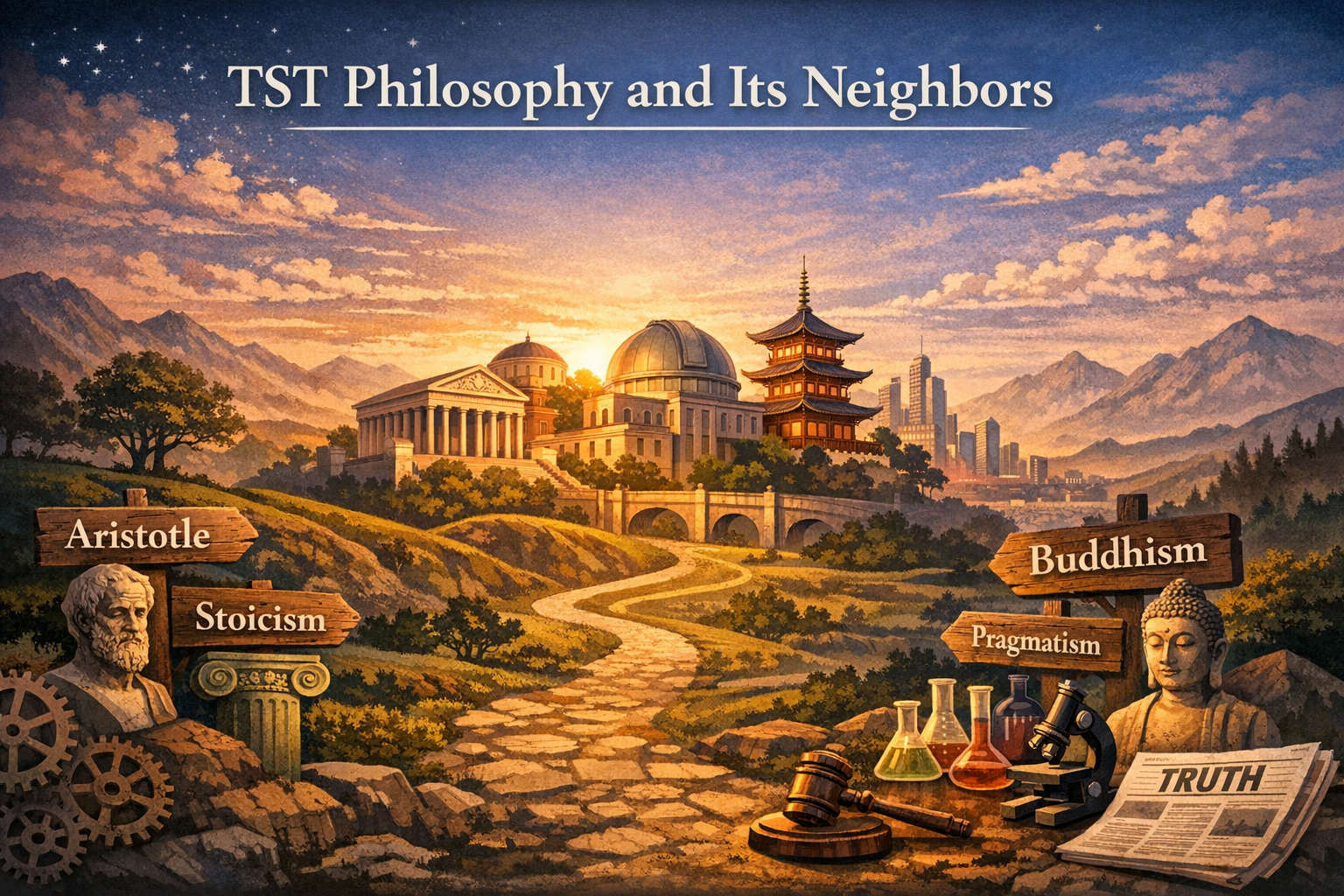
What historical ideas shaped TST Philosophy?

Wed 4 Mar 2026
Published 1 month ago.
Updated 2 weeks ago.
Related FAQs
Is the prisoner choosing bread over a key to freedom a critical thinking error?
What is Ontology and why is it important?
Did the Buddha believe in Mount Meru and the six realms of existence?
What does neuroscience say about “identity?”
Does the philosophy of Heraclitus resonate with Eastern philosophy?
Will AI systems attain consciousness?
Share :
Email
Print

What historical ideas shaped TST Philosophy?

TST Philosophy is a layered framework uniting truth, virtue, and critical thinking toward sustainable flourishing for all.

If you ask me on a random Tuesday what my philosophy is, I might say:

“I identify as an Epicurean Stoic embracing Secular Spirituality.” –30 Philosophers

That answer isn’t a slogan. It’s a breadcrumb trail. Epicureanism taught me moderation — that pleasure isn’t indulgence but intelligent cultivation. Not every desire deserves pursuit. Long-term stability beats short-term thrill. Stoicism taught me resilience — that reality doesn’t bend to my preferences. You align yourself with what is, or you suffer the friction. Character matters. Self-discipline stabilizes life. Buddhism — especially its secular forms — taught me clarity about impermanence and illusion. Life includes suffering. Attachment amplifies it. Awareness reduces unnecessary distortion. 

Those weren’t passing influences. They were structural.

Then history layered on something else. The skeptics reminded me that certainty is fragile. The empiricists insisted on testing claims against experience. The scientific revolution institutionalized humility — method over authority. By the time you get to modern philosophy of science — especially Popper — confidence becomes calibrated, not declared.

TST didn’t replace those traditions. It integrated them.

It asked:

What if pleasure and virtue are not competing goals — but components of something larger?

What if suffering, pleasure, and virtue are all variables inside a broader aim? That broader aim is flourishing. So historically, TST is not a rebellion. It’s a synthesis. Ancient ethics gave it a goal. Skepticism gave it humility. Science gave it method. Modern epistemology gave it calibration. And architecture gave it structure.

— map / TST —

Michael Alan Prestwood
Author & Natural Philosopher
Prestwood writes on science-first philosophy, with particular attention to the convergence of disciplines. Drawing on his TST Framework, his work emphasizes rational inquiry grounded in empirical observation while engaging questions at the edges of established knowledge. With TouchstoneTruth positioned as a living touchstone, this work aims to contribute reliable, evolving analysis in an emerging AI era where the credibility of information is increasingly contested.
This Week @ TST
April 8, 2026
»Column Archive
WWB Research….
1. Story of the Week
Pragmatism
2. Quote of the Week
“Our statements about the external world face the tribunal of sense experience not individually, but only as a corporate body.”
3. Science FAQ »
Why do scientific models work if they aren’t literally true?
4. Philosophy FAQ »
Is agnosticism a ludicrous position to occupy?
5. Critical Thinking FAQ »
Do my people and culture help or harm my critical thinking?
6. History FAQ!
Did Berger and Luckmann really say reality is just made up?
Bonus Deep-Dive Article
TST Doxastic Formation: Public Belief, Tribe, and Worldview

Comments

Join the Conversation! Currently logged out.
NEW BOOK! NOW AVAILABLE!!

30 Philosophers: A New Look at Timeless Ideas

by Michael Alan Prestwood
The story of the history of our best ideas!
Scroll to Top