
Phil • Cr. Think • Science • Hist • …
TST PRACTICE

By Philosopher Michael Alan Prestwood

First Synapsids

☐ Listened
☑ Listened
You’ve listened to this 0 times.
You’ve read this 0 times.
~ < 1 of audio

First Synapsids

~308 Million years ago
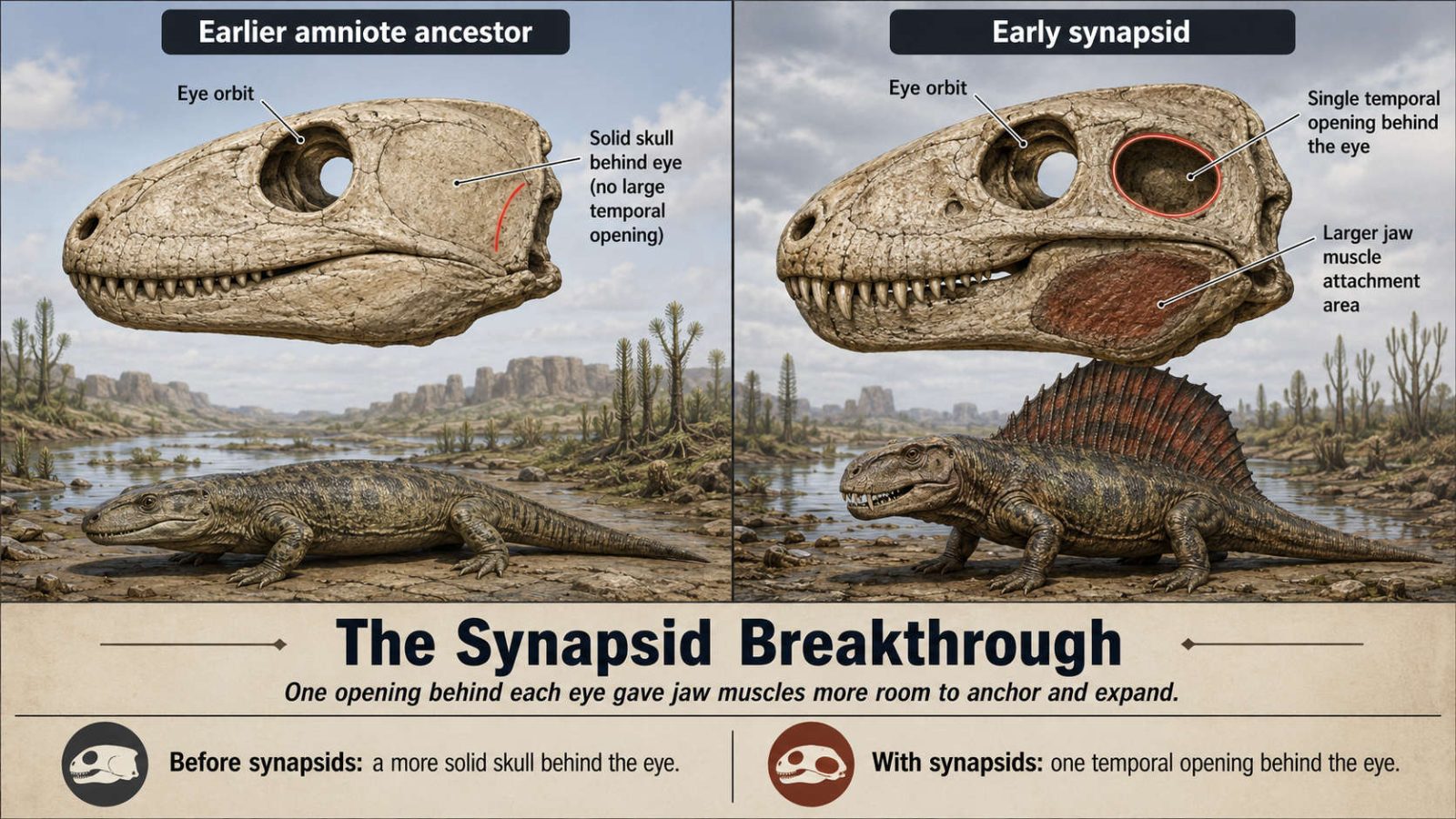
Single temporal opening behind the eye.

Echinerpeton and Archaeothyris are among the oldest known synapsids. They mark the mammal-side branch of amniotes, recognized by the single temporal opening behind the eye. UCMP frames Synapsida as a 300-million-year-old group with mammals as one surviving branch, while Archaeothyris is commonly treated as one of the oldest undisputed synapsids.

Picture in the foreground an Echinerpeton. It had a slightly more robust body and a subtle raised/back-ridge look. The Echinerpeton is an ancestor to the Dimetrodon so it had taller neural spines., but not a big Dimetrodon-style sail, yet.

In the midground, picture an animal on a log, that’s the Archaeothyris. It was smaller, lower, slimmer, and more agile. Kind of like a small, lizard-like early synapsid predator.

A common environment for these first synapsids was a swampy Carboniferous coal forest with wet ground, shallow water, giant lycopsid-like trunks, horsetail/clubmoss-style plants, and dense ferns. Giant dragonfly-like insects were around too. The environment of the synapsids was a “Coal Age forest” mood.
And now, a premium bonus.

Early synapsids looked reptile-like, but they were not on the reptile line. They were the first recognizable step on the long road toward mammals.
Subject: Mammal Evolution.
Evolution does not announce itself with a trumpet. The mammal story began quietly, in small swamp-floor animals moving through ancient forests. Their bodies still looked primitive, but their skulls held a new design. That small opening behind the eye marked a branch that would one day lead to us.

Flashcard.

What trait identifies the first synapsids?.
Answer. Single temporal opening behind the eye..


That Science Story, 

was first published on TST 5 months ago.
All story is part of the broader TST project.
Each tidbit carries its own links and citations, allowing claims to be traced back to their sources without overloading longer essays and articles.

The end!

Scroll to Top