
Weekly Insights for Thinkers

Science  Philosophy  Critical Thinking  History  Politics RW  AI  Physics  •  Evolution  Astronomy 30 Phil Book More…
Science  Phil  Cr. Thinking  History 

STORY

Population III Stars: Heavier Elements

By Michael Alan Prestwood

Author and Natural Philosopher

Mon 25 Mar 2024
Published 2 years ago.
Updated 2 years ago.
Share :
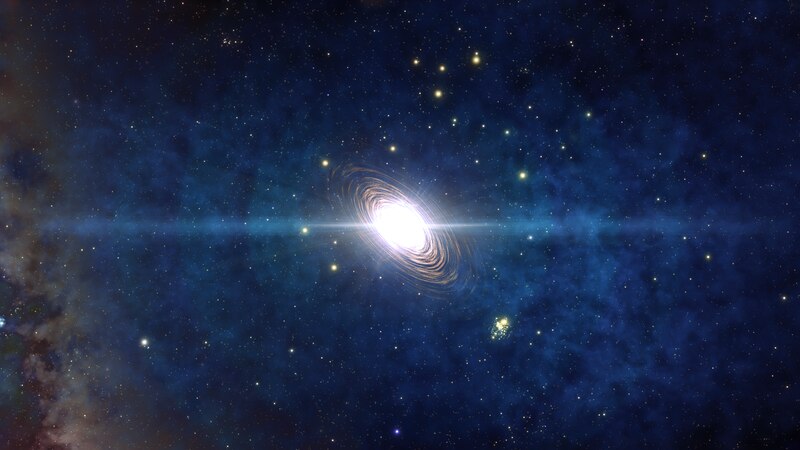
NOIRLab/NSF/AURA/J. da Silva/Spaceengine, CC BY 4.0 , via Wikimedia Commons

Population III Stars: Heavier Elements

13.6 Billion Years Ago
Verified. Empirically supported and rationally deduced.

Legacy: First 26 elements of the periodic table of elements.

After a few hundred million years, gravity continued to play its part, drawing atoms into an intimate collapse, giving birth to the very first stars and galaxies. These first stars, known as Population III stars, were stellar giants: massive, hot, and short-lived; they burned for just a few million years, likely with no planets to keep them company. None of these titans still illuminate the cosmos today. Their legacy is the creation of increasingly heavier elements, starting with carbon, nitrogen, and oxygen, and continuing up to iron with its 26 protons.

Big History Thresholds: 1=Big Bang | 2=Stars&Galaxies | 3=Chemicals | 4=Solar System | 5=First Life | 6=TI | 7=Agrarian | 8=Science

Stars Light Up: The formation of the first stars marked the second threshold. These stars forged the first heavy elements in their cores, which are essential for the creation of everything from planets to human life.

Michael Alan Prestwood
Author & Natural Philosopher

Prestwood writes on science-first philosophy, with particular attention to the convergence of disciplines. Drawing on his TST Framework, his work emphasizes rational inquiry grounded in empirical observation while engaging questions at the edges of established knowledge. With TouchstoneTruth positioned as a living touchstone, this work aims to contribute reliable analysis in an emerging AI era where the credibility of information is increasingly contested.

WWB Menu
7 Jan 2026
Essay of the Week
The Architecture of Change: Finding Stability in Flux
Story of the Week
Heraclitus
Quote of the Week
“Everything is in flux.”
Weekly Crossroads!
1. Science »
Will the night sky have stars nearly forever?
2. Philosophy »
What does existence before essence mean?
3. Critical Thinking »
Is cause and effect certain?
4. History!
Who were the Presocratic Philosophers?
WWB Menu
7 Jan 2026
Essay of the Week
The Architecture of Change: Finding Stability in Flux
Story of the Week
Heraclitus
Quote of the Week
“Everything is in flux.”
Weekly Crossroads!
1. Science »
Will the night sky have stars nearly forever?
2. Philosophy »
What does existence before essence mean?
3. Critical Thinking »
Is cause and effect certain?
4. History!
Who were the Presocratic Philosophers?
Scroll to Top