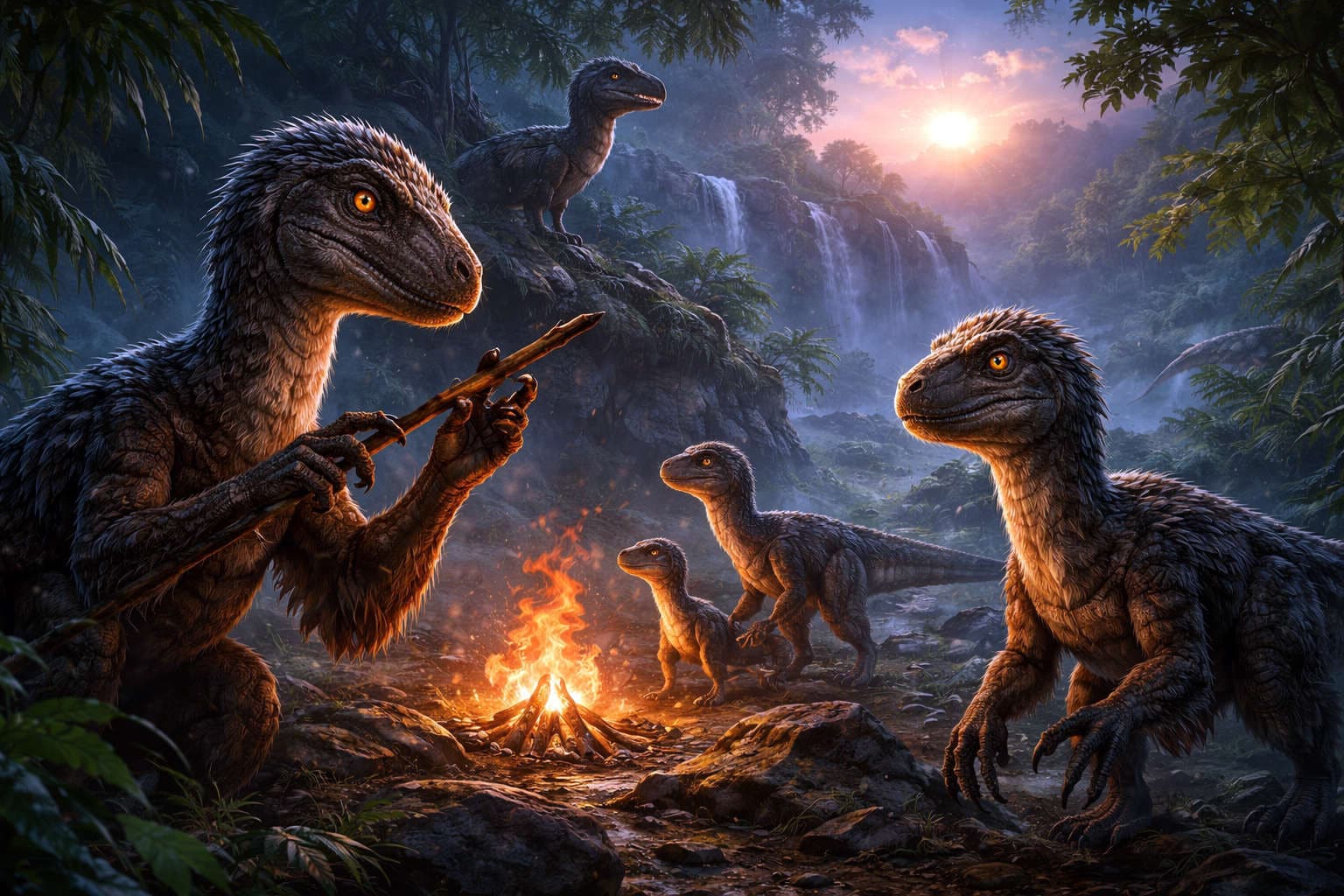
Probably not — at least, there is no clear evidence that any non-avian dinosaur reached the kind of flexible, coordinated, almost horror-movie intelligence shown in Jurassic Park. In plain terms, “Jurassic movie smart” would mean something like crow-level intelligence, or maybe a little beyond: sharp memory, problem-solving, social awareness, and the ability to adapt quickly. The fossil evidence does support smarter than people once thought, especially for some small, bird-like theropods. But so far, it does not show confirmed crow-level intelligence in non-avian dinosaurs, and paleontologists are cautious because skull endocasts cannot reveal the full neuron-level brain organization that helps make crows so impressive.
But, we can wonder.
Dinosaurs ruled the land for roughly 170 million years, across the whole globe, between the end-Triassic extinction and the asteroid impact 66 million years ago. Then the K–Pg extinction wiped out about three-quarters of Earth’s species, including all non-avian dinosaurs and nearly all bird lineages. That means we are judging dinosaur intelligence from a tiny surviving slice of a once vast and varied world. On top of that, crow-like intelligence evolved later in surviving bird lines over much shorter spans of time, with the crow family itself appearing only around the Miocene — the timespan from about 20 to 5 million years ago. Those are real facts, and they are good reasons not to assume dinosaur minds never got surprisingly sophisticated.
So the best answer is this: no evidence for movie-raptor smart, but good reason to keep an open mind. What would move the needle? We would need stronger clues that some non-avian dinosaurs had not just relatively large brains, but the kind of brain structure linked to flexible intelligence in modern birds — especially enlarged forebrain regions, better evidence for dense neural processing, or behavioral signs such as repeated tool use, complex hunting coordination, advanced nest care, prolonged juvenile learning, or unusually rich social behavior. Until then, the careful position is not “they were movie smart,” but we should not be too quick to assume evolution never got closer than the fossil record currently shows.
Furthermore, if it turns out that three major lines of birds — that is, three lines of dinosaurs — survived the K–Pg extinction, that could itself be a clue. If those lines truly reach back into the Late Cretaceous, then they may have already shared a basic bird-style brain before the asteroid struck. That would not mean non-avian dinosaurs were “Jurassic movie smart.” But it would suggest that fairly advanced dinosaur brains were already on the landscape before the extinction, and that later bird intelligence may have been building on foundations laid in the age of dinosaurs. That is still speculative, but it is exactly the kind of clue that tells us to keep looking.
And if that turns out to be true, an even bigger question follows: were those three surviving bird lines average for their time, or were they already unusually advanced? Maybe they survived simply because they were smaller, adaptable, and only moderately intelligent by dinosaur standards. Or maybe they carried forward brain traits that had already been evolving for tens of millions of years. Perhaps one day we will be able to say with confidence that movie-raptor-style intelligence, or something close to it, evolved more than once across more than 100 million years of dinosaur history. Until then, the fossils keep us cautious, and the movies keep our imagination alive.
Modern predator-prey scenes may be clouding our judgment. We tend to picture dinosaurs as less mentally sophisticated than the average mammal alive today. But that may be the wrong comparison. It is possible that many avian-line dinosaurs were more behaviorally complex than we usually imagine. If so, the ancient game between hunter and hunted may have looked less like the blunt struggle we often picture and more like a sharper contest of timing, memory, deception, and adaptation. Not movie-raptor silliness like opening doorknobs they had never seen, but a more complex and sophisticated game between the pursuing predator and the evading prey.
A final note: Recent work does say that brains showing aspects of avialan brains evolved multiple times among maniraptoran theropods, and older work similarly argued that bird-like encephalization indices evolved multiple times among non-avian maniraptorans. So yes, it is reasonable to wonder whether some dinosaurs lived more behaviorally complex lives than we once imagined.