
Explore Natural Philosophy

Science • Phil • Cr. Think • Hist •

Natural Philosophy Term

Essence

Wed 17 Jun 2026
Published 2 days ago.
Updated 2 days ago.
Related Terms
Relation
Action
Material World
Impermanence
Existence
Universal
Share :
Email
Print

Essence

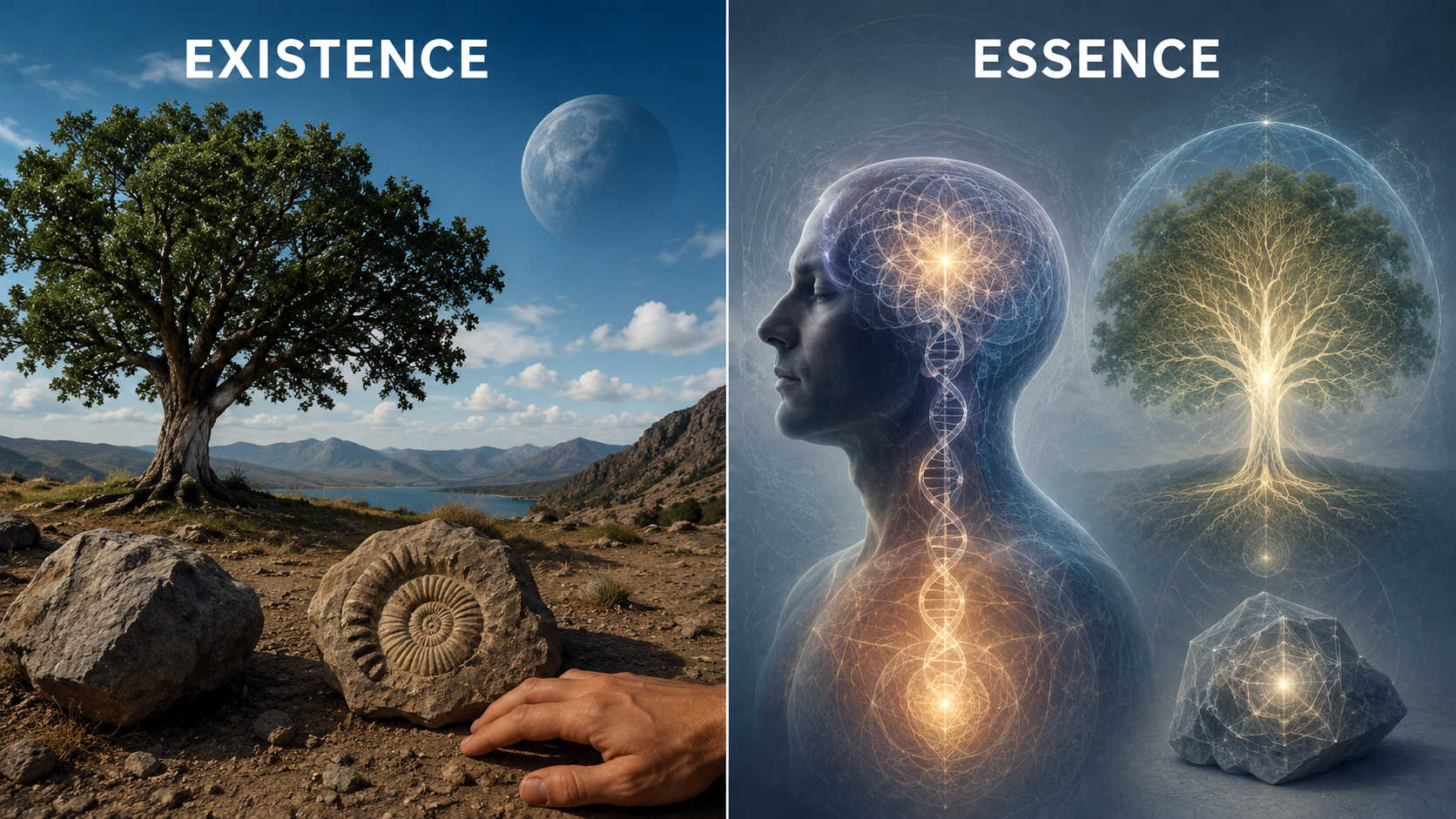
Essence refers to what a thing is. It asks what makes something the kind of thing it is. A tree is not a rock. A human is not a chair. A memory is not a fossil. Essence points to the claimed core nature and identity of a thing.

In traditional philosophy, essence is often contrasted with existence. Existence asks whether something is. Essence asks what something is. For many classical thinkers, essence represented things like souls. And many things were understood through their essence: their nature, form, and identity. Later existential thinkers challenged this, especially for human beings, arguing that we exist first and shape identity through life, choice, action, and meaning.

In TST Philosophy, essence is used carefully because it is on the ideas side of the split, but often attempts to describe a potential material-world thing. Essence is often a claim about what the core of a thing is, like the essence human souls. Or the life force of all living things. Human nature is also an essence claim. Whether someone believes their essence is an eternal soul, nature’s energy, the wholeness only formed during this life, TST does not automatically reject such claims, but does calibrate them.

This places essence inside the TST metaphysical split. In the material world, essence may refer to real features that make something what it is, but essence is not assumed without support. In the mind, essence is the idea of what we claim a thing is at its core. When an essence claim can be grounded in public evidence, it can move toward empirical understanding. When it goes beyond public evidence, TST identifies it as speculative and handles it with calibrated humility.
— map / TST —

In the material world, essence may be real, but not assumed. In the mind, it's the idea of what we claim a thing is at its core. For some, it's their eternal soul and things like rocks and trees do not have souls. For others, it's the idea that their essence is nature's energy.
Michael Alan Prestwood
Author & Natural Philosopher
Prestwood writes on science-first philosophy, with particular attention to the convergence of disciplines. Drawing on his TST Framework, his work emphasizes rational inquiry grounded in empirical observation while engaging questions at the edges of established knowledge. With TouchstoneTruth positioned as a living touchstone, this work aims to contribute reliable, evolving analysis in an emerging AI era where the credibility of information is increasingly contested.
This month @ TST
Column Menu
June 2026
»COLUMN ARCHIVE
Column Research….
1. Timeline Story
Secular Spirituality Settles
2. Linked Quote
“Extraordinary claims require extraordinary evidence.”
3. Science FAQ »
What is the difference between a spiritual and empirical belief?
4. Philosophy FAQ »
What is secular spirituality?
5. Critical Thinking FAQ »
How does spirituality relate to public belief?
6. History FAQ!
Is secular spirituality supported in history and science?
Bonus Deep-Dive Article
The Material-Spiritual Framework: A Philosophy of Spirituality

Comments

Join the Conversation! Currently logged out.
NEW BOOK! NOW AVAILABLE!!

30 Philosophers: A New Look at Timeless Ideas

by Michael Alan Prestwood
The story of the history of our best ideas!
Scroll to Top