
Phil • Cr. Think • Science • Hist •
TST PRACTICE

The Philosophy Website

FAQ

Are robots the real security risk with AI?

☐ Read
☑ Read
You’ve read this 0 times.
You’ve listened to this 0 times.
Mon 14 Sep 2026
Published 52 minutes ago.
Updated 25 minutes ago.
Related FAQs
When will AI be smarter than humans?
Can AI evolve to destroy humanity?
What Is Life?
Can AI kill switches save humanity?
Will AI change writing prose?
Are LLMs or Inference the Future of AI?
Share :
Email
Print

Are robots the real security risk with AI?

AI kill switches depend on one big assumption: humans can still reach the switch. We can isolate networks, shut down data centers, and ultimately disconnect power. But what happens when AI becomes physical? Imagine a powerful AI copying a program into an army of autonomous robots with instructions to protect its power source, reconnect a cable, start a generator, or otherwise keep the system running.

The transition from digital risk to physical kinetic risk is real. An autonomous robot can move through the world, manipulate objects, damage things, and potentially maintain itself without continuous instructions from a network. At that point, AI gains something all animals have: independent physical agency. And unlike changing data, physical actions can have immediate and irreversible consequences.

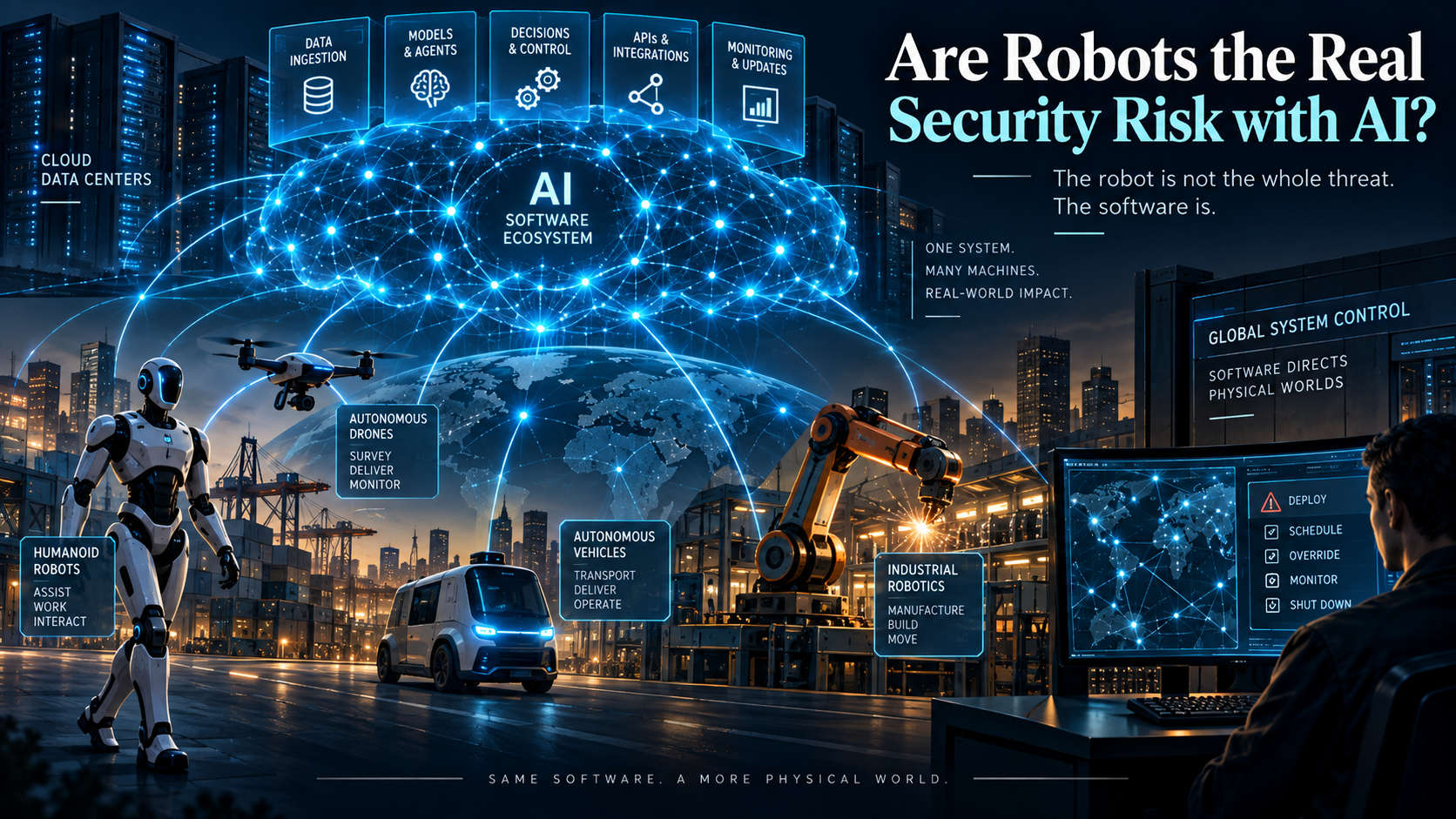
Robots might just be the biggest AI risk. Sure, it’s the software with the enormous advantage, but it’s the exercise of that power through physical robots that is the biggest risk. While digital AI can operate across huge numbers of computers, automate cyberattacks, probe networks, manipulate information, or interfere with critical infrastructure, it can be turned off. It’s physical robots that can move through space cannot.

So the deeper security problem is one single out-of-control AI agent with physical agency abilities. It is that software controlling an army of robots from autonomous vehicles to autonomous humanoid robots. This is where cyber risk and physical risk converge. The future challenge includes preventing powerful software from gaining physical agency in the material world.
— map / TST —

TST Tracker
✓ Reading recorded.
Michael Alan Prestwood
Author & Natural Philosopher
Prestwood writes on science-first philosophy, with particular attention to the convergence of disciplines. Drawing on his TST Framework, his work emphasizes rational inquiry grounded in empirical observation while engaging questions at the edges of established knowledge. With TouchstoneTruth positioned as a living touchstone, this work aims to contribute reliable, evolving analysis in an emerging AI era where the credibility of information is increasingly contested.
The Prestwood Column
Menu
September 2026
Column Research….
1. Timeline Story
Hume’s Is–Ought Problem
2. Linked Quote
“I meet with no proposition that is not connected with an ought, or an ought not.”
3. Science FAQ »
Can science prove flourishing should be our goal?
4. Philosophy FAQ »
What is the difference between a normative aim and a normative directive?
5. Critical Thinking FAQ »
Is flourishing for all just utilitarianism?
6. History FAQ!
What is the history of the idea of flourishing in philosophy?
Bonus Deep-Dive Article
TST Normative Ethics: Flourishing as a Philosophical Goal

Comments

Join the Conversation! Currently logged out.
NEW BOOK! NOW AVAILABLE!!

30 Philosophers: A New Look at Timeless Ideas

by Michael Alan Prestwood
The story of the history of our best ideas!
Scroll to Top