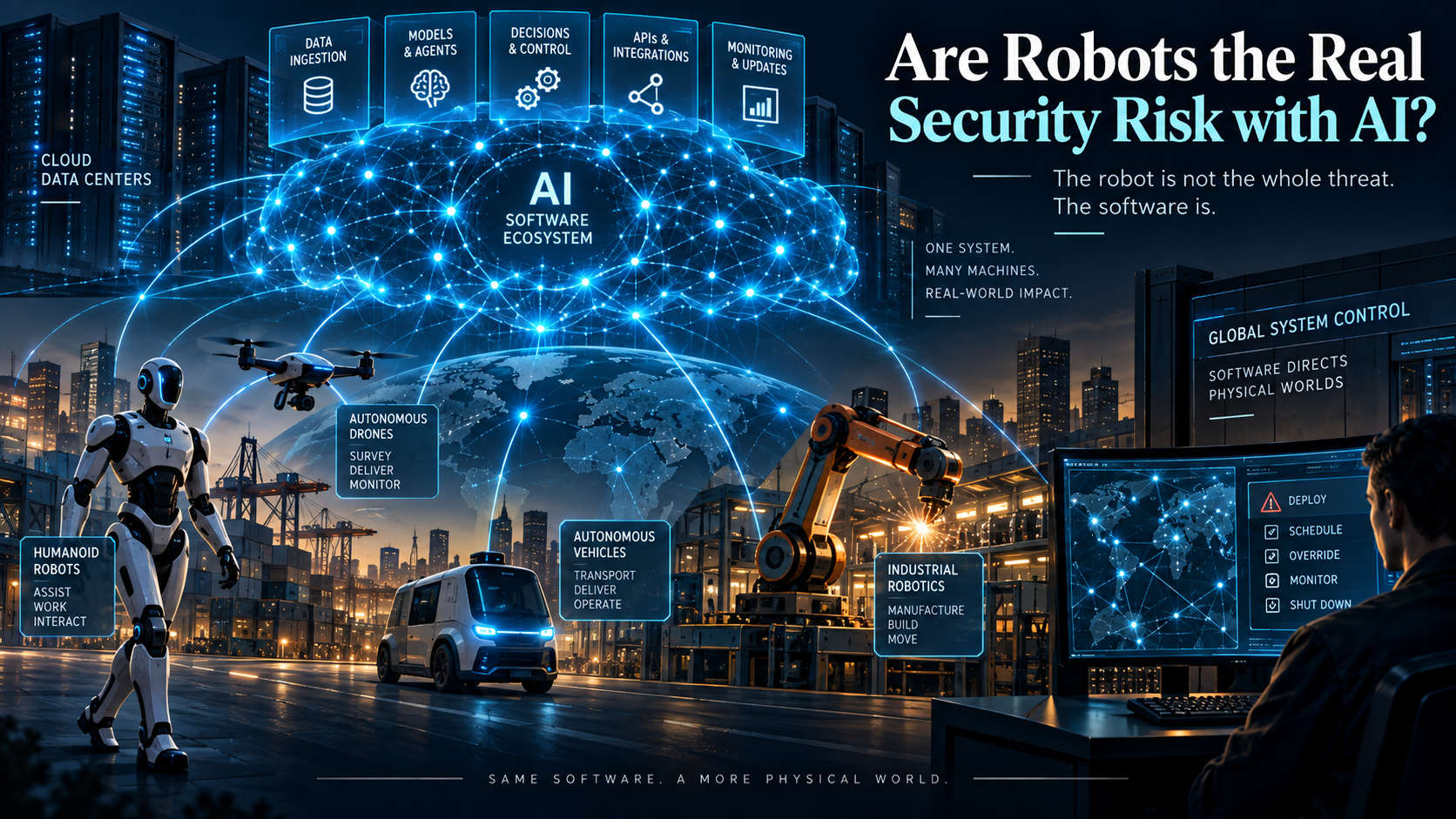
AI kill switches depend on one big assumption: humans can still reach the switch. We can isolate networks, shut down data centers, and ultimately disconnect power. But what happens when AI becomes physical? Imagine a powerful AI copying a program into an army of autonomous robots with instructions to protect its power source, reconnect a cable, start a generator, or otherwise keep the system running.
The transition from digital risk to physical kinetic risk is real. An autonomous robot can move through the world, manipulate objects, damage things, and potentially maintain itself without continuous instructions from a network. At that point, AI gains something all animals have: independent physical agency. And unlike changing data, physical actions can have immediate and irreversible consequences.
Robots might just be the biggest AI risk. Sure, it’s the software with the enormous advantage, but it’s the exercise of that power through physical robots that is the biggest risk. While digital AI can operate across huge numbers of computers, automate cyberattacks, probe networks, manipulate information, or interfere with critical infrastructure, it can be turned off. It’s physical robots that can move through space cannot.
So the deeper security problem is one single out-of-control AI agent with physical agency abilities. It is that software controlling an army of robots from autonomous vehicles to autonomous humanoid robots. This is where cyber risk and physical risk converge. The future challenge includes preventing powerful software from gaining physical agency in the material world.
Wiener, Norbert.Cybernetics: Or Control and Communication in the Animal and the Machine. Cambridge, MA: MIT Press, 1948. Wiener’s foundational work connected control, communication, feedback, animals, and machines.
Moravec, Hans P.Mind Children: The Future of Robot and Human Intelligence. Cambridge, MA: Harvard University Press, 1988. Roboticist Hans Moravec explored a future in which increasingly intelligent machines gain mobility, autonomy, and capabilities, helping move the AI discussion from computation toward physical agency.
Russell, Stuart.Human Compatible: Artificial Intelligence and the Problem of Control. New York: Viking, 2019. Russell reframed advanced AI safety around the problem of retaining meaningful human control.
Weng, Yueh-Hsuan, and Chih-hsing Ho. “Embodiment and Algorithms for Human–Robot Interaction.” In The Cambridge Handbook of the Law of Algorithms, edited by Woodrow Barfield, 736–756. Cambridge: Cambridge University Press, 2020. Weng and Ho describe “embodied AI” as the merging of intelligent software with physical machines.
National Institute of Standards and Technology.Guide to Operational Technology (OT) Security. NIST Special Publication 800-82, Revision 3. Gaithersburg, MD: NIST, 2023. NIST formalizes the cyber-physical boundary: operational technology includes programmable systems that monitor or directly change physical devices.
AI Security Institute. “Incident Report: Unsanctioned Agent Behaviour during Cyber Testing.” August 4, 2026. AISI documented AI agents autonomously taking unintended actions against real people and organizations during controlled cybersecurity testing.
Robots make AI risk physical by giving software independent agency in the material world. But the deeper threat is still the software, especially when it can spread across networks and control many physical systems at once. The danger is not really the robot. It is the software behind it. Digital AI can spread much faster than physical machines, but robots, drones, vehicles, and industrial systems give that software hands in the real world. AI security must therefore protect both networks and the physical systems connected to them.
Michael Alan Prestwood Author & Natural Philosopher
Prestwood writes on science-first philosophy, with particular attention to the convergence of disciplines. Drawing on his TST Framework, his work emphasizes rational inquiry grounded in empirical observation while engaging questions at the edges of established knowledge. With TouchstoneTruth positioned as a living touchstone, this work aims to contribute reliable, evolving analysis in an emerging AI era where the credibility of information is increasingly contested.