

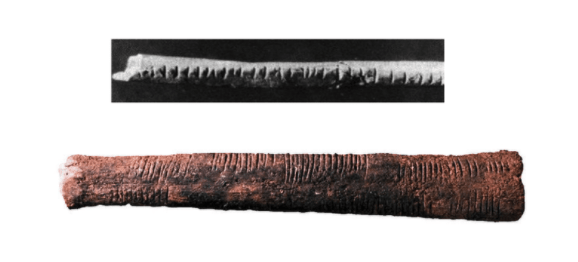
The Lebombo Bone is one of the oldest known mathematical artifacts in human history. This ancient tool is a baboon fibula with 29 distinct notches carved into it. It was discovered in the Lebombo Mountains between South Africa and Swaziland. It was initially dated to approximately 35,000 years, but 24 radiocarbon tests since date it back about 44,000 years.
The Lebombo Bone was potentially used as a lunar phase counter or a simple tally stick. The series of notches may represent a lunar calendar, which would imply that early humans were tracking lunar phases for either ritualistic purposes or as a practical method for keeping time, possibly related to menstrual cycles or seasonal changes.
This artifact belongs to the Middle Stone Age, a period characterized by the development of more advanced stone tool technologies and the emergence of modern human behavior, including symbolic thought and perhaps early forms of arithmetic. The Lebombo Bone suggests that early humans engaged in complex thinking and had the capacity for abstract thought and planning.
The discovery of the Lebombo Bone and similar artifacts underscores the cognitive capabilities of early humans and their ability to use numerical concepts long before the development of written language or formal systems of numeration. This artifact, along with others like the Ishango Bone from Central Africa, indicates that the concept of counting and numerical recording was a part of human culture across different regions of Africa tens of thousands of years ago.

