
Explore Science-first Philosophy

STORY

Emergence of Early Hominin Shelters

By Michael Alan Prestwood

Sun 5 May 2024
Published 2 years ago.
Updated 2 weeks ago.
Related Stories
Blombos Cave Engravings
Material-Spiritual Framework
Many Early Out of Africa Migrations
Bad Faith
Phenotype Variation: Eye Shape and the Epicanthic Fold
Great Apes: Medicine Emerges
Share :
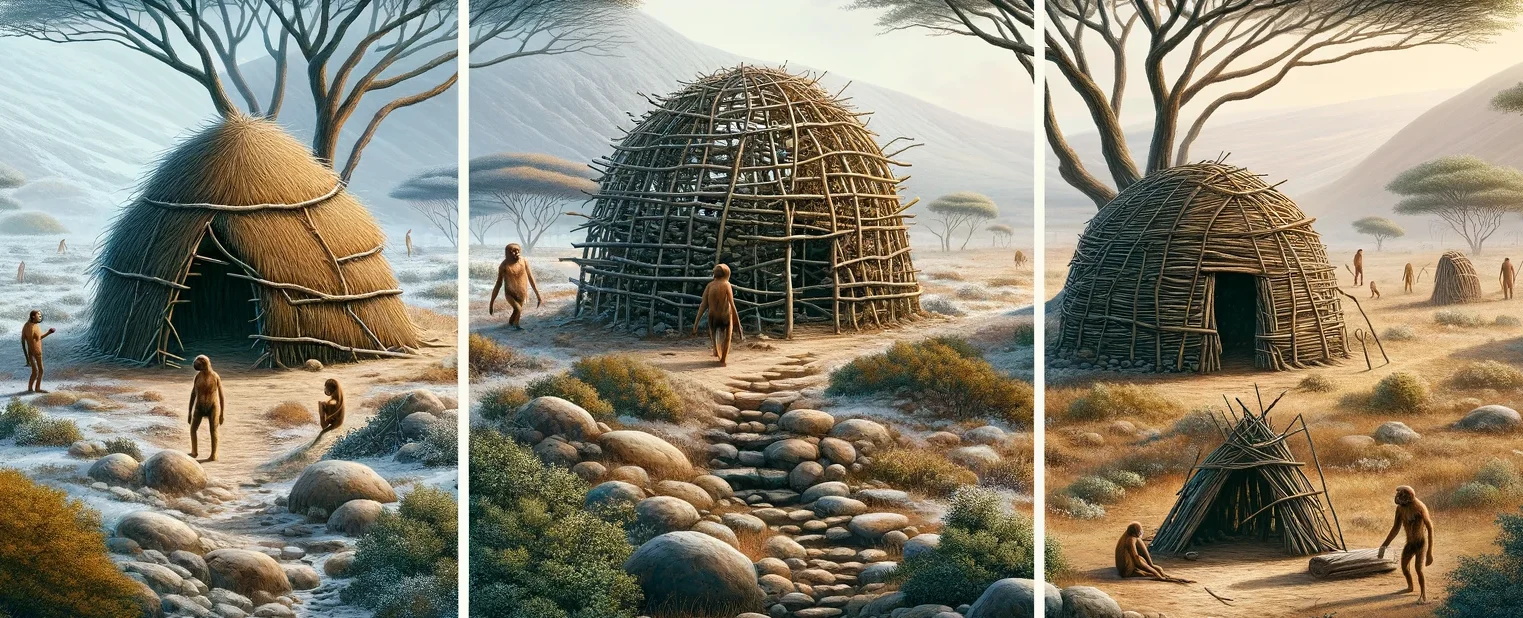
Imagined image: three types of early shelters that Homo erectus might have constructed. 1) Simple Lean-to: Made from branches and large leaves, providing basic protection against elements. 2) Structured Windbreak: Constructed with tightly packed branches and possibly covered with animal hides for better insulation. 3) Rudimentary Hut-like Structure: Using interwoven branches and vines, with a base of large stones to anchor it.

Emergence of Early Hominin Shelters

1.8 Million Years Ago (+/- 500,000 years)

The origins of tent-like structures in human history remain shrouded in mystery, primarily due to the perishable materials involved and the lack of direct archaeological evidence. However, as Homo erectus appeared and spread into varied climates, their enhanced tool-making skills and control of fire likely necessitated and enabled the construction of more complex shelters. This period marks a significant point where early humans may have started to build the first tent-like structures using branches, leaves, and plant fibers to create semi-permanent shelters. The move into cooler environments would have increased the need for such innovations.

Before this timeframe, it’s possible Homo habilis created simple shelters. The emergence of Homo habilis and their use of simple stone tools opens a window of possibility. They might have used vines or branches to create rudimentary windbreaks or lean-tos for temporary protection from the elements.

Primary Timeline…

— map / TST —

Michael Alan Prestwood
Author & Natural Philosopher
Prestwood writes on science-first philosophy, with particular attention to the convergence of disciplines. Drawing on his TST Framework, his work emphasizes rational inquiry grounded in empirical observation while engaging questions at the edges of established knowledge. With TouchstoneTruth positioned as a living touchstone, this work aims to contribute reliable, evolving analysis in an emerging AI era where the credibility of information is increasingly contested.
Email
Print
This month @ TST
Column Menu
May 2026
»COLUMN ARCHIVE
--COLUMN--
Column Research….
1. Timeline Story
Book: The Idea of History
2. Linked Quote
“The historian without his facts is rootless…the facts without their historian are…meaningless.”
3. Science FAQ »
Is science tainted by bias?
4. Philosophy FAQ »
Debating History: Should We Say “Dark Ages” or “Middle Ages?”
5. Critical Thinking FAQ »
What is the preservation bias?
6. History FAQ!
Did Einstein’s driver really give one of his early talks?
Bonus Deep-Dive Article
TST Philosophy of History

Comments

Join the Conversation! Currently logged out.

Leave a Reply

NEW BOOK! NOW AVAILABLE!!

30 Philosophers: A New Look at Timeless Ideas

by Michael Alan Prestwood
The story of the history of our best ideas!
Scroll to Top