


Can you explain quantum mechanics simply?
Quantum mechanics is where nature outgrows common sense. It is our best-tested description of the tiny world, but its deeper meaning remains open. The math ...

Was Trump the worst president in history?
Historians and political scientists rank presidents for the history books, and they already rank Trump as the worst president.

Should you engage Trump supporters?
Should you engage Trumpsters? Yes and no. The short answer is no because they are brainwashed. The longer answer is yes, but only on basic ...

Who came up with radiometric dating?
Post Medieval < History

Is the idea of ownership a real thing?
Ownership is real as a social construct, not as a natural object. It is a human agreement layered over reality, protected by customs, laws, and ...

What is the classic double‐slit experiment?
The double-slit experiment shows why quantum mechanics is so strange: tiny things land like particles, but their overall pattern can form like waves.

Is the Rip-Bang theory a good theory?
Philosophy of Science < Truth Hammers < Critical Thinking

Does wave-particle duality imply a multiverse?
Wave-particle duality does not prove a multiverse. It shows a real quantum mystery, while many-worlds offers one possible interpretation of what that mystery might mean.

How does the quantum measurement problem relate to metaphysics?
The quantum measurement problem shows where physics meets philosophy: the results are empirical, the math is rational, but the deeper meaning remains metaphysical.
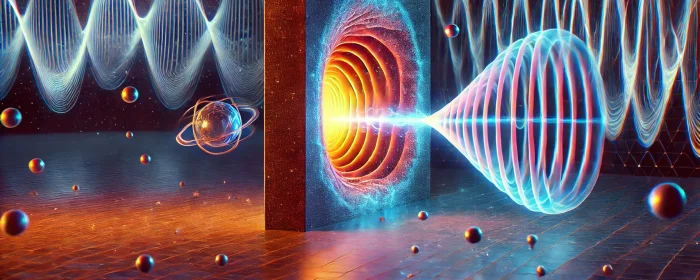
Can you explain quantum tunneling simply?
Quantum tunneling happens when a particle is found beyond an energy barrier it should not cross under classical physics.

What does quantum entanglement imply about metaphysics?
Entanglement proves connection. It does not prove what that connection means. Quantum entanglement shows that particles can share linked states across distance.

Does time exist?
Time exists as part of spacetime, but the passing of time is how we experience and measure change: objects moving, positions shifting, events unfolding, and ...

Does antimatter travel backward?
Antimatter moves forward in time like normal matter. The “backward in time” idea is a useful mathematical interpretation, not an observed physical fact.
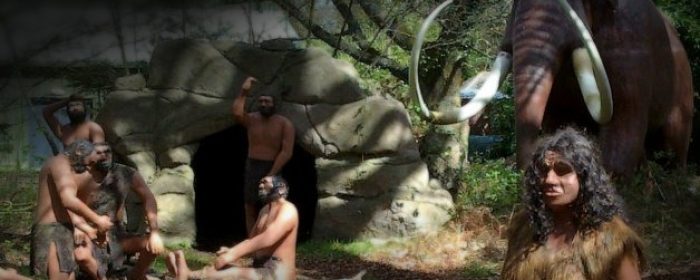
Were neanderthals artistic?
Yes. Deep into prehistory, Neanderthals were artistic, revealing intelligence comparable to our own.

What is the farthest object in space?
The farthest thing we can observe isn’t an object at all, but the universe’s oldest light. The Cosmic Microwave Background.

Why do we rely on authority figures for information?
Authority is a cognitive shortcut for managing complexity. Choose your authorities carefully, and never stop auditing them.

Did Charles Darwin’s uncle invent the steam engine?
The steam engine was invented in ancient greece. Lost, it was rediscovered by Thomas Newcomen in 1712. Later improved by James Watt, no relation to ...

What is consciousness?
Consciousness is experiencing reality, and it exists on a spectrum shaped by cognition and sensory input.

Will the universe end in an ever-expanding cold isolated death?
The universe is likely to expand forever toward a cold, isolated end known as the Big Freeze, but that's trillions of years from now.

Are there more Christians or Muslims in the world today?
About 50% worldwide identify with one of the Abrahamic religions. Christians about 31%, Muslims about 24%, and Jews a tiny .2%.