
Phil • Cr. Think • Science • Hist •
TST PRACTICE

The Philosophy Website

FAQ

Can you explain quantum tunneling simply?

☐ Read
☑ Read
You’ve read this 0 times.
You’ve listened to this 0 times.
Tue 10 Jan 2023
Published 4 years ago.
Updated 3 months ago.
Related FAQs
Has Planck’s Constant been updated?
How does Schrödinger’s Cat relate to wave-particle duality and the multiverse?
Does antimatter travel backward?
How does the quantum measurement problem relate to metaphysics?
Is space truly empty? Anywhere?
Can you explain superposition simply?
Share :
Email
Print

Can you explain quantum tunneling simply?

In classical physics, if a ball does not have enough energy to roll over a hill, it stops. Simple enough.

But quantum particles do not behave like tiny billiard balls following fixed paths. In quantum mechanics, a particle is described by a wavefunction: a rational model that gives us probabilities for where the particle may be found.

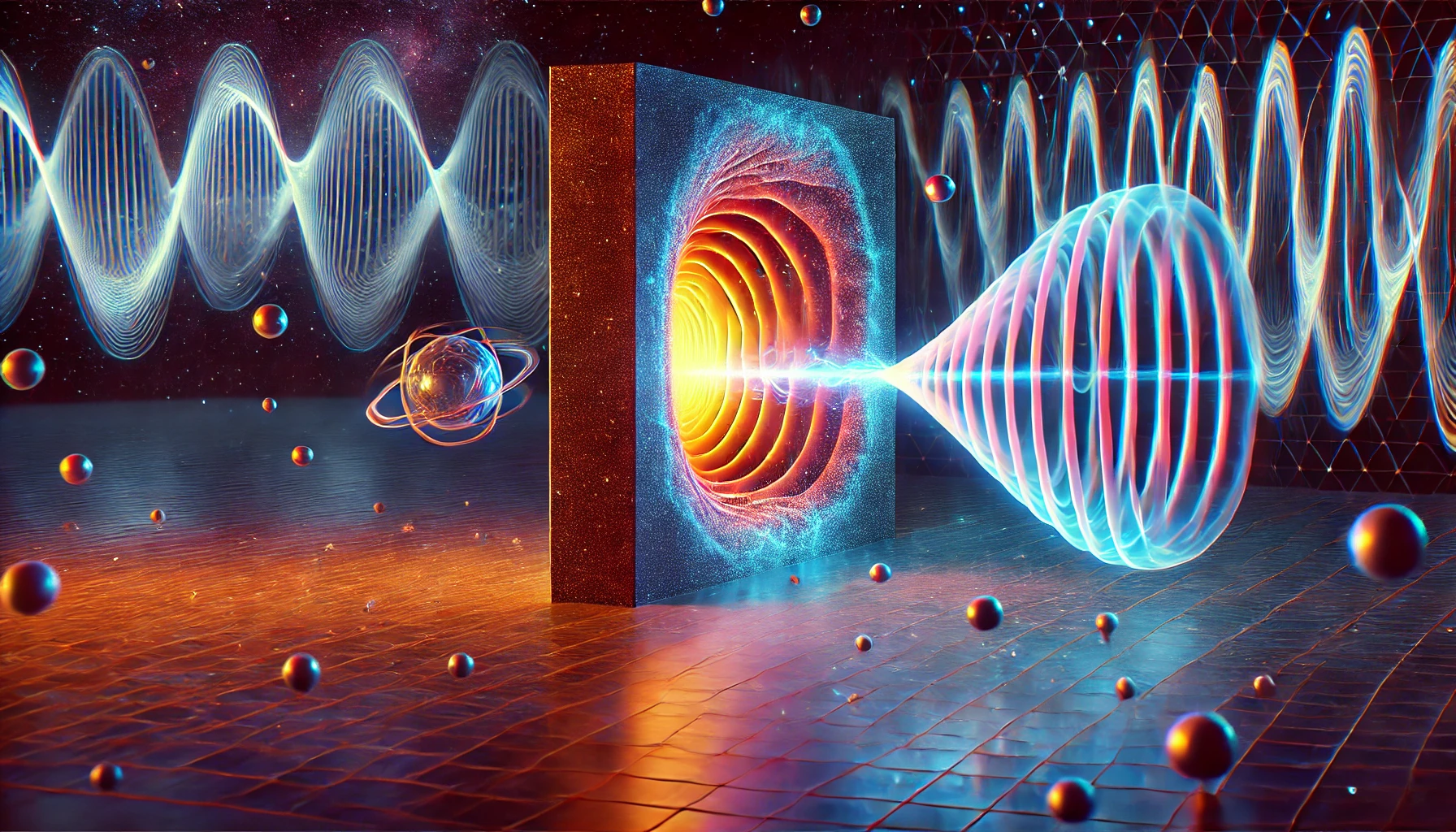
Sometimes, that model predicts a small chance the particle will be found on the other side of an energy barrier, even though classical physics says it should not have enough energy to get there. When that happens, we call it quantum tunneling. And yes, we’ve verified it! This is not just math on a chalkboard. This part is empirical.

And this a strange idea has real effects. It helps explain nuclear fusion in stars, certain types of radioactive decay, and enables technologies like scanning tunneling microscopes.

So did the particle literally pass through the barrier? Did it “borrow” energy? Did it exist in several places until measured?

That deeper meaning is still debated.

The TST distinction helps: quantum tunneling is empirical in its observed effects, rational in its mathematical description, and speculative in its metaphysical meaning. The phenomenon is real. The math works. But the deeper explanation of what kind of reality allows it remains unsettled.
— map / TST —

TST Tracker
✓ Reading recorded.
Quantum tunneling is when nature gets through a wall classical physics says should stop it.
Michael Alan Prestwood
Author & Natural Philosopher
Prestwood writes on science-first philosophy, with particular attention to the convergence of disciplines. Drawing on his TST Framework, his work emphasizes rational inquiry grounded in empirical observation while engaging questions at the edges of established knowledge. With TouchstoneTruth positioned as a living touchstone, this work aims to contribute reliable, evolving analysis in an emerging AI era where the credibility of information is increasingly contested.
The Prestwood Column
Menu
September 2026
Column Research….
1. Timeline Story
Hume’s Is–Ought Problem
2. Linked Quote
“I meet with no proposition that is not connected with an ought, or an ought not.”
3. Science FAQ »
Can science prove flourishing should be our goal?
4. Philosophy FAQ »
What is the difference between a normative aim and a normative directive?
5. Critical Thinking FAQ »
Is flourishing for all just utilitarianism?
6. History FAQ!
What is the history of the idea of flourishing in philosophy?
Bonus Deep-Dive Article
TST Normative Ethics: Flourishing as a Philosophical Goal

Comments

Join the Conversation! Currently logged out.
NEW BOOK! NOW AVAILABLE!!

30 Philosophers: A New Look at Timeless Ideas

by Michael Alan Prestwood
The story of the history of our best ideas!
Scroll to Top