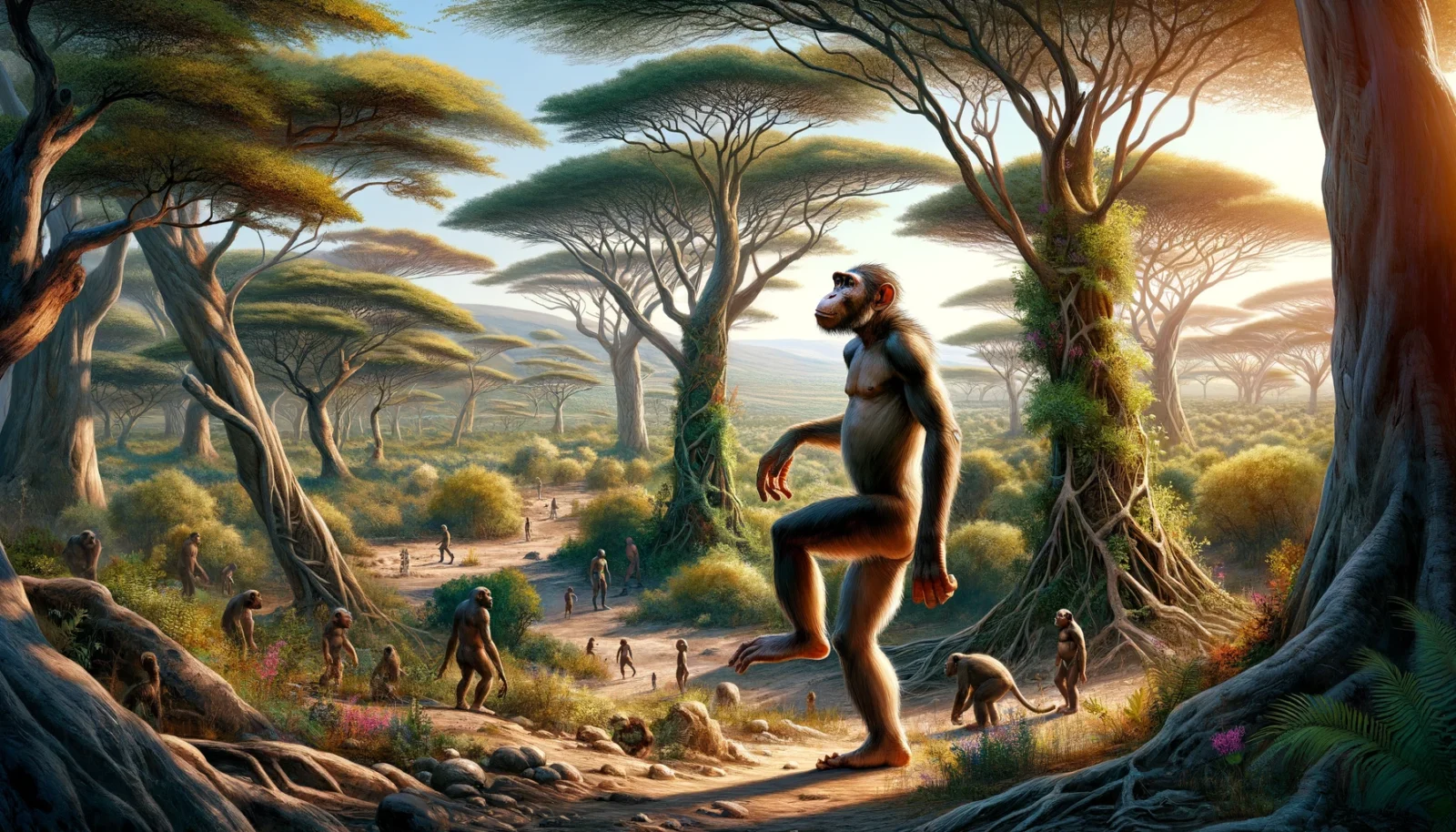
Less Body Hair Emerges in Homo erectus
Less visible body hair in Homo erectus reflects a shift in hair behavior, not hair loss, enabling endurance, sweating, and survival in open, hot landscapes.
Less Body Hair Emerges in Homo erectus Read More »
Master Timeline
Less visible body hair in Homo erectus reflects a shift in hair behavior, not hair loss, enabling endurance, sweating, and survival in open, hot landscapes.
Less Body Hair Emerges in Homo erectus Read More »
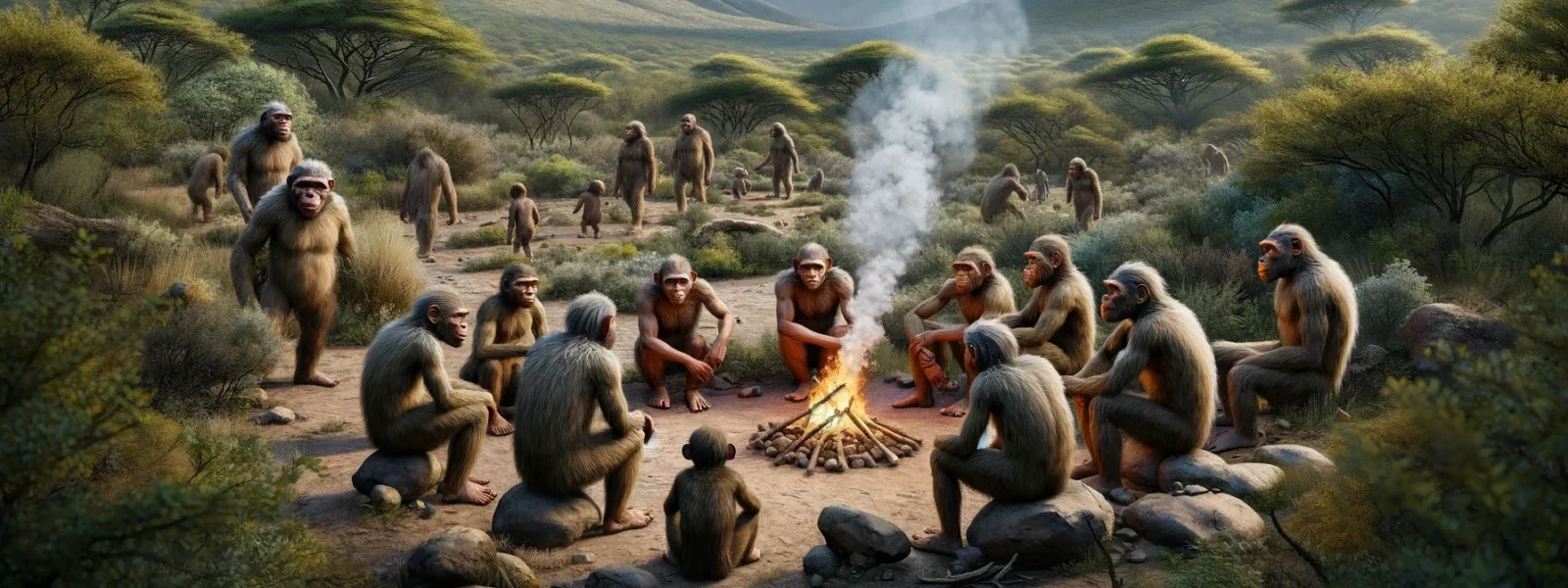
Homo heidelbergensis lived in Africa, Europe and Asia from 700,000 to 200,000 years ago. They coexisted with humans in Africa, Europe, and Asia from our emergence around 315,000 years ago until their extinction about 200,000 years ago. Imagined Image: A Homo heidelbergensis campsite a few thousand years before they went extinct, set in a lush European
Extinction: Homo heidelbergensis Read More »
Discovered in 2013 and first dated in 2017, Homo naledi and humans coexisted in South and East Africa from our emergence around 315,000 years ago until their extinction about 236,000 years ago. It is possible that we share a common ancestor with them, but research is pending. Homo naledi lived in South Africa from 335,000 to
Extinction: Homo naledi Read More »
Discovered in 2019, Homo luzonensis inhabited the Luzon area north of Manila in the Philippines from at least about 67,000 to about 50,000 years ago. While current evidence suggests that Homo luzonensis may have become extinct before the documented arrival of Homo sapiens around 35,000 to 40,000 years ago, the exact timing of their extinction
Extinction: Homo luzonensis Read More »
Discovered in 2003, Homo floresiensis (also known as the “Hobbit”) inhabited the island of Flores in Indonesia from 190 to 50 thousand years ago. Humans arrived about 50,000 years ago and may be the reason for their extinction. Lineage: Most likely not a Homo heidelbergensis, but a descendant species from an earlier ancient human. Perhaps
Extinction: Homo floresiensis Read More »
Homo erectus didn’t just come before us—they lasted so long that, in deep time, they almost shared space with modern humans in Java.
Extinction: Homo Erectus Read More »
Denisovans and humans coexisted in Siberia from about 194,000 to around 40,000 years ago. While their exact cause of extinction remains debated, competition with modern humans and climate change are thought to be contributing factors. Imagined image: Set in Siberia around 45,000 years ago, a group of Denisovans is depicted in their winter camp, surrounded
Extinction: Denisovans Read More »
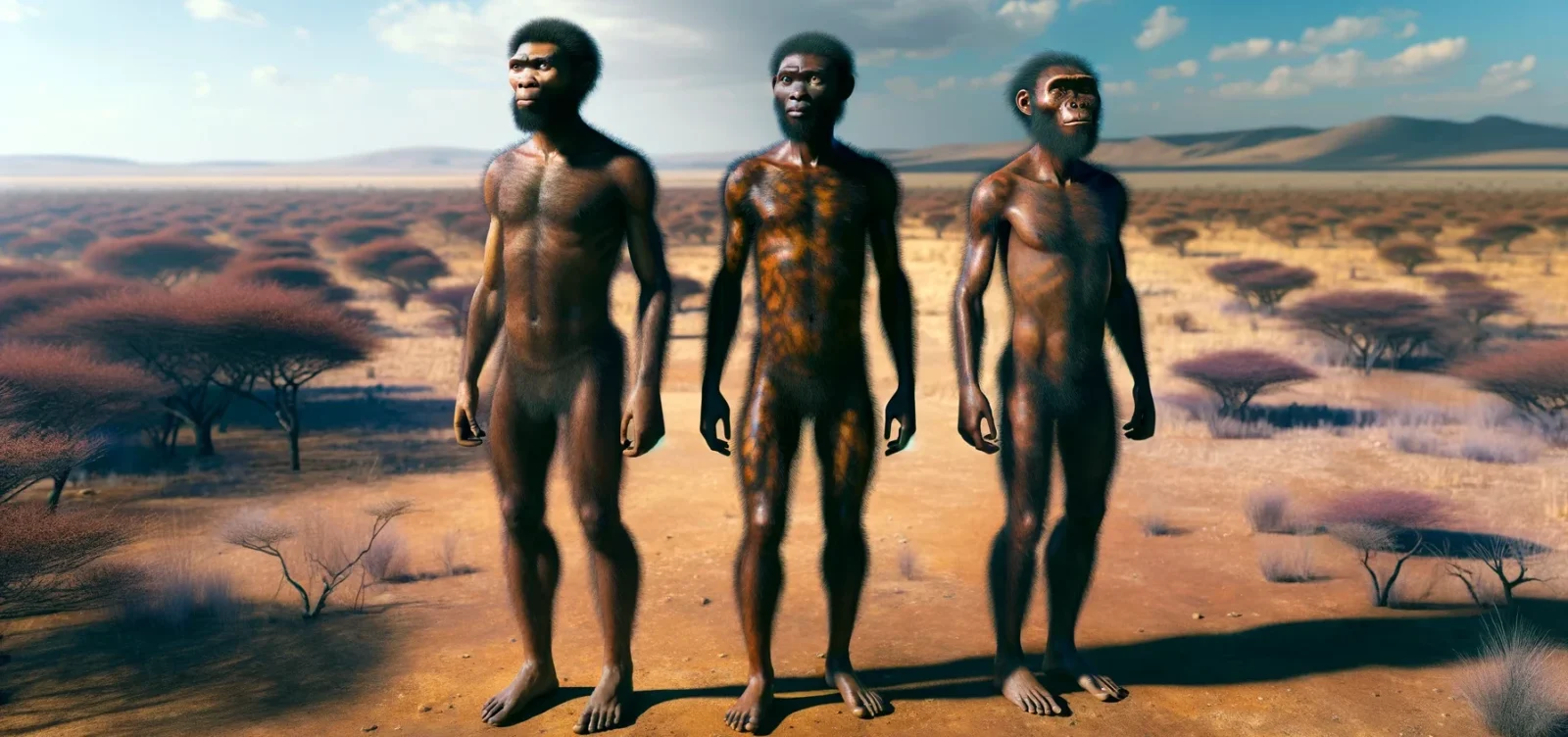
Homo neanderthalensis: Neanderthals and humans coexisted in Europe and Asia until around 40,000 years ago. While their exact cause of extinction remains debated, competition with modern humans and climate change are thought to be contributing factors. Imagined image: Left is a neanderthal, right a human. Just as human looks vary widely, Neanderthals did too. This
Extinction: Neanderthals Read More »
Earliest known symbol use in the Europe/Mediterranean zone. Dating back to around 40,000 BCE, the Upper Paleolithic cave art found across Europe presents a compelling narrative of early human communication and symbolic expression. Sites like Lascaux in France and Altamira in Spain feature elaborate depictions of animals, human figures, and abstract symbols that recur with
Upper Paleolithic Cave Art with Symbols Read More »
Earliest known writing in the Americas zone. The Olmec civilization flourished in what is now the southeastern part of Mexico from around 1500 BC to about 400 BC. The Olmecs are often referred to as the “Mother Culture” of Mesoamerica, influencing later civilizations like the Maya and the Aztecs. The Cascajal Block artifact, dated to
Olmec Hieroglyphs: Mexico Read More »
Earliest known writing in the European/Mediterranean zone. The earliest known writing system in the European/Mediterranean zone is the Cretan Hieroglyphic script from ancient Crete, part of the Minoan civilization. This script dates back to around 1900 BC to 1700 BC. Closely related and slightly later in development is Linear A, which emerged around 1800 BC
Cretan Hieroglyphic script: Greek Island Read More »
Earliest undeciphered writing in the Asian zone. The Indus Valley script, emerging around 2600 BCE in one of the world’s earliest urban civilizations, remains one of archaeology’s greatest puzzles. Found across a vast expanse from today’s northeast Afghanistan to Pakistan and northwest India, this script comprises over 400 unique symbols, ranging from geometric shapes to
Indus Valley Script: Northwest India Read More »
Earliest deciphered writing in Asian zone: Indus Valley writing, undeciphered, predates this to circa 2600 BCE. The earliest known writing system in Asia is typically considered to be the Oracle Bone Script from ancient China. This script was used during the Shang Dynasty around 1200 BCE, but evidence suggests it may have developed as early
Oracle Bone Script: China Read More »
Eastern Asia and Europe: The domestication of dogs marks one of the most remarkable and earliest examples of animal domestication by humans. This significant event occurred approximately 20,000 years ago, with some studies suggesting an even earlier date. The process began when wolves, drawn by the waste and remnants of hunting left by human groups,
Earliest Known Domesticated Animal: Dogs Read More »
Other than humans, today’s smartest primates—chimpanzees, bonobos, gorillas, and orangutans—have a combined wild population of approximately 400,000 to 700,000. This number persists despite their near-complete inability to expand beyond their current ideal environments, a restriction not faced by any human species since before Homo habilis. Moreover, this is in spite of the extreme pressures exerted
Hominin World Population: 2 Million (speculative) Read More »
When Homo sapiens first emerged, their population in Africa was likely just a few hundred thousand, while the total hominin population, including other species like Neanderthals and Homo heidelbergensis, may have ranged from 1.1 to 2.1 million. During this period, Homo sapiens were primarily found in Africa, while other hominins occupied broader ranges across Eurasia,
Hominin World Population: 2 Million (maybe) Read More »
Cognitive Revolution By 70,000 BCE. Population range: 500,000 to 2.5 million. Given the uncertainties and lack of direct data, the following are speculative estimates. Africa-Middle East: 50-60% or 600,000 to 1 million people Africa, being the origin of modern humans, likely had the highest population density at this time, particularly in Sub-Saharan regions which were
World Population: 1.5 Million Read More »
Late Stone Age Mesolithic Period: 10,000 BCE – 6000 BCE. Africa-Middle East: 30% or 1.2 million peopleg Asia: 40% or 1.6 million people Europe-Mediterranean: 15% or 600 thousand people The Americas: 10% or 400 thousand people Oceana-Australasia: 5% or 200 thousand people
World Population: 4 Million Read More »
Stone Copper Age Chalcolithic Period: 3,000 BCE – 500 BCE. Africa-Middle East: 36% or 5 million people Early civilizations include Egypt and Mesopotamia with a relatively higher population density. Asia: 36% or 5 million people Early civilizations include Indus Valley and ancient China. They saw early urban development and agriculture which supported larger populations. Europe-Mediterranean:
World Population: 15 Million Read More »
Earliest Known Semi-Permanent Settlement in the Americas: Located in the lush landscapes of southern Chile, Monte Verde marks one of the earliest known human settlements in the Americas. Dating back to around 14,800 years ago, this site provides compelling evidence of early human ingenuity and adaptability far from the commonly accepted Eurasian cradles of civilization. The
Seasonal Settlements at Monte Verde Read More »