
Explore Science-first Philosophy

STORY

Land Deed Signed

By Michael Alan Prestwood

Thu 14 Feb 2019
Published 7 years ago.
Updated 2 years ago.
Related Stories
Share :
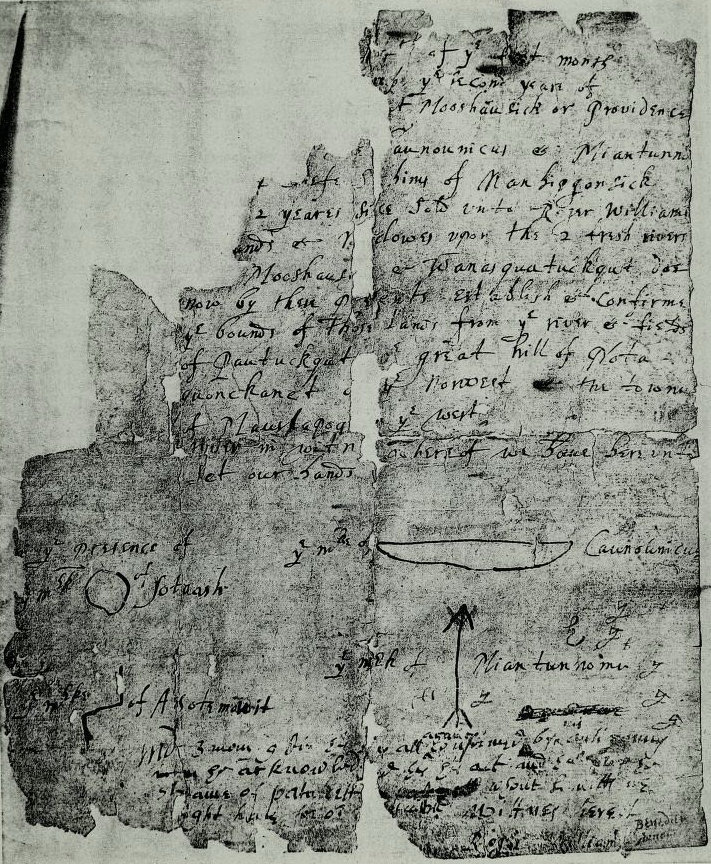
The "Towne Evidence" was the original land deed drawn up by Roger Williams and the Sachems in 1637/8 for land that would become the Providence Plantations with the marks of: 1.Soatash, 2.Caunanicusse, 3.Assotemewett, and 4.Meiantenomu. Later on it came out that the document had been mistaken for waste paper and that pieces had been torn from it to wrap garden seeds in.

Land Deed Signed

24 Mar 1638

In 1638 Roger Williams purchased the land on the north side of the Pawtuxet River from the local Native Americans. He then sold the land that same year to William Arnold and William Harris for the price of a cow. He signed the land deed with the sachems, Canonicus, and Miantonomy tribes on March 24, 1638.

The “Towne Evidence” to the right was the original land deed drawn up by Roger Williams and the Sachem. Unlike most early settlers, Roger Williams arranged to buy the land from the local natives for a fair price. He then arranged to transfer the land to those that settled the land with him.

— map / TST —

Michael Alan Prestwood
Author & Natural Philosopher
Prestwood writes on science-first philosophy, with particular attention to the convergence of disciplines. Drawing on his TST Framework, his work emphasizes rational inquiry grounded in empirical observation while engaging questions at the edges of established knowledge. With TouchstoneTruth positioned as a living touchstone, this work aims to contribute reliable, evolving analysis in an emerging AI era where the credibility of information is increasingly contested.
Email
Print
This Week @ TST
April 1, 2026
»Column Archive
WWB Research….
1. Story of the Week
The Dawn of Empirical Spirituality
2. Quote of the Week
“It is wrong always, everywhere, and for anyone, to believe anything upon insufficient evidence.”
3. Science FAQ »
Is science tainted by bias?
4. Philosophy FAQ »
How do knowledge frameworks help transform information into wisdom?
5. Critical Thinking FAQ »
Are personal spiritual experiences believable?
6. History FAQ!
Did the Buddha believe in Mount Meru and the six realms of existence?
Bonus Deep-Dive Article
TST Theory of Justification: What to Believe
Scroll to Top