

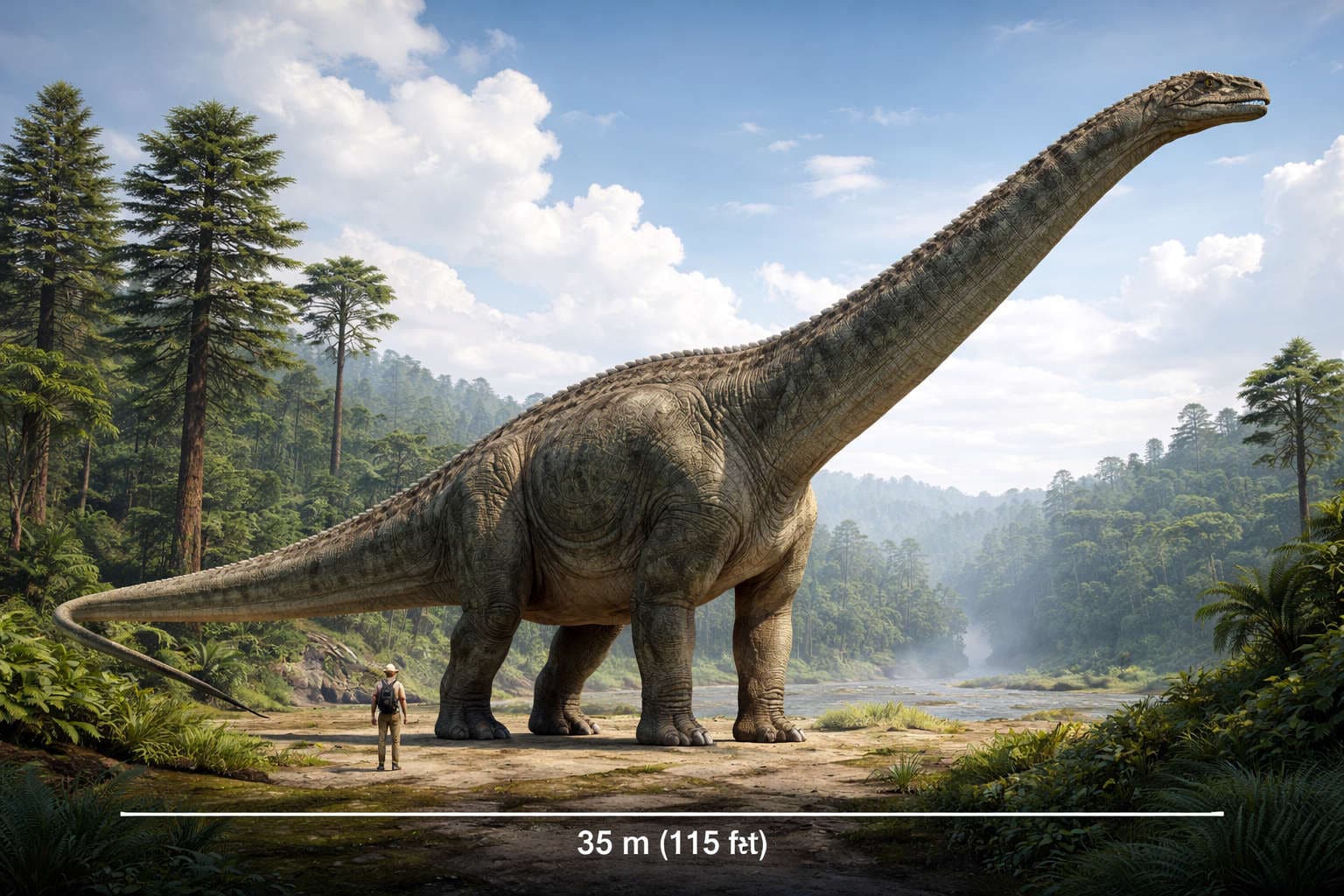
Argentinosaurus lived in what is now Patagonia, Argentina, during the Late Cretaceous, roughly 97 to 94 million years ago. It was a giant titanosaur sauropod: a long-necked, long-tailed plant-eater with pillar-like legs and a body built on a scale almost beyond imagination. Even from fragmentary remains, paleontologists can tell it was one of the largest land animals ever known, a true giant from a world that still had room for giants.
When people ask about the biggest known dinosaur, Argentinosaurus is still one of the main names at the top of the list. Estimates vary because the fossils are incomplete, but a reasonable working range puts it at about 30 to 35 meters long and roughly 65 to 75 metric tons, with some estimates running even higher. That uncertainty is part of the story. These biggest dinosaurs are often known from frustratingly incomplete material, which means paleontologists are reconstructing greatness from enormous bones, not from perfect skeletons.
And that is where the wonder begins. In any large population, there can be unusually big individuals now and then, the rare outliers that push beyond the norm. Fossils are extraordinarily scarce, so it is possible that one of those exceptional giants fossilized, but it is at least as possible that the bones we have represent something closer to the upper end of normal rather than the absolute maximum. A recent population-modeling study on T. rex suggested the largest individual of a fossil species might be substantially bigger than the biggest specimen we have found. That does not prove the same for Argentinosaurus, and doubling the size would be a very large leap, but it does leave room to wonder whether somewhere in deep time an even more extraordinary sauropod once walked the earth.
