

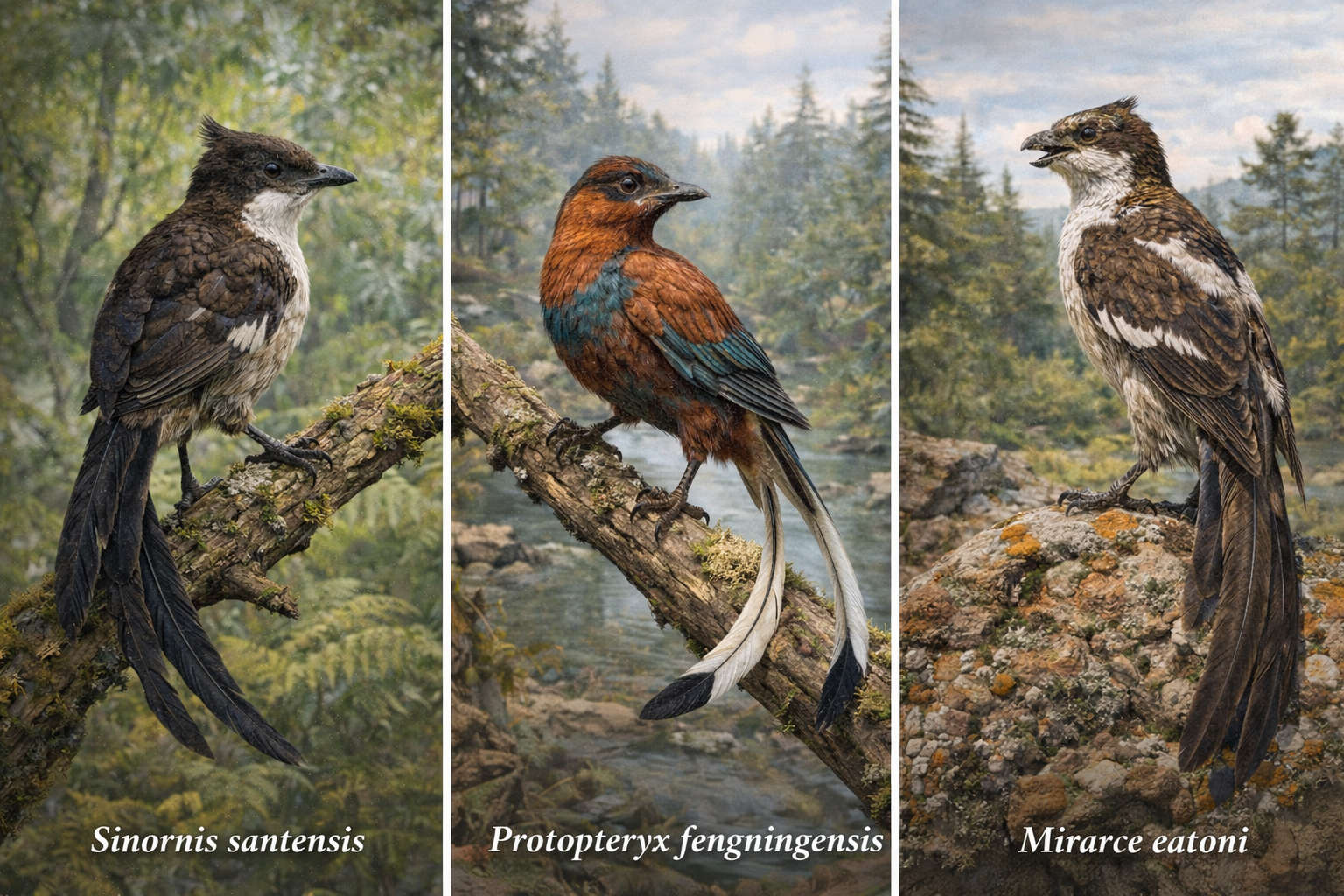
Enantiornithes were one of the most successful early bird branches of the Cretaceous, but unlike Confuciusornithiformes, they generally kept their teeth and often looked a bit more like small, sharp-faced bird-dinosaurs than beaked proto-birds. They were still feathered, winged, and fully avian in the broad sense, but many retained clawed wings and other primitive skeletal traits. Their name, “opposite birds,” refers to an unusual shoulder-joint arrangement that differed from that of modern birds. In simple terms, if Confuciusornithiformes are famous for an early toothless beak, Enantiornithes are better remembered as the great radiation of toothed, clawed, primitive birds that flourished across the Cretaceous.
They appeared by about 131 million years ago, with early records from northeastern China, and then spread widely across the globe. They arose within the broader avialan radiation after the earliest bird line had already split into multiple experiments, but they were not on the direct line to modern birds. Compared with Confuciusornithiformes, which were an earlier and more specialized beaked side branch, enantiornithines became a much broader and more ecologically varied group. Fossils show they were the dominant birds of the Mesozoic and probably the first truly global avian radiation.
Their lineage ultimately ended at the end-Cretaceous extinction, around 66 million years ago. That is one of the great contrasts with the line leading to modern birds: Enantiornithes were diverse, widespread, and successful for tens of millions of years, yet none survived into the modern world. Instead, another avialan branch, the ornithuromorph line that includes Neornithes, made it through and later gave rise to all living birds. So Enantiornithes stand as a reminder that the dominant bird branch of the dinosaur age was not the one that won the long game.
